
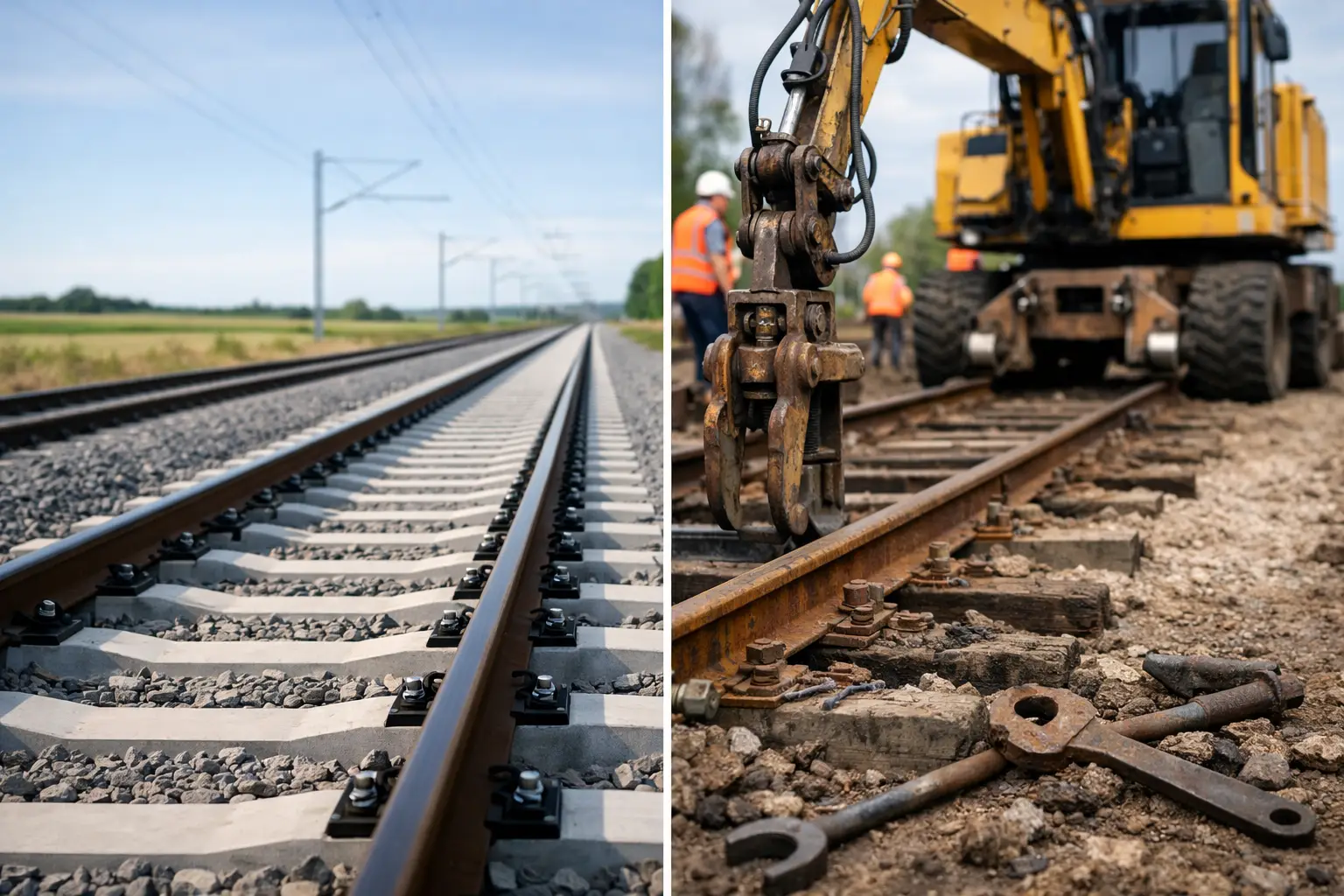
A track that forces you to cut back on switching, limit loads or make emergency repairs stops being an operating asset and becomes a source of cost and risk. In the decision between new track vs railway rehabilitation, the question is not only how much the work costs: it is which alternative best protects the terminal’s continuity, capacity and safety over the coming years.
For an industrial, rail or logistics operation, this choice affects loading and unloading speed, the availability of locomotives or switching equipment, technical compliance and the ability to increase volumes without creating bottlenecks. The right answer depends on the actual condition of the asset, projected traffic, the required geometry and the facility’s growth strategy.
New Track vs Railway Rehabilitation: The Real Difference
Building new track means designing and constructing infrastructure from the earthwork up to the track superstructure. It allows the alignment, grades, drainage, ballast, ties, rail, turnouts and connections to be defined according to the requirements of current and future operations. It is the right alternative when additional capacity, a new connection, a switching yard or a terminal that did not previously exist is required.
Railway rehabilitation, on the other hand, restores or improves existing infrastructure. It can include replacing rail, ties and fasteners; correcting surface and alignment; cleaning or replenishing ballast; repairing drainage; renewing grade crossings; or working on turnouts and crossings. Its goal is not just to return the track to a functional state, but to restore reliable conditions for safety, operation and maintenance.
The difference seems simple, but the line is not always clear. A deep rehabilitation may require dismantling long sections, renewing the substructure and rebuilding turnouts. In those cases, the scope and cost can approach those of new construction. That is why it is advisable to assess the life cycle of the solution rather than focusing only on the initial budget.
When Building New Track Makes Sense
New track is usually the soundest decision when existing infrastructure does not meet operational needs. This happens, for example, when adding a new production line, enabling a specialized loading point, increasing unloading positions or connecting a facility to an existing rail network.
It is also advisable when the available geometry limits operations. Insufficient curve radii, grades incompatible with the tonnage, short siding lengths or access points that hinder switching can constrain productivity more than the condition of the rail. Repairing a track does not by itself correct a design that no longer serves the plant’s logistics model.
A new construction project offers significant advantages: it allows the roadbed to be sized for projected loads, drainage to be designed from the start, components to be selected for the traffic, and provisions to be made for expansions. If the terminal depends on frequent moves, longer trains or intensive operations with railcar movers, this approach reduces future constraints.
The trade-off is a higher initial investment and a more demanding engineering phase. Topographic, geotechnical, hydraulic and operational studies must be considered, along with permits, interfaces with the railroad concessionaire or network manager, and coordination with plant activities. Fast execution without that upfront definition can carry design problems into the operating phase.
New Track Should Be Designed for Operations, Not Just for the Ribbon-Cutting
The quality of new construction is not measured solely by its materials. It is measured by how easily it allows consists to be built, railcars to be spotted, inspections to be carried out and traffic to keep moving without interfering with critical industrial processes.
This requires analyzing routes, frequencies, usable lengths, type of rolling stock, axle loads, parking points and maintenance access. A properly built track that is poorly integrated into the plant’s flow can generate unproductive time for decades.
When to Rehabilitate Existing Track
Rehabilitation is an efficient decision when the alignment, roadbed and operating function of the track remain valid, but the superstructure shows wear or accumulated defects. It is common on industrial sidings, access branches, internal classification yards and loading areas with recurring traffic.
Not all deterioration requires complete renewal. In some sections, the problem is concentrated in deteriorated fasteners, worn-out ties, fouled ballast or geometry defects. A selective intervention, combined with a preventive maintenance program, can restore performance with less impact on operations.
However, rehabilitation should not be seen as postponing a necessary reconstruction. If there are recurring drainage failures, roadbed settlement, severe deformations or widespread structural deterioration, replacing rail and ties will not be enough. The track may look better, but the underlying defect will reappear under load.
The main advantage of rehabilitation is that it makes use of existing assets and, when well planned, allows work to be carried out in phases to reduce periods of unavailability. Its value increases when combined with a rigorous technical inspection, risk-based prioritization and a scope tailored to each section.
The Criteria That Should Drive the Investment
The decision must be based on field data, not on a visual impression or an isolated unit cost. A technical assessment should review track geometry, rail condition, tie wear, ballast condition, drainage capacity, turnouts and roadbed stability.
Based on that information, operations management should cross-reference the diagnosis with four business variables:
- Required capacity: current volume, projected growth, train length and switching frequency.
- Operational criticality: the economic impact of a restriction, a failure or a service interruption.
- Investment horizon: expected service life, maintenance costs and the need to expand the terminal.
- Execution constraints: permits, available space, access, industrial safety and work windows.
The cost of not acting should also be part of the analysis. Speed restrictions, derailments, railcar damage, prolonged switching and production stoppages are usually more expensive than a properly specified intervention. At terminals with continuous activity, track availability is an operational indicator, not just a maintenance issue.
Initial Cost vs Life-Cycle Cost
A partial rehabilitation may be the cheapest option in the short term, but not necessarily the most cost-effective over five or ten years. If it requires frequent interventions, consumes operating windows and maintains load or speed restrictions, its total cost may exceed that of a well-executed reconstruction or expansion.
Conversely, new track oversized for unlikely demand ties up capital without a return. The right approach is not to build more, but to build or rehabilitate to the level of performance the operation needs and can justify.
A serious estimate must include engineering, construction, materials, temporary switching, interruptions, future maintenance and operational risk. It should also consider spare parts availability and component standardization, especially at terminals that manage several branches or their own equipment.
Execution Determines the Outcome
Even a sound decision can lose value through poor construction planning. In industrial rail projects, the contractor must coordinate construction with plant safety, internal traffic, materials logistics and continuity of switching. Complete shutdowns may be unfeasible; in those cases, phased work and temporary tracks must be studied from the engineering stage.
Quality also depends on materials control, layer compaction, proper installation of ties and fasteners, and final geometry adjustment. Turnouts deserve special attention: they concentrate stresses, are critical for switching and usually require specific maintenance to remain reliable.
A full-service supplier adds value when it can take on the diagnosis, engineering, supply, construction and subsequent maintenance under a single technical responsibility. Track Speq approaches these projects by connecting infrastructure, materials, operational support and switching equipment, so the client does not have to coordinate fragmented solutions.
Turning the Project into a Sustained Operational Improvement
The work does not end at commissioning. New track must enter an inspection and maintenance program from day one, and rehabilitated track needs follow-up to confirm that the treated defects do not return. Measuring geometry, wear, drainage, fastener condition and turnout performance makes it possible to intervene before an issue affects operations.
The best decision between new track and railway rehabilitation is the one that turns the investment into reliable, safe and maintainable capacity. Before choosing a scope, it is worth defining what cargo movement the terminal must support five years from now: that answer usually clarifies whether the asset needs to be restored or whether the time has come to build its next stage.
