
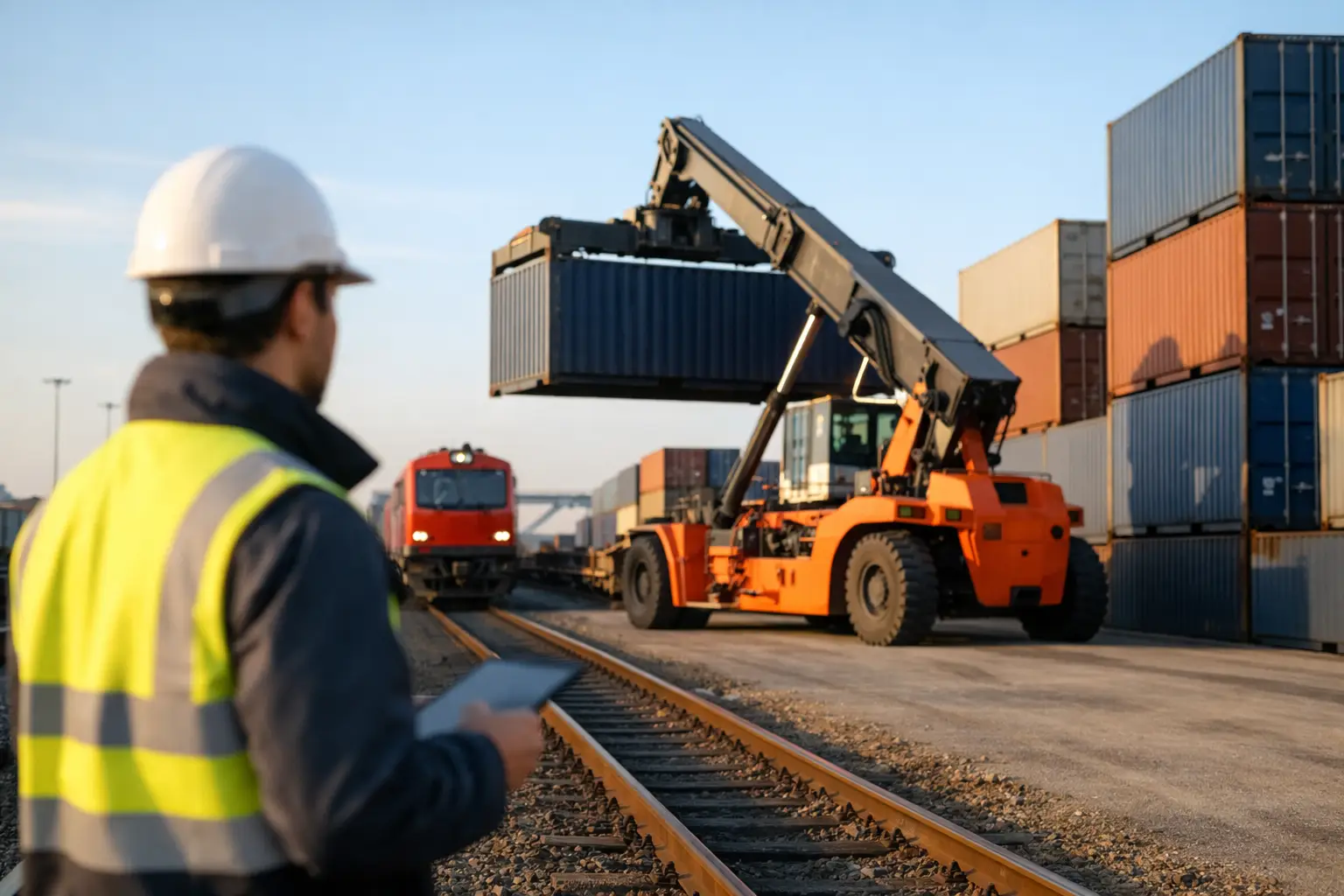
A terminal does not lose profitability because of one big isolated failure. It loses it through accumulated minutes: a switch that does not respond well, a switching move that takes longer than planned, a track occupied without clear criteria, a piece of equipment out of service at a critical time. Talking about efficient rail terminal operation means talking about real operational control, usable capacity, and continuity for plants, logistics centers, and industrial complexes that cannot afford bottlenecks.
In B2B environments, rail efficiency does not depend solely on the number of cars moved per day. It depends on how infrastructure, switching equipment, maintenance, safety, traceability, and regulatory compliance interact. When one of those layers fails, the terminal keeps operating, but it does so with cost overruns, greater exposure to risk, and less room to respond.
What defines efficient rail terminal operation
Efficient rail terminal operation is one that moves freight safely, predictably, and at a controlled cost, without sacrificing asset availability or the flexibility to absorb variations in demand. It is not just about going faster. In many cases, going faster on a particular switching move can cause congestion downstream, track occupancy conflicts, or positioning errors.
The right benchmark is different: how much effective capacity the terminal has, how much of that capacity is used, and what level of service it can sustain repeatably. A well-managed terminal reduces dead time, minimizes unnecessary moves, and maintains clear criteria for receiving, classification, loading, unloading, temporary storage, and dispatch.
There is also a strategic component. An efficient rail terminal protects the industrial operation it serves. If a plant depends on rail for incoming raw materials or outgoing finished product, any friction in the yard translates into a direct impact on production, inventory, and commercial commitments.
Terminal design shapes the entire operation
Many operational inefficiencies arise before the first train arrives. They arise in the design, expansion, or rehabilitation phase. Poorly resolved track geometry, unfavorable curve radii, insufficient runarounds, loading areas with limited access, or a usable length shorter than required create restrictions that people later try to offset with more switching moves, more personnel, or more time.
That rarely works well in the long run. The terminal must be designed based on the actual operating pattern: type of cargo, train length, arrival frequency, service windows, available equipment, coexistence with internal traffic, and projected growth. A facility for bulk material is not the same as one for automotive, steel, dry freight, or hydrocarbons. Nor is a plant terminal managed the same way as a high-turnover logistics hub.
When the design responds to the operation, the terminal gains fluidity. When the design falls short or does not consider growth scenarios, the operation starts to depend on temporary solutions that end up becoming permanent and costly.
Nominal capacity versus actual capacity
A critical distinction for any director of operations is the one between nominal capacity and actual capacity. On paper, a terminal may seem sufficient. In operation, that same terminal can lose performance due to interference between switching moves, track clearance times, access limitations, or a lack of holding areas.
Actual capacity is measured under working conditions, not ideal assumptions. That is why it is advisable to review track occupancy, cycle times, conflict points, and physical constraints before talking about expansions or buying additional equipment.
Rail switching is a decisive factor
In an industrial terminal, switching sets the pace of the yard. The right equipment, well maintained and assigned to the right operating profile, can reduce positioning times, improve safety, and avoid excessive dependence on outside resources. Having motive power alone is not enough. What is needed is switching capacity that is compatible with the load, the terminal’s configuration, and the demands of each shift.
Railcar movers have gained importance precisely for that reason. In many environments they allow for more flexible operation, especially where there are space constraints, visibility needs, or intensive movement cycles. But they are not a universal answer. Their suitability depends on tonnage, grades, frequency of use, track conditions, and the maintenance model.
The common mistake is to evaluate equipment solely on purchase price. The right decision considers availability, fuel consumption, technical support, access to spare parts, the staff learning curve, and total cost of ownership. In a terminal, a piece of equipment that is down costs more because of the impact it generates than because of the repair bill.
Maintenance is not an indirect cost
If the railway infrastructure is only addressed when a failure occurs, the terminal operates in reactive mode. And a reactive operation always ends up costing more. Degradation of track, turnouts, fastenings, yard signage, and crossing surfaces does not only increase risk. It also lengthens switching moves, forces speed reductions, increases equipment wear, and complicates daily planning.
Preventive and corrective maintenance must be integrated with operations, not compete with them. That requires planned windows, inspection criteria, a minimum inventory of critical materials, and traceability of recurring incidents. A terminal that knows the condition of its assets can prioritize interventions based on productive criteria, not just technical ones.
There is also the question of continuity. If track maintenance, material supply, and support for switching equipment are managed in a fragmented way, each incident generates more coordination, more waiting, and a greater risk of incomplete diagnosis. By contrast, an integrated approach reduces friction and speeds up response. That is one of the reasons why a technical partner with construction, supply, and support capabilities adds operational value, not just commercial value.
Safety and compliance: where efficiency is put to the test
In industrial railroading, efficiency without safety is false efficiency. A yard that moves more cars at the cost of increasing incidents, noncompliance, or personnel exposure is not improving. It is shifting the problem to another part of the business.
Operations must rely on clear procedures for switching, coupling, area segregation, access control, communication among personnel, and management of interfaces with vehicles, pedestrians, and loading equipment. Added to this is applicable regulatory compliance, which in Mexico can become a critical point when there are expansions, new connections, infrastructure modifications, or changes to the operating scheme.
It pays to be realistic here. Not all terminals need the same level of formal documentation or the same immediate investment. It depends on volume, type of goods, operational risk, and the facility’s level of maturity. What matters is avoiding two equally harmful extremes: oversizing controls that block operations, or underestimating requirements that later lead to penalties, incidents, or interruptions.
Operational data: measure better to decide better
Improving a terminal does not start with a purchase. It starts with serious measurement. If cycle times, track occupancy rates, causes of delay, incidents per shift, equipment availability, and congestion patterns are unknown, any decision is based on partial perceptions.
Useful indicators are usually less spectacular than they seem. Average service time per train, switching moves per shift, hours of equipment unavailability, recurring causes of stoppages, track utilization, and window compliance are enough data to detect significant losses. What is decisive is that this data translates into actions on design, maintenance, resources, or operating sequence.
A good practice is to review the terminal as a system, not by isolated areas. Sometimes the apparent problem lies in switching, but the real source is a poorly configured loading area. In other cases, the delay is attributed to infrastructure when the bottleneck lies in coordination with the plant or in a lack of dispatch rules.
When it makes sense to intervene in the terminal
A full expansion is not always necessary to improve performance. In some terminals, it is enough to rehabilitate track, replace critical hardware, optimize runarounds, redefine yard sequences, or add more suitable switching equipment. In others, continuing to make corrections on the same base only prolongs a structural limitation.
The clearest signal for intervention is this: when the terminal meets its schedule only through extraordinary effort. If every week depends on recovery switching moves, improvised decisions, or tolerance for risk to maintain service, the operation is already eating into the business’s margin.
At that point, the most effective approach is usually a comprehensive one. Engineering, permitting, construction, materials supply, maintenance, and operational support must talk to one another. Track Speq works precisely at that intersection, where infrastructure and operations stop being treated as separate matters and become a single performance strategy.
The underlying question is not whether a terminal can keep operating as it is. The useful question is how much value it loses every day by not operating better. When that answer is put into numbers, efficiency stops being an abstract goal and becomes a business decision with a clear return.
