
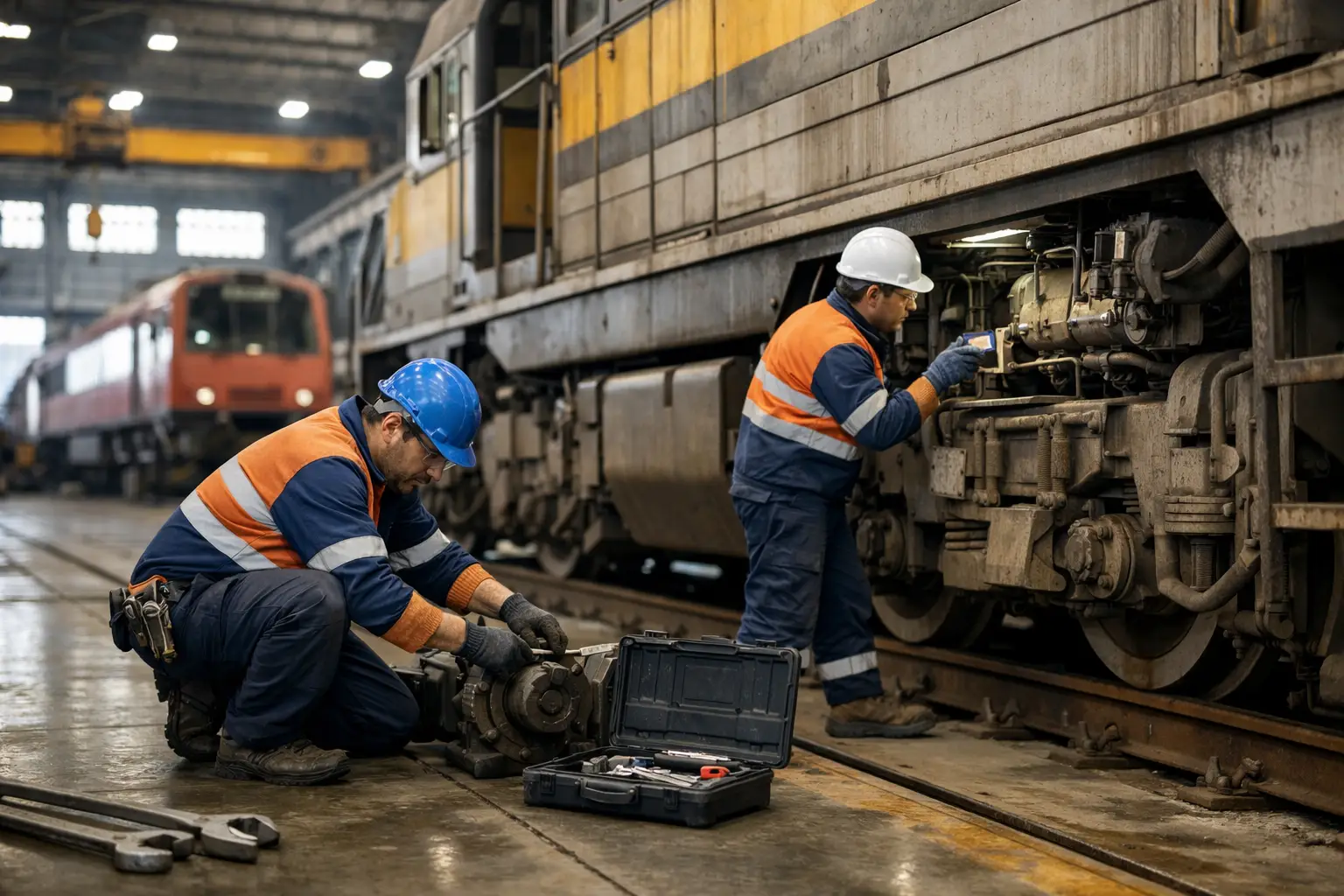
A switch point that does not close properly, a rail with an active crack, or a disabled piece of switching equipment are not isolated incidents: they can halt shipments, block a loading track, and compromise the safety of the entire terminal. Industrial railway corrective maintenance comes into play when an asset already has a failure, degradation beyond acceptable limits, or a condition that requires immediate intervention to restore operations.
For operations leadership, the priority is not just to repair quickly. It is to restore movement capacity using technical criteria, while controlling risk, the quality of the intervention, and the effect on logistics planning. A poorly executed correction can resolve the symptom and leave intact the cause that will trigger the next shutdown.
What industrial railway corrective maintenance involves
Corrective maintenance is the set of tasks aimed at returning a railway asset to a safe, functional, service-ready condition after a failure or anomaly is detected. In an industrial facility, it covers both track infrastructure and switching elements, traction equipment, signaling, and components associated with internal train movement.
Not all corrective work has the same urgency. A localized deformation that allows restricted movement is not handled the same way as a broken rail, a tie that has lost its holding capacity in a critical zone, or a derailment. The initial classification must assess technical severity, exposure of personnel, the volume of cargo affected, the number of tracks compromised, and the real possibility of maintaining an alternative operation.
In terminals connected to a main rail network, the criteria must also consider the concessionaire’s requirements, applicable regulations, and access and safety procedures. Repairing quickly does not justify intervening without authorization, without track protection, or without checking the compatibility of the materials installed.
The failures that hurt operations the most
On industrial track, many corrective jobs originate from defects that have developed over weeks or months. Concentrated traffic, high axle loads, poor drainage, fouling by fines, and loose or missing fastenings accelerate deterioration. When the problem shows up, it can affect geometry, rail stability, or the performance of a turnout.
Among the highest-impact incidents are broken rails and excessive rail wear, deteriorated joints, defective welds, loss of fasteners, degraded ties, fouled ballast, subgrade settlement, and misalignment in curves or switches. At internal grade crossings and loading areas, damage caused by road vehicles, impacts from machinery, or spills that compromise the infrastructure are also common.
Turnouts require specific attention. A switch point that does not close fully, wear on stock rails, a misadjusted switch machine, or deteriorated connecting components can prevent trains from being made up and create unsafe operating conditions. Because they concentrate stresses and components, corrective work on turnouts requires precise diagnosis, compatible spare parts, and a final adjustment verified in the field.
The other critical source of shutdowns is switching equipment. A railcar mover that is out of service can limit railcar movement even when the infrastructure is available. Hydraulic, electrical, transmission, brake, coupling, or control problems must be handled by technicians who understand both the equipment and how it interacts with terminal operations.
Diagnose before mobilizing resources
An effective response starts with reliable information. The maintenance manager must record the exact location of the incident, the asset affected, the condition observed, the last train movement, the restrictions applied, and any relevant prior event. A visual inspection provides an initial reading, but it does not replace the geometry assessment, ultrasonic testing, wear measurements, fastener checks, or functional review each case may require.
This diagnosis makes it possible to distinguish a spot repair from a necessary rehabilitation. For example, replacing a single tie may be enough if the subgrade and ballast retain their capacity. If there are multiple deteriorated ties, pumping, loss of surface, and poor drainage, an isolated replacement will only postpone a larger intervention. The lowest initial cost does not always represent the lowest operating cost.
It is also advisable to define the release criteria from the outset. The track or equipment should not return to service just because the failure appears to have disappeared. Quality checks, geometric tolerances, tightening torques, functional tests, and, where appropriate, temporary speed or load restrictions until stabilization is complete must be established.
How to carry out a repair without making the shutdown worse
A well-managed corrective intervention combines safety, logistics, and technical capability. The first step is to isolate the area, protect train movement, and coordinate alternative switching moves with production, shipping, and industrial safety. In terminals with few tracks available, the work window must be planned precisely so that the corrective work does not create congestion more costly than the failure itself.
The execution must then follow a defined sequence: controlled removal of the affected component, preparation of the base or contact area, installation of conforming materials, adjustment of geometry or configuration, compaction where applicable, and final verification. In rail work, welding, cutting, grinding, and alignment require qualified procedures. In turnouts, adjusting point closure and checking wheel passage are decisive.
Materials availability determines recovery time. Keeping an inventory of rail, ties, hardware, plates, fasteners, joints, turnout components, and signaling makes it possible to resolve frequent failures without waiting for an urgent purchase. However, stockpiling for its own sake is not an efficient strategy either: inventory should be based on criticality, supply lead times, standardization of the facility, and historical consumption.
When the incident affects switching equipment, the approach must integrate mechanical and operational diagnosis. It may be more convenient to have a replacement unit, a temporary hauling solution, or a planned repair window than to force operations with equipment in poor condition. The continuity of railcar flow should guide the decision.
Corrective, preventive, and renewal: deciding with data
Corrective maintenance is inevitable on any industrial rail network, but it should not become the usual way of managing assets. If failures recur on the same section, the problem may lie in the design, drainage, actual load, material quality, installation method, or the absence of preventive inspections.
The decision to repair, rehabilitate, or renew depends on the asset’s residual condition and its function in the terminal. A secondary track with limited traffic may accept a localized repair and operating restrictions. A receiving, departure, or interchange track, where a shutdown blocks the entire chain, needs a higher availability standard and an early renewal strategy once deterioration reaches certain thresholds.
The most useful indicators are not just maintenance spending. It is advisable to measure hours of unavailability, incidents per kilometer, failure recurrence, mean response time, cost per ton moved, and compliance with loading windows. This data turns maintenance into a decision-making tool for operations, engineering, and technical procurement.
A response model for demanding terminals
Corrective maintenance management becomes more effective when a single partner can assess the failure, mobilize specialized personnel, supply compatible materials, repair the infrastructure, and support the return to service. Avoiding fragmentation among diagnosis, supply, and execution reduces coordination time and ensures that a single technical responsibility stands behind the result.
Track Speq works under this comprehensive approach, combining maintenance capabilities, track rehabilitation, component supply, and support for switching equipment. For the industrial client, the value lies in having a response aligned with the continuity of its operation, rather than contracting disconnected services for each phase of the incident.
Real preparedness for a failure starts before it happens: with defined critical inventories, up-to-date drawings, communication protocols, periodic inspections, and suppliers with a proven ability to intervene. When a track or a piece of equipment stops the flow of cargo, that preparedness is the difference between a controlled incident and a disruption that affects the entire logistics chain.
