
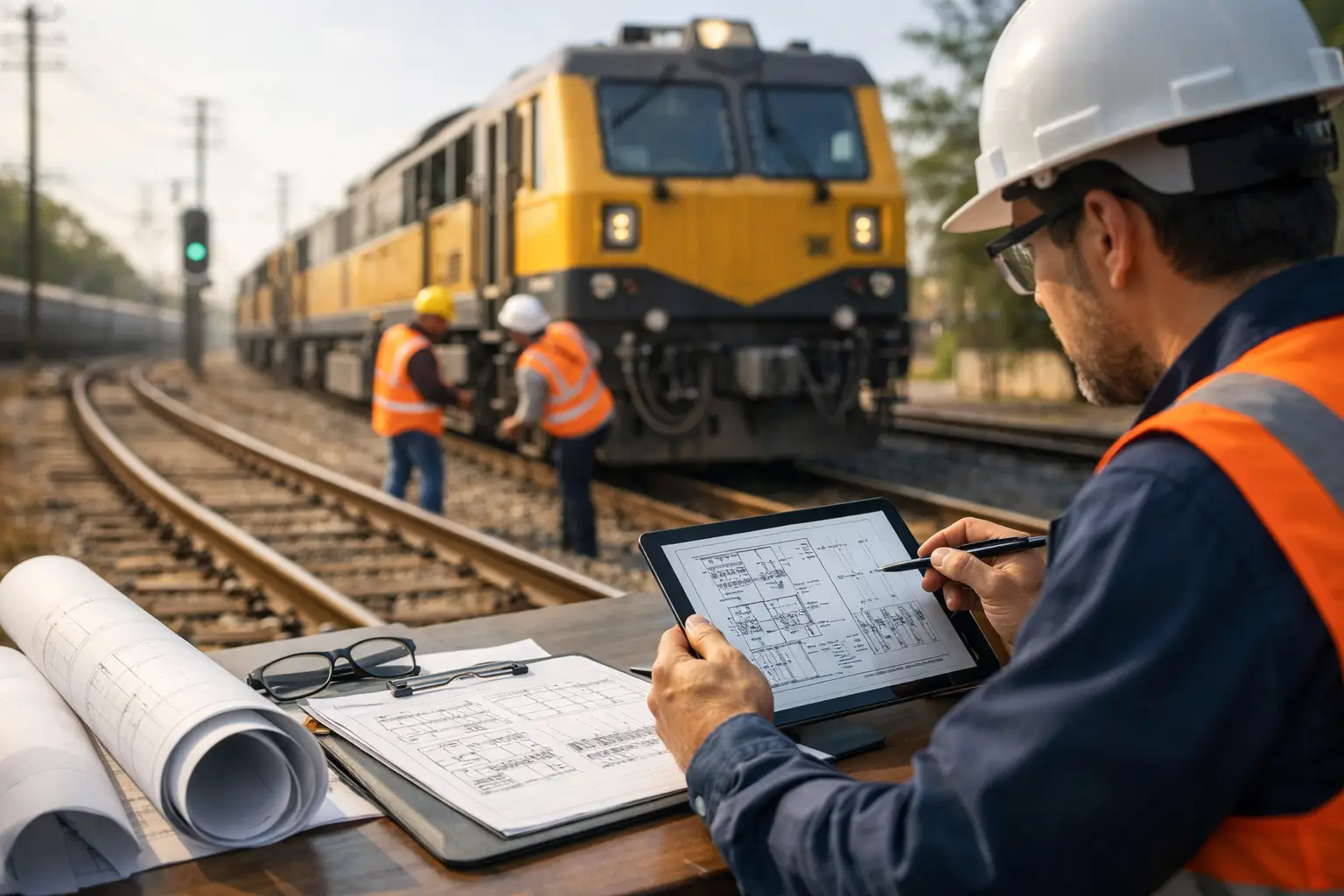
Track that fails rarely gives enough warning. What shows up first is an operating restriction, a slower switching move, a turnout that loses reliability, or wear that starts shifting cost onto the rolling stock. That is why understanding how to plan preventive railway maintenance is not just another administrative task, but a direct decision about operational continuity, safety, and cost control.
In industrial and logistics environments, preventive maintenance cannot be designed as a generic calendar. The demands of an automotive terminal are not the same as those of a steel plant or a hydrocarbons facility. Nor is the criticality of a main track the same as that of a siding, a runaround, or a loading area with repetitive switching. Planning well requires starting from the actual operation, the type of traffic, and the level of risk acceptable to the business.
What it means to plan preventive railway maintenance
Planning preventive railway maintenance means defining what will be inspected, how often, under what technical criteria, and with what resources interventions will be carried out before a failure occurs that affects operations. It is not just about scheduling activities. It is about linking infrastructure condition, level of use, operating windows, regulatory compliance, and available budget.
That nuance is key. An effective preventive plan does not aim to intervene on everything all the time. It aims to act where deterioration has the greatest impact and before the problem forces an urgent correction that is more costly and more disruptive. In industrial railroading, the difference between preventing and reacting is often measured in hours of downtime, logistics penalties, and lost switching capacity.
How to plan preventive railway maintenance with operational criteria
The first step is to establish a reliable baseline of the asset. Without an initial diagnosis, any plan is incomplete from the start. That baseline should include the condition of the rail, ties, fastenings, ballast, track geometry, turnouts, crossings, drainage, signage, and safety conditions in operating areas. If there is equipment associated with switching or complementary infrastructure, it should also be included in the assessment.
It is important to avoid a common practice here: basing all planning on the age of the track. Age matters, but it does not by itself explain the level of deterioration. There are relatively new sections with accelerated fatigue due to poor water drainage, overloading, intensive switching, or installation defects. And there are old sections that continue to perform acceptably because they have received consistent upkeep.
With that baseline, the next step is to classify assets by criticality. Not all elements carry the same weight in operational risk. A switch point with high frequency of use and minimal tolerance for failure requires different attention than a secondary section with sporadic traffic. The same applies to areas where a speed restriction has a limited effect versus others where any incident blocks the terminal’s entire operation.
A useful classification usually combines three variables: impact on safety, impact on operational continuity, and cost of failure. When these three variables are cross-referenced, the plan stops being a technical list and becomes a management tool.
Inspection and maintenance frequency
Frequency should not be set by habit, but by condition and use. On lines or terminals with constant traffic, heavy loads, or intensive switching, visual and functional inspection intervals should be shorter and more disciplined. For less demanding assets, intervals can be longer, provided there is technical evidence to support it.
The sensible approach is to separate inspection from intervention. Inspecting does not mean intervening on every visit. It means generating data to decide when a minor correction, an adjustment, or a targeted replacement will prevent a major rehabilitation. When the two are mixed without criteria, the budget gets distorted and traceability is lost.
Condition, not just the calendar
A good preventive plan combines calendar-based routines with condition-based decisions. The calendar ensures discipline. Condition provides precision. If there is only a calendar, there is a risk of performing unnecessary work in some places and arriving too late in others. If there are only condition-based criteria, many organizations end up reacting late because they lack a minimum inspection routine.
In practice, a balance usually works best: defined periodic reviews, technical intervention thresholds, and a recording system that makes it possible to compare trends between periods.
Elements the plan must include
The core of the plan should include an asset inventory, technical data sheets, incident history, inspection frequencies, acceptance and rejection criteria, intervention procedures, required resources, and owners for each activity. It seems basic, but in many operations these elements are scattered among maintenance, operations, purchasing, and contractors.
When that information is not integrated, two problems arise. The first is duplicated decisions, such as buying materials without real prioritization. The second is time lost coordinating work windows, personnel, industrial safety, and track availability.
It is also essential to define which activities are routine and which should be triggered by a threshold. For example, cleaning drains, tightening fastenings, inspecting joints, checking turnouts, or selectively replacing components can be part of a routine. On the other hand, a broader replacement of ties or a leveling intervention may depend on the degradation detected.
Common mistakes when planning preventive railway maintenance
One of the most costly mistakes is separating maintenance from operations. When the plan is built without understanding loading windows, switching sequences, yard schedules, or logistics priorities, it ends up being technically correct but operationally unworkable. The result is that it is postponed again and again until a failure forces an intervention with no margin.
Another mistake is underestimating drainage and the subgrade. Many geometry problems or cases of premature degradation do not start in the rail, but in a loss of support. If water remains where it should not, deterioration accelerates and surface work does not last long. Correcting only the symptom usually costs more than addressing the cause.
It is also worth watching for a common tendency in technical purchasing: choosing the lowest unit cost without reviewing life cycle, compatibility, and actual performance. In railway infrastructure, a seemingly economical decision can multiply costs through early replacement, unavailability, or the need for rework.
Indicators to know whether the plan is working
A preventive plan must be measured. If it is not measured, it becomes just an intention. The most useful indicators are not only how many activities were completed, but what effect they had on operations. It is worth tracking trends in unplanned incidents, operating restrictions, downtime, repeated failures at the same point, consumption of critical materials, and the percentage of preventive versus corrective work.
In addition, it is advisable to review the variance between the planned budget and actual spending. If corrective work continues to absorb a high share of total cost, the plan needs adjustment. It may lack inspection frequency, proper prioritization, or execution capacity.
The relationship between budget and risk
No plan is unlimited. There is always a relationship between the available budget and the expected level of service. The point is not to spend more as a rule, but to allocate resources where they reduce the most risk. Sometimes it pays to carry out a partial rehabilitation today to avoid five minor corrections and a major shutdown over the next twelve months. Other times, it is enough to strengthen inspection and act selectively.
These kinds of decisions require technical experience and an operational understanding of the asset. That is where a specialized partner adds real value: it not only performs the work, but also helps prioritize with railway and business judgment.
From plan to field: execution without losing control
Planning fails when it does not translate into clear execution procedures. Each intervention must reach the field with a defined scope, available materials, safety conditions, internal permits, operational coordination, and closeout criteria. If the crew detects an anomaly and there is no clear escalation path, the finding stays in a report instead of turning into action.
It is also advisable to maintain traceability for every action: what was found, what was done, what material was used, what tolerance was restored, and when it should be reviewed again. This discipline makes it possible to move from reactive management to cumulative management of knowledge about the asset.
In industrial operations with high dependence on rail, centralizing diagnosis, construction, supply, and technical support reduces friction. Track Speq works precisely from this logic: turning maintenance into a planned function, integrated with infrastructure, materials, and operations, rather than a series of isolated responses.
Planning well does not eliminate every unforeseen event. What it does is reduce their frequency, impact, and cost. And in a demanding rail operation, that difference translates into something very concrete: more control over the real capacity to move freight when the business needs it.
