
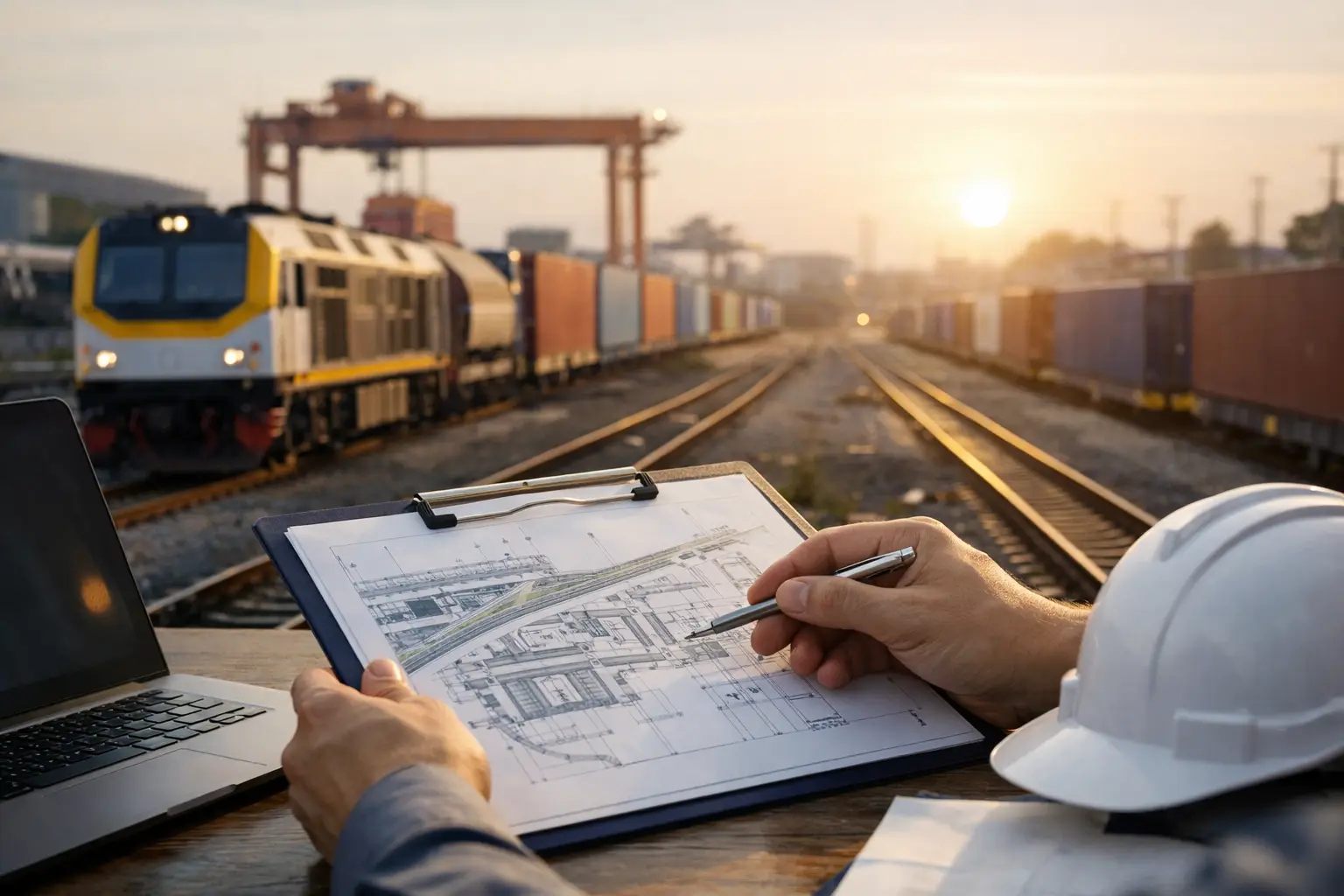
A rail terminal is not defined by the number of tracks installed, but by its real capacity to receive, classify, load, unload, and dispatch railcars without creating bottlenecks. For an industrial operation, inadequate design can translate into delays, switching cost overruns, unnecessary track occupancy, and safety risks. That is why planning a terminal requires connecting infrastructure, equipment, regulations, and operations from the very first drawing.
The right approach starts with an operational question: what cargo volume must the facility move reliably today, and what growth must it absorb in the coming years? The answer determines track lengths, turnout configuration, loading areas, the switching system, road access, and the maintenance strategy. Building without this vision usually forces expansion under pressure, at higher cost and with a direct impact on plant continuity.
What an industrial rail terminal must solve
A terminal is not simply the point where a train enters or leaves a facility. It is an operating asset that coordinates the interface between the rail network, production, the warehouse, and road transportation. Its performance depends on physical and documentation flows being aligned.
In sectors such as automotive, steel, food, dry bulk, or hydrocarbons, requirements change depending on the type of goods, railcar turnover, and safety restrictions. A bulk facility needs to handle unloading, emissions control, and product management; a finished-goods terminal requires precise classification, cargo protection, and predictable shipments. There is no standard configuration that works for every case.
The terminal must make it possible to receive trains, separate or group railcars, spot them at loading or unloading points, and release them quickly. If a single switching move blocks the main access or a service track, the problem stops being a rail problem and starts affecting the entire logistics chain.
Usable capacity versus theoretical capacity
One of the most common mistakes is calculating capacity based on the meters of track available. Usable capacity is lower and depends on factors such as the effective length between turnouts, safety margins, grade, internal grade crossings, the position of loading and unloading equipment, and the time each railcar sits idle.
The typical train consist also matters. A terminal designed for short trains can lose efficiency when it receives longer trains, forcing additional cuts and repetitive switching moves. It is advisable to evaluate peak-demand scenarios, not just the expected average traffic.
Design must start with operations
Before defining rail, ballast, or turnouts, it is necessary to map the complete railcar cycle. This includes arrival from the connecting line, inspection, receiving, classification, spotting, loading or unloading, documentation, departure, and possible incidents.
This analysis makes it possible to decide which tracks should be used for receiving, departure, classification, storage, or service. It also reveals whether runaround tracks, immobilization zones, inspection points, or spaces for safely parking switching equipment are needed. When these decisions are made after construction begins, modifications are usually costly and limit the final functionality.
Track geometry must respond to axle loads, railcar type, switching speeds, and ground conditions. Curve radius, superelevation, drainage, and subgrade stability directly influence wear, ride quality, and safety. Saving on subgrade preparation or drainage may seem reasonable during construction, but it leads to settlement, geometry deviations, and recurring corrective work.
Switching: where productivity is won or lost
Switching is one of the variables with the greatest impact on cost per railcar. Relying on an outside locomotive for every movement may be appropriate in low-volume terminals or with sporadic traffic. However, when the operation requires daily movements, frequent repositioning, or service to several loading areas, having in-house switching capacity provides operational control.
Railcar movers make it possible to move railcars within the facility with agility, especially when distances are short and operations demand an immediate response. Equipment selection must consider pulling capacity, adhesion, grades, number of railcars, environmental conditions, spare parts availability, and technical support. The most powerful equipment is not always the best choice if its cost, dimensions, or configuration do not match the actual work profile.
In addition to equipment, the terminal needs clear procedures: movement authorization, communication between operators, signage, crossing protection, and parking rules. Efficiency must not be achieved at the expense of reducing critical controls.
Compliance and safety from the engineering phase
In Mexico, a rail terminal requires orderly permit management, connection requirements, technical criteria, and obligations applicable to each project. Conditions can vary depending on the location, the associated railroad concessionaire, the type of cargo, and the characteristics of the facility. Treating regulation as an afterthought can delay commissioning and compromise decisions that have already been built.
Operational safety must be built into the design. This includes clearances, signage, lighting, pedestrian crossings, protection of loading areas, access control, drainage, and visibility at switching points. In terminals handling hazardous materials, safety distances, containment systems, and emergency protocols carry even greater weight.
Good engineering also accounts for future maintenance. There must be room to inspect turnouts, replace components, work on drainage, and bring in machinery without unnecessarily stopping operations. Infrastructure that is hard to maintain ends up being expensive to operate.
Construction and materials: decisions with long-term effects
The quality of a terminal depends as much on its design as on field execution. Proper subgrade leveling, compaction, ballast placement, rail welding or joining, turnout assembly, and geometric adjustment must be controlled through verifiable technical procedures.
Nor are materials interchangeable without analysis. Rail, ties, fasteners, plates, hardware, and turnouts must be selected according to load, expected traffic, corrosive environment, and maintenance strategy. In an industrial facility, exposure to dust, moisture, chemicals, or heavy traffic can accelerate the deterioration of components that seemed adequate on paper.
Rehabilitation deserves a specific evaluation. In some cases, renewing specific components, correcting drainage, and restoring geometry gives an existing track back its capacity with a reasonable investment. In others, deterioration of the subgrade or turnouts makes partial or total reconstruction more efficient. The decision must be based on a technical inspection, not on the surface appearance of the track.
Maintenance to protect availability and budget
A rail terminal must be maintained before it fails. Preventive maintenance makes it possible to detect rail wear, loose fasteners, tie defects, ballast fouling, drainage problems, and geometry deviations before they affect traffic or cause an unplanned shutdown.
Inspection frequency depends on intensity of use, tonnage, type of switching, and the environment. A departure track used a few times a month does not require the same plan as a loading area subject to continuous movements and repeated braking. What matters is having priority criteria, condition records, and the response capacity to correct issues without prolonging downtime.
For operations and maintenance managers, the key indicator is not just the cost of each intervention. It is the cost of unavailability: idle railcars, constrained production, postponed shipments, and resources mobilized on an emergency basis. A well-designed program turns maintenance into a tool for operational continuity.
Choosing a partner that integrates capabilities
Supplier fragmentation tends to complicate rail projects. If engineering, permits, construction, materials supply, switching equipment, and maintenance are managed separately, interfaces, lead times, and the chance that no one takes full responsibility for the outcome all increase.
Track Speq addresses this need with an offering that integrates infrastructure, materials, equipment, and technical support for industrial terminals. This approach ensures that design decisions take future operations, spare parts availability, and real maintenance requirements into account from the start.
The best terminal is not the one with the most track or the one built on the lowest initial budget. It is the one that keeps cargo flowing, protects people’s safety, and allows for growth without having to redesign operations every time demand changes. Planning with that discipline turns rail infrastructure into a sustainable operational advantage.
