
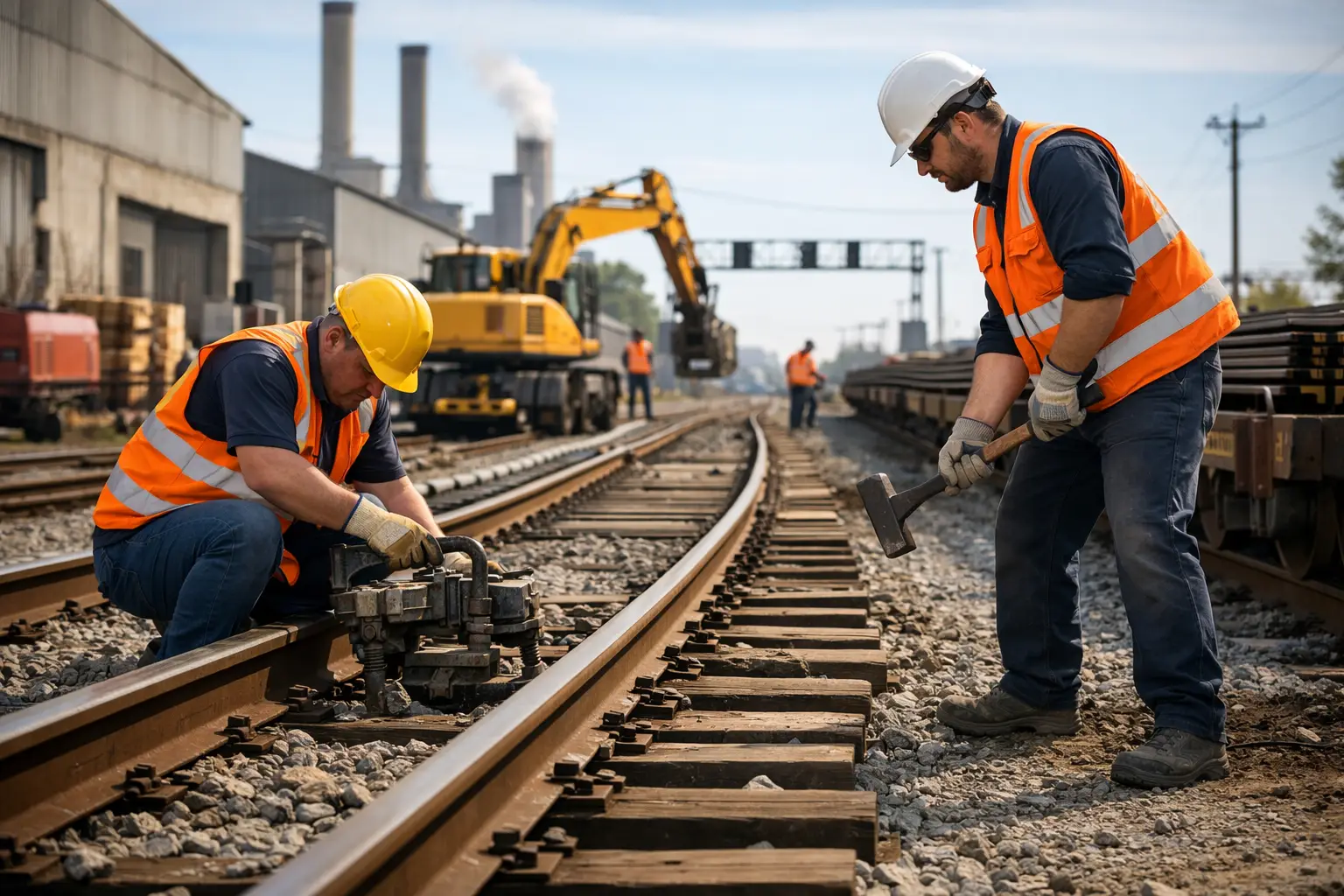
An industrial track rarely fails all at once. Very specific signs appear first: internal speed restrictions, minor derailments during switching, localized settlement, abnormal wear on turnouts or maintenance costs that rise without improving availability. Understanding how to rehabilitate industrial railway tracks requires reading those symptoms with technical judgment and turning them into an intervention plan that restores safety, capacity and service life without compromising operations.
In an industrial environment, rehabilitation does not simply mean replacing rail. It means working on the superstructure and, when necessary, the substructure, drainage, geometry, hardware, crossings and the terminal’s operational integration. The right decision depends on the track’s actual condition, the type of cargo, switching frequency, interaction with hauling equipment and the applicable regulatory framework.
What Rehabilitating an Industrial Railway Track Involves
Rehabilitation is a planned action to restore acceptable safety and performance conditions to the infrastructure. At a terminal, yard or plant branch line, this can range from spot replacement of ties, fasteners and ballast to renewal of entire sections, roadbed correction, drainage improvement and reconstruction of turnouts.
The key point is that not all deterioration justifies the same scope. In some cases, a localized intervention solves the problem; in others, patching only prolongs the risk and increases the total cost. When geometry is lost repeatedly, the earthwork is compromised or drainage collapses during the rainy season, the discussion is no longer about corrective maintenance but about structural rehabilitation.
How to Rehabilitate Industrial Railway Tracks Without Stopping Operations More Than Necessary
The first decision is not about construction, but about diagnosis. A serious project begins with a technical field inspection that combines a geometry survey, visual review, and assessment of rail wear and the condition of joints, welds, fasteners, plates, ties, ballast, crossings and turnouts. It is also advisable to review the history of incidents, operating restrictions, axle loads, traffic patterns and switching.
That diagnosis must answer three questions: where the risk is, what is causing it and what level of intervention corrects it sustainably. If only the symptom is addressed, the track deteriorates again. It is common to find sections where the apparent problem is uneven rail, when the real cause is fines pumping due to poor water drainage or a weakened subgrade.
1. Condition and Criticality Assessment
Not all segments of the internal network carry the same operational weight. A main access to loading and unloading, a critical crossover or a connection with the concessioned network deserves different treatment than a low-frequency secondary track. That is why the assessment must classify assets by operational criticality and risk level.
This prioritization helps decide where to act first, how to sequence the work and which work windows are feasible. For an operations director, this difference is decisive: it is not just about repairing, but about protecting production continuity.
2. Defining the Technical Scope
With a clear diagnosis, the next step is to determine whether a light, medium or major rehabilitation is appropriate. A light rehabilitation usually focuses on spot replacements, surfacing, alignment, tamping, adding ballast and correcting fasteners. A medium rehabilitation includes partial renewal of rail, ties and hardware, as well as drainage work and internal grade crossings. A major rehabilitation involves rebuilding the track bed, treating the roadbed, fully renewing turnouts or redesigning the geometry.
Two common mistakes should be avoided here. The first is oversizing the solution and spending capital where a targeted intervention would have sufficed. The second, more frequent, is falling short to protect the short-term budget and ending up repeating the work within months.
3. Engineering, Permits and Operational Compatibility
In the industrial setting, track does not exist in isolation. It coexists with pavement, buildings, pits, loading docks, utility networks, truck traffic, switching equipment and plant safety protocols. Rehabilitation engineering must take that coexistence into account from the start.
In addition, if the infrastructure connects to the main line or is subject to specific regulatory requirements, document review and permits are not a minor formality. A good project aligns technical specification, regulatory compliance and the execution plan. This coordination prevents delays and rework, especially at terminals where every hour of downtime has a direct cost.
The Components That Most Often Require Intervention
Rail is the most visible element, but it is not always the source of the problem. On industrial tracks with years of service, deteriorated wood ties, fatigued fasteners and fouled ballast usually explain much of the loss of geometry. When poor drainage is added, structural capacity drops quickly.
Turnouts deserve separate attention. A worn or poorly adjusted switch concentrates operational risk, especially in frequent low-speed switching where accumulated damage tends to be underestimated. Switch points, frogs, guard rails, throw mechanisms and fastening elements must be reviewed as a system, not as isolated parts.
Internal crossings and areas embedded in concrete or pavement must also be considered. These are points where a simple visual inspection can hide significant deterioration. If there is mixed rail and road traffic, the quality of these interfaces affects both safety and future maintenance.
Materials and Specification Criteria
Rehabilitating properly is not just a matter of installing new material. The selection of rail, ties, fastening system, ballast and hardware must respond to axle load, operating frequency, curve radii, environmental exposure and maintenance strategy.
At some terminals, for example, it pays to invest in more durable components to reduce interventions in areas that are operationally difficult to access. At others, the priority is to standardize materials to simplify spare parts inventory and speed up maintenance response. There is no single recipe. There is a suitable solution for each operating profile.
A supplier with a comprehensive view adds value precisely here: it not only supplies materials, but helps specify them based on expected performance, compatibility and life-cycle cost.
Construction Execution: What Defines the Real Result
The best engineering can fail with poor execution. In industrial railway rehabilitation, field quality control is decisive. Track bed preparation, compaction, effective ballast depth, correct tie placement, fastener adjustment, surfacing, alignment and rail stress relief must be verified with discipline.
The construction sequence also matters. If the work is carried out in short windows to avoid stopping operations, planning must be extremely precise. Available materials, suitable machinery, a coordinated work front and a clear protocol for handing the track back to operations are as important as the technical solution itself.
When the rehabilitation includes switches, crossings or connections with switching equipment, final validation must include real operational tests. It is not enough for the track to be built; it must perform as daily operations require.
Follow-Up Maintenance: Where the Investment Is Protected
A newly rehabilitated track does not maintain itself. Without an inspection and preventive maintenance program, deterioration returns sooner than expected. After the intervention, the goal should be to move from a reactive approach to planned asset management.
That means defining inspection frequencies, intervention criteria, drainage control, geometry monitoring, turnout reviews and incident traceability. For industrial clients with high logistics demands, this discipline makes the difference between having a functional track and having a reliable one.
This is where the technical partner matters. A company like Track Speq is especially valuable when it integrates diagnosis, construction, materials, maintenance and operational support under a single performance logic. For the client, this reduces friction between contractors and speeds up decision-making in the field.
When to Rehabilitate and When to Rebuild
The line is not always obvious. If the roadbed is stable, drainage can be recovered and deterioration is concentrated in the superstructure, rehabilitation is usually the right decision. But if the problem is systemic, with repeated failures at different points, persistent deformation and obsolescence of critical components, rebuilding may be more cost-effective in the medium term.
The key is to look beyond the initial CAPEX. A seemingly cheaper solution can prove expensive if it forces frequent closures, limits switching, increases risk or chronically consumes corrective maintenance. In industrial operations, the real cost of deficient track usually lies outside the track itself: delays, incidents, lower productivity and loss of logistics reliability.
Rehabilitating an industrial railway track is a business decision supported by engineering. When the diagnosis is accurate, the specification is well defined and execution is aligned with operations, the infrastructure stops being a point of risk and becomes what it should be: a reliable asset for moving cargo with continuity, safety and control.
