
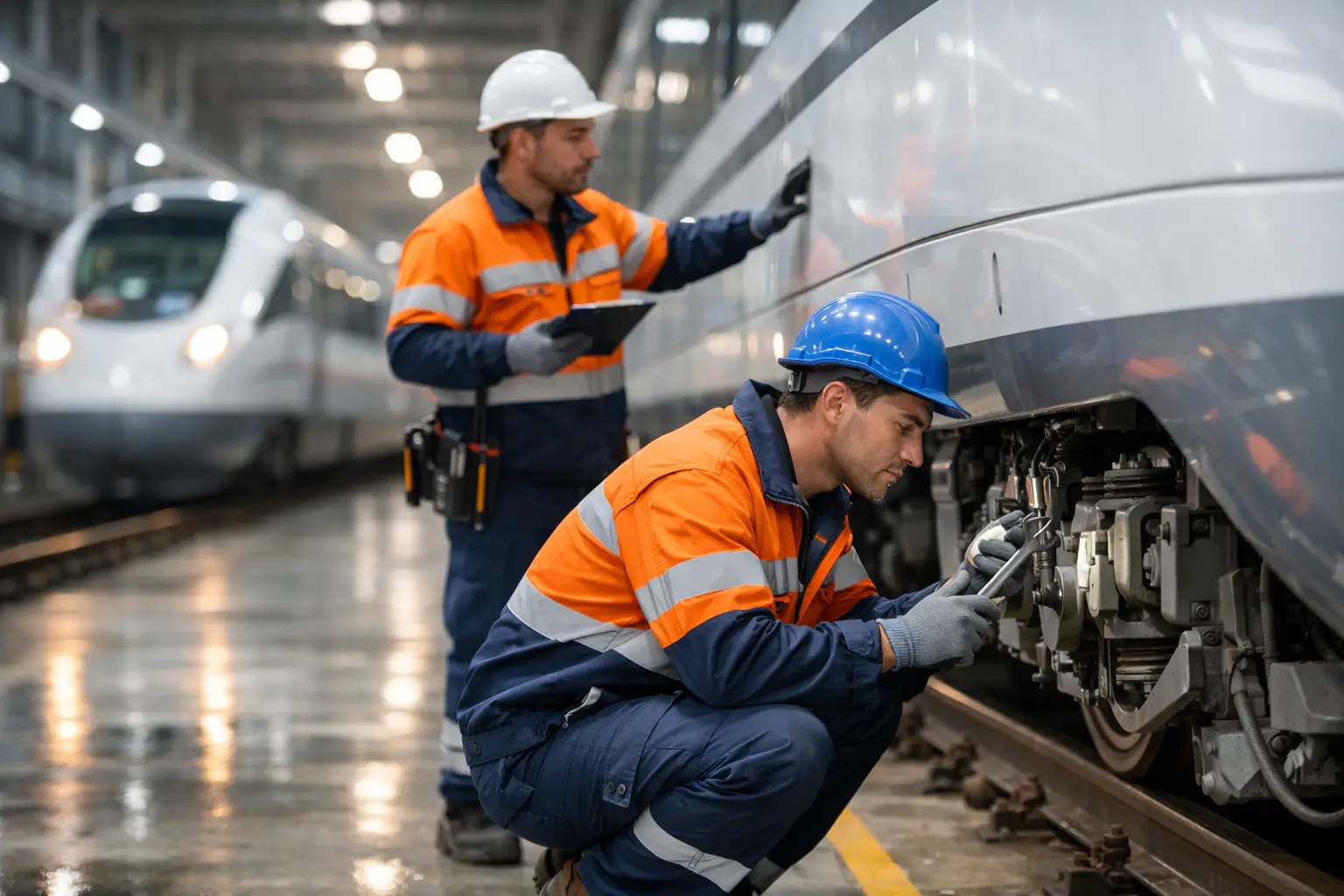
A service track can seem operational until a switch fails to close properly, a tie loses its hold or a drainage problem degrades the roadbed. In an industrial terminal, these failures are not isolated incidents: they can stop shipments, disrupt plant scheduling, increase switching moves and expose the operation to avoidable risks. Railway maintenance is therefore a discipline of operational continuity, safety and asset protection.
For operations management, the goal should not be to intervene only when a breakdown appears. The effective approach combines technical inspection, prevention, prioritized correction and traceability of every action. This maintains load capacity, reduces unplanned interruptions and allows investment decisions to be made with field data rather than estimates.
What Industrial Railway Maintenance Covers
Maintaining industrial railway infrastructure goes far beyond replacing visible elements. It includes the track, turnouts, crossings, loading and unloading areas, access points, signage and the elements that affect switching. It also requires reviewing the interaction between infrastructure, rolling stock and traction or switching equipment.
The track must maintain geometry appropriate to the type of traffic it carries. Surface, alignment, gauge and the condition of rails, joints, welds, ties, fasteners and ballast determine how loads are distributed and how the system responds to passing cars. A small defect can progress quickly when combined with high tonnage, frequent traffic, poor drainage or a deteriorated base.
Switches deserve specific attention. They are components subject to concentrated wear, and their failure can block an entire route within the terminal. Inspecting switch points, stock rails, frogs, switch rods, actuating systems and fastening elements makes it possible to detect play, cracks, wear or abnormal movement before they become an operating restriction.
The track’s surroundings also matter. Vegetation that limits visibility, poorly defined internal grade crossings, areas with runoff, accumulation of fine material and insufficient signage can increase risk even if the rail appears to be in good condition. Maintenance must analyze the entire system, not individual parts.
Preventive, Corrective and Predictive: Each Model Has Its Role
Preventive maintenance is scheduled based on frequency of use, tonnage, track criticality and operating conditions. Its usual tasks include visual and dimensional inspections, retightening of fasteners, turnout adjustment, wear monitoring, cleaning, brush clearing and early correction of drainage defects. Its main advantage is that it reduces the likelihood of unplanned shutdowns and makes resource planning easier.
Corrective maintenance comes into play when a defect already compromises operations or exceeds acceptable limits. It may involve replacing ties, rails, plates, fasteners or switch components, as well as rehabilitating ballast, roadbed or drainage. Having this capability is essential, because a rail operation can always face unforeseen damage. However, relying on it as the main method usually raises total cost and forces work to be done under pressure.
Predictive maintenance incorporates measurements, incident history and trend observation to decide when to act. Not all terminals require the same level of instrumentation or the same frequency of track monitoring. A facility with occasional switching and light loads needs a different approach from a plant with daily traffic, heavy freight and very tight shipping requirements. The key is to define technical criteria proportionate to the risk and economic impact of each asset.
How to Build a Plan That Reflects Real Operations
A useful plan starts with a reliable inventory. The company must know the track length, rail type and weight, tie condition, fastening system, location of switches, crossings, drainage, loading areas and points with operating restrictions. Without that foundation, the maintenance budget becomes a series of estimates and emergencies.
The next step is to classify criticality. A defect on a storage track does not have the same effect as one on the main access track, next to a railway scale or in a switch connecting unloading with production. Priority must consider safety, impact on the flow of goods, available alternatives, repair time and the cost of an interruption.
A well-defined program usually integrates four lines of work:
- Periodic inspections of track, turnouts, signage, drainage and the operating environment.
- Scheduled preventive maintenance in windows compatible with production and logistics.
- Prioritized correction of defects according to their level of risk and impact on service.
- Records of work performed, materials installed, incidents and restrictions applied.
Documentation is not an administrative formality. It makes it possible to demonstrate what has been inspected, justify investments, compare the performance of different sections and prevent technical knowledge from depending exclusively on one person. It also facilitates coordination with those responsible for safety, logistics, engineering and purchasing.
The Points That Most Often Compromise Availability
Drainage is one of the most underestimated factors. When water accumulates or seeps into the roadbed, the ballast loses its working capacity, deformation appears and geometry deteriorates faster. Repairing the rail without addressing the hydraulic cause may provide a temporary improvement, but not a lasting solution.
Ties and fasteners are another recurring focus. Deterioration due to age, moisture, contamination or repetitive stress reduces their ability to hold the rail in position. In some cases a localized replacement is enough; in others, the failure pattern shows that it is better to rehabilitate an entire section. Deciding between spot repair and renewal depends on the overall condition, expected traffic and the service life expected from the asset.
Interference with industrial operations must also be monitored. Pavement encroaching on the track profile, materials placed in safety zones, vehicles crossing rails without adequate protection and poorly positioned loads create wear and risks that conventional maintenance alone does not correct. The terminal’s operating discipline is part of maintenance.
Infrastructure and Switching Must Be Managed Together
A track’s availability depends as much on its condition as on how it is used. Abrupt switching moves, inappropriate speeds, overloads, improper dragging or the use of unsuitable equipment can accelerate wear on rails and turnouts. That is why the plan must incorporate operating procedures, personnel training and review of the condition of switching equipment.
In facilities with heavy car movement, maintenance of railcar movers and their associated systems deserves its own planning. A switching unit that is out of service can nullify the capacity of perfectly maintained infrastructure. Integrated management makes it possible to coordinate the availability of track, equipment, spare parts and work windows without fragmenting responsibilities.
Track Speq addresses this need from a comprehensive perspective: infrastructure, materials, rehabilitation, maintenance and support for switching equipment. For the industrial customer, this coordination reduces the number of contacts, shortens response times and helps ensure that technical decisions fit the terminal’s real needs.
Indicators That Support Better Decisions
Measuring only annual maintenance spending gives an incomplete picture. It is advisable to relate the investment to indicators of availability, number of incidents, hours under restriction, compliance with the preventive program, response time and repeat failures by section or component. These data reveal whether the root cause of the problem is being eliminated or whether low-scope repairs are simply being repeated.
The evaluation must include the cost of not acting. A scheduled component replacement may look like a significant line item, but its value changes when compared with a shipping stoppage, logistics penalties, use of alternative transportation or loss of storage capacity. Well-managed railway maintenance protects daily operations as well as the capacity for future growth.
The best decision is not always to renew the entire track or to merely repair the most visible defect. It is to define a technical strategy that responds to traffic, the criticality of each section and the plant’s objectives. When infrastructure is managed from that perspective, rail stops being a source of uncertainty and becomes a reliable operating asset.
