
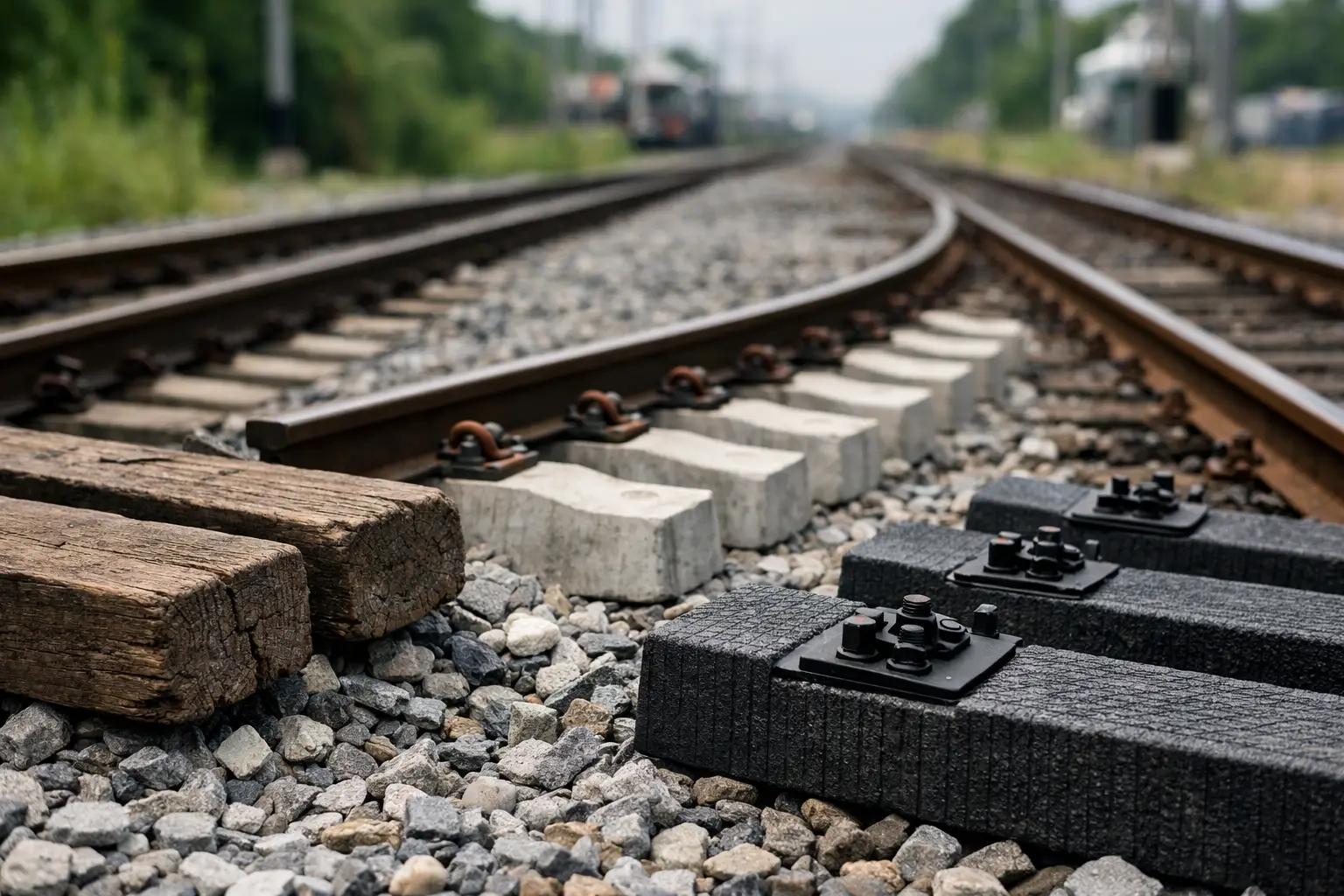
An industrial track can appear stable until its geometry starts to degrade, the gauge shifts, or maintenance cycles shorten for no apparent reason. In many cases, the root cause is an inadequate specification of the railroad ties for the railway track. They are not a secondary component: they transfer loads from the rail to the ballast, maintain track gauge, and shape how the entire superstructure responds to traffic, switching, and the environment.
For a terminal, a plant, or a logistics branch line, choosing the right tie is not just a matter of comparing unit prices. The decision must account for axle loads, traffic frequency, type of switching, fastening system, available drainage, and the maintenance plan. A poorly planned purchase can shorten track life and increase operational disruptions much sooner than expected.
The structural function of the tie
The tie, called a tie in much of the European technical literature, maintains the spacing between rails and transmits forces to the ballast layer, the subballast, and the subgrade. It also provides the support needed for fasteners, tie plates, and other hardware that limit the longitudinal and lateral movement of the rail.
Its performance directly affects critical parameters: gauge, surface, alignment, and superelevation where present. If the tie deteriorates, loses support, or no longer properly retains its fasteners, the track begins to absorb loads unevenly. That condition accelerates rail wear, loosens hardware, and can create geometry defects that force operating restrictions.
The choice, therefore, must be made as part of a complete track solution. A high-capacity tie will not make up for fouled ballast, a waterlogged subgrade, or an incompatible fastening system. Likewise, a heavier rail section will not solve the problem of a foundation that cannot distribute the load.
Types of railroad ties for railway track
The available materials meet different needs. There is no universally superior option: the best choice depends on the intended use, installation conditions, and life-cycle strategy.
Treated wood
Wood remains a relevant option for industrial tracks, sidings, terminals, and turnout areas. Its main advantage is ease of handling, cutting, drilling, and field adjustment. It accommodates a variety of fastening systems and is especially practical in rehabilitation work where existing configurations must be matched.
Its performance depends on the preservative treatment, the wood species, the quality of supply, storage, and drainage. Persistent moisture, biological attack, switching impacts, and loss of fastener holding power can reduce its service life. In facilities with moderate traffic, periodic inspection, and well-executed maintenance, it can be an efficient solution. In high-demand corridors or harsh environmental conditions, it is necessary to assess whether its long-term performance justifies the choice.
Concrete
Concrete ties offer high dimensional stability and a great capacity to withstand repetitive loads. They are common on lines with heavy traffic and in projects that seek uniformity, stiffness, and durability under well-controlled track geometry.
However, they require a higher-quality subgrade, ballast, and installation. Their weight makes handling difficult in areas with limited access and calls for suitable installation equipment. In addition, the stiffness of the system can place greater demands on the supporting layer if drainage or compaction is deficient. They are a solid solution for certain scenarios, but they should not be installed as a direct replacement for wood without reviewing the complete track design.
Steel and composite materials
Steel ties can be useful when lower weight than concrete, good industrial consistency, and resistance to certain environmental agents are desired. Their use requires controlling corrosion, electrical insulation where applicable, and compatibility with fasteners.
Composite materials, for their part, are gaining interest in humid or corrosive environments or where there are specific sustainability and service-life requirements. They can resist moisture and biological deterioration better than wood, but their upfront cost, availability, and local installation experience must be rigorously evaluated. The specification must be based on verifiable performance, not generic durability promises.
What a technical specification should define
An effective specification starts by describing the actual rail operation. It is not enough to state that it is a freight track. Axle loads, annual tonnage, speed, number of daily movements, use of locomotives or switching equipment, and the presence of cars carrying sensitive or hazardous goods must all be known.
Where the ties will be installed also matters. A tangent section of track on open subgrade does not behave the same as a sharp curve, a crossing, a switch point, a loading area, or a scale approach. In curves, lateral force and gauge maintenance become more important. In turnouts, special lengths, fastener layout, and geometric precision make a solution designed for the whole assembly essential.
The specification must integrate the rail section and condition, the tie plates, the screw spikes or anchors, the clips, the insulators, and the ballast. When these components are procured separately, incompatibilities arise that are paid for during installation or, worse, during operation. The value of a specialized supplier lies in validating the complete system before the material arrives on site.
Drainage and support: where service life is gained
A track can be built with top-quality materials and still degrade rapidly because of water trapped beneath the ballast. Poor drainage reduces bearing capacity, promotes ballast fouling, and causes differential settlement. The result is usually a progressive loss of surface and alignment that requires more frequent tamping.
Before replacing ties, it is advisable to diagnose the condition of the ballast and the subgrade. If there are fines, mud pumping, soft spots, or uncontrolled runoff, changing the material alone will offer limited improvement. Rehabilitation may require ballast cleaning or renewal, slope correction, ditches, transition layers, or subgrade stabilization.
Uniform support is just as important. A tie that is left partially suspended receives repeated impacts every time an axle passes. That dynamic impact damages the tie itself, the fasteners, and the rail. Inspection should identify these spots before they develop into more costly defects.
Purchasing, receiving, and installation without losing control
Tie quality is confirmed both at purchase and during installation. For wood, dimensions, straightness, checks, critical knots, treatment, and fastener holding capacity must be reviewed. For concrete, tolerances, integrity, insert position, and absence of shipping damage must be controlled. For steel or composites, coatings, geometry, stated properties, and fastening system compatibility must be verified.
Lot traceability helps manage claims, replacements, and maintenance programs. It is also advisable to define clear acceptance criteria before delivery, especially when the project involves different lengths, turnouts, or materials intended for areas with different operating requirements.
During installation, placement must respect the design spacing, squareness relative to the rail, the correct orientation of plates and fasteners, and the ballast profile needed to confine the tie. A rushed installation can cancel out the advantages of the best supply. The track needs precise initial geometry and progressive adjustment after the first load cycles.
Maintenance focused on operational continuity
Tie maintenance is not limited to replacing visibly damaged pieces. It must integrate inspections of fasteners, ballast condition, drainage, rail wear, and geometry. A growing rate of loose screw spikes, a concentration of cracked ties, or repeated settlement at the same spot usually points to a systemic problem.
For operations managers, the relevant indicator is not only how many ties are replaced per year. It is the impact on terminal availability, switching safety, and cost predictability. Planning partial renewals before the track reaches a critical condition makes it possible to schedule work windows and avoid emergency repairs.
Track Speq approaches railway infrastructure from this comprehensive perspective: materials, design, construction, rehabilitation, and maintenance must all follow the same operational logic. When the tie is specified with an understanding of the load, the environment, and the service objective, it stops being a purchasing line item and becomes a decision that protects the facility’s logistics capacity.
The right question is not which tie costs less up front, but which one will keep the track stable, safe, and available throughout the operating period your terminal needs.
