
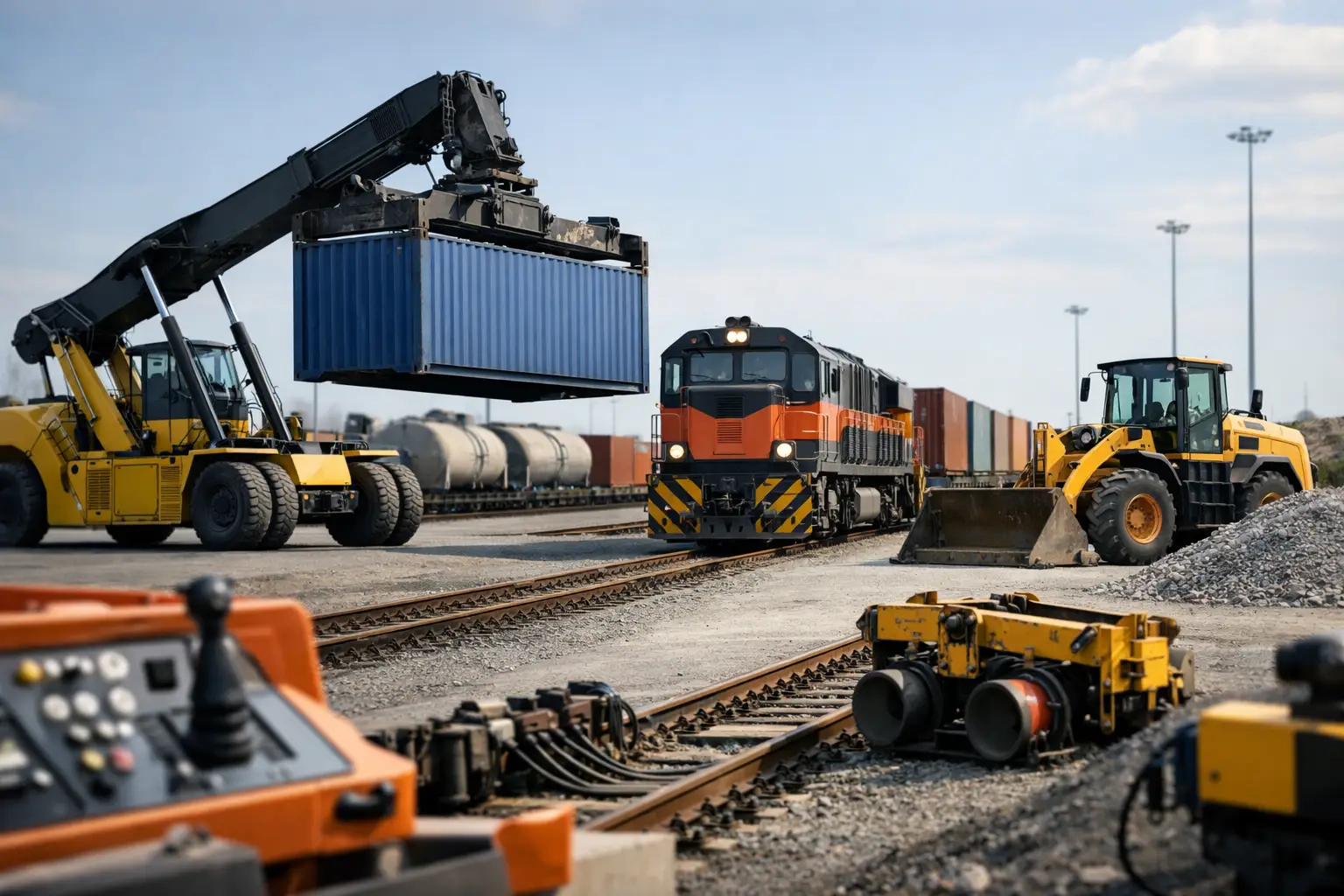
A terminal does not fail only because of deteriorated track or a lack of locomotives. It can lose capacity because of a poorly designed switch, a scale with no operational integration, an unprotected loading area or switching equipment that does not respond when the cars arrive. Understanding what equipment a rail terminal needs means evaluating the entire operation: type of cargo, volume, frequency of moves, connection to the concessioned network, safety requirements and growth horizon.
For an industrial plant, equipment should not be selected from a catalog or by unit cost. It must respond to a real work sequence: receiving, inspecting, classifying, spotting, loading or unloading, weighing, documenting, holding and releasing cars with continuity. Each element conditions the next.
The Starting Point: The Terminal’s Operating Profile
Before specifying equipment, it is advisable to define how many cars will be received per week, how long they will remain at the plant, how long the trains are and what goods they carry. An automotive terminal with frequent switching moves does not require the same configuration as a facility handling bulk materials, steel, food products or hydrocarbons.
The solution also changes depending on whether the terminal handles receiving, shipping, transloading, temporary storage or integrated production. An operation with two cars a day can work with compact infrastructure and well-controlled procedures. A terminal with multiple loading fronts, limited rail windows and high turnover needs auxiliary tracks, selective automation and in-house switching capacity.
Engineering must consider site constraints, curve radii, grades, clearances, drainage, internal crossings and safety distances. Buying equipment without resolving these conditions usually results in underused assets and slow moves that translate into operating costs.
Railway Track, Turnouts and Safety Elements
The track is the system that supports the entire operation. It includes rail, ties, fasteners, ballast, subballast, drainage and roadbed, but it does not end there. A functional terminal requires turnouts that make it possible to separate, store and direct cars to the process areas. Switches, crossings and crossovers must be selected based on geometry, expected speed, axle load and switching regime.
In industrial terminals, tracks are usually divided into receiving and departure, classification, loading or unloading, storage and maintenance. The number needed depends on the required usable length and the number of cars that must remain stationary without blocking the arrival of a new train. Capacity is not measured only in meters of track: it is measured in moves that can be completed without interference.
Safety requires bumping posts where appropriate, wheel chocks, derails, signage, crossing protection and devices for securing cars. In areas with people, forklifts, trucks or process equipment, physical and visual separation is as important as the condition of the rail. A properly located derail can prevent an unauthorized car from reaching a critical area, but it must be integrated into a clear operating procedure.
Track Inspection and Maintenance
The terminal needs the means to inspect geometry, wear, fasteners, joints, turnouts and drainage condition. Routine interventions require track tools, tightening, cutting, drilling, lifting and component replacement equipment, as well as an inventory of critical materials. The relevant decision is not to accumulate tools, but to ensure availability and trained personnel to act before an anomaly stops the operation.
Switching Equipment: Choosing Power and Flexibility
Moving cars within a terminal is a specialized task. Depending on volume and track layout, the operation may rely on a conventional locomotive, a railcar mover or a specific car-pulling system. The choice must consider tractive capacity, adhesion, number of cars per move, grades, available space, hours of use, emissions, maintenance cost and the need to operate indoors or near process areas.
A railcar mover offers an especially effective alternative when high availability, repetitive switching moves and flexibility are needed in industrial facilities. Its configuration can reduce dependence on road locomotives and make it easier to respond to tight operating windows. However, it does not automatically replace a locomotive in terminals with heavy consists, long distances or demanding grades. The tractive effort calculation and track profile evaluation must be done before deciding.
Switching equipment must be supported by communication systems between the operator, ground personnel and the control center, work lighting, audible alarms, signage and lockout procedures. The productivity of a switching move depends on coordination. A powerful machine with ambiguous signals or occupied routes will still generate delays and exposure to risk.
Equipment for Loading, Unloading and Transloading
The commodity defines a large part of the investment. Dry bulk may require hoppers, conveyor belts, telehandlers, dust collection systems and sampling equipment. For liquids and gases, the terminal may need loading arms, certified hoses, pumps, valves, containment basins, vapor recovery systems and fire protection.
Operations involving steel, forest products, construction materials or general merchandise use different solutions: cranes, overhead cranes, high-capacity forklifts, grabs, slings, ramps or transfer platforms. In automotive, the priority is on ramps, spotting tracks, inspection areas and damage protection. Every interface between the railcar and the process must be designed to prevent impacts, spills, overloads and idle time.
Environmental and personnel protection cannot be added at the end of the project. It must be part of the specification from the start, with leak detection where applicable, lighting, ventilation, spill control, safe access, emergency points and operational signage.
Weighing, Control and Car Traceability
A terminal that loads or unloads commercial goods needs reliable data. Railway scales make it possible to verify the weight per car or per consist, control payload and reduce the risk of overloading. The choice between static and in-motion weighing depends on the required accuracy, operating flow and available space. In some cases, integrating weighing with the logistics management system adds more value than installing a standalone scale.
Car identification through visual reading, radio frequency or recognition systems can improve traceability, but its usefulness depends on linking the data to loading orders, inspections, inventory and documentation. Automation must resolve a specific operational decision: knowing which car is on each track, what product it contains, what condition it is in and what the next authorized move is.
Cameras, access controls, occupancy detectors and radio communication help manage complex areas. Not all terminals need the same level of instrumentation. A small facility can operate with disciplined manual processes; a high-volume terminal benefits from real-time visibility to avoid blockages and reduce coordination errors.
Shop, Spare Parts and Incident Preparedness
Rail continuity depends on recovery capability. For that reason, a terminal with regular activity should provide an area for basic inspection and maintenance of switching equipment, as well as organized storage of spare parts and consumables. The scope may include lubricants, approved brake components, hoses, hardware, track components, wheel chocks, signage and personal protective equipment.
The point is not to turn the plant into a full railway shop. It is to distinguish which failures can be resolved in-house, which tasks require a specialized supplier and which parts have lead times incompatible with a shutdown. A well-defined preventive plan reduces emergency repairs, but it also establishes responsibilities, inspection frequencies and criteria for taking assets out of service.
Track Speq can support this definition from terminal engineering through supply, switching, maintenance and technical support, preventing infrastructure and equipment from being contracted as disconnected decisions.
The Best Investment Is the One That Eliminates Bottlenecks
The right equipment is not necessarily the largest or the most automated. It is the equipment that makes it possible to move the expected freight safely, meet applicable requirements and maintain a margin for variations in demand. A terminal prepared to grow usually reserves space, electrical capacity, drainage and track geometry for a future expansion, even if it does not install all the assets from day one.
Before issuing a purchase, it is advisable to validate the operation with a flow diagram, switching times, track occupancy and incident scenarios. When each piece of equipment responds to a specific move and a defined maintenance need, the terminal stops being a collection of assets and becomes a rail operation that is controllable, safe and profitable.
