
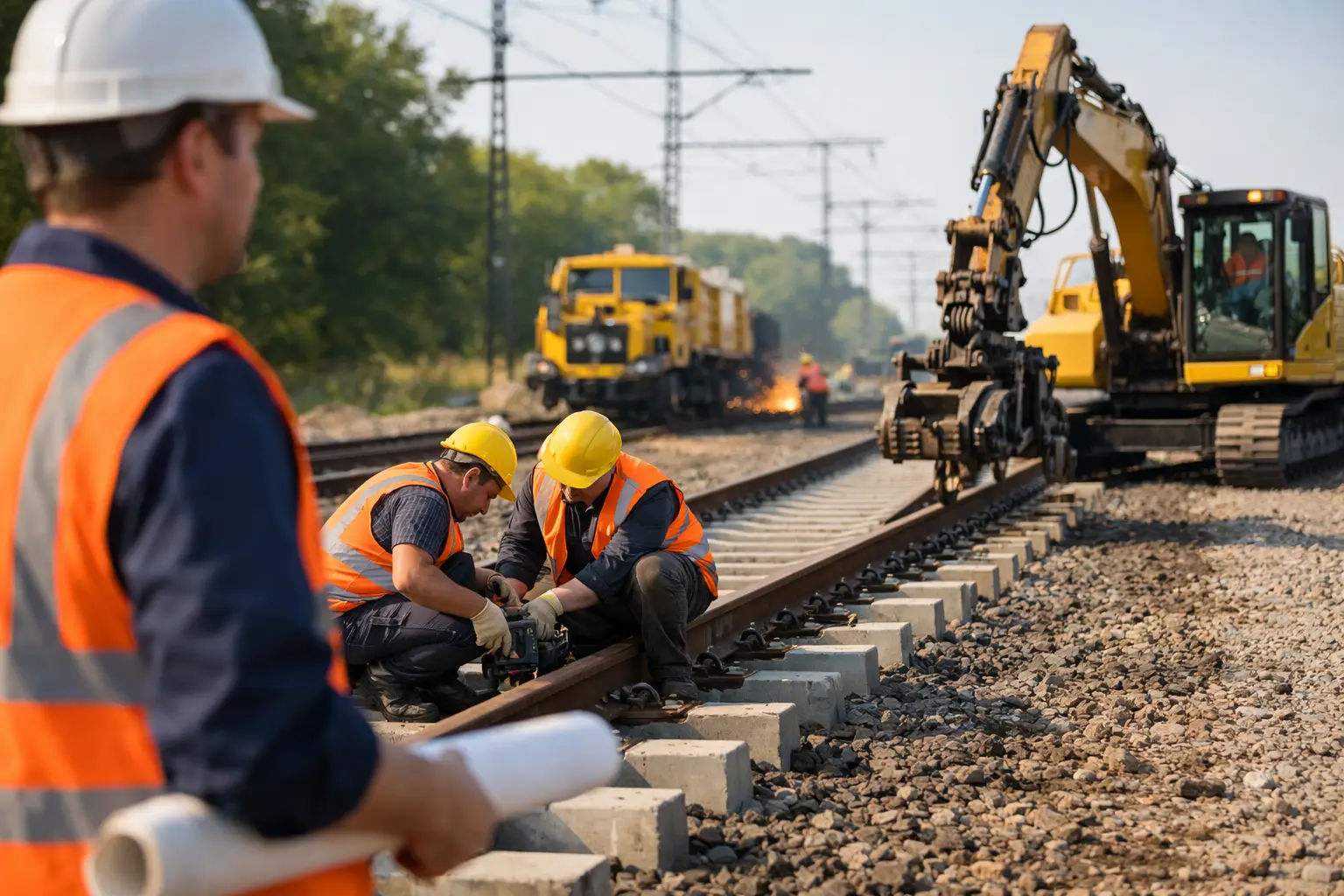
A track with speed restrictions, recurring minor derailments, accelerated wear or areas of settlement does not just generate maintenance costs: it compromises the shipping capacity of the entire terminal. Understanding what railway rehabilitation includes makes it possible to define a technical scope that restores the reliability of the infrastructure without doing more work than necessary or postponing failures that will end up affecting operations.
In an industrial environment, rehabilitation does not simply mean replacing rail. It is a planned intervention on the elements that support, guide and protect rail movement. The right scope depends on the actual condition of the track, the tonnage hauled, the type of car, the planned switching moves and the service life expected after the work.
What a Well-Defined Railway Rehabilitation Includes
A railway rehabilitation begins with an assessment and ends with a track validated to return to service. Between those two points come engineering, material supply, execution, quality control, safety and operational coordination. When these activities are contracted separately, the risk of technical incompatibilities, delays and unclear responsibilities increases.
The goal is not always to rebuild the entire track. In some projects it is enough to correct geometry, renew ties and improve drainage. In others, rail deterioration, ballast contamination or insufficient roadbed capacity justify a deeper renewal. The decision must be based on field data and on load and operating requirements, not on a standard solution.
Track Inspection, Survey and Assessment
The first component is a technical evaluation of the existing infrastructure. The condition of the rail, joints, ties, fasteners, ballast, turnouts, grade crossings and drainage structures is reviewed. Visible defects, deformation, corrosion, cracks, railhead wear and conditions that could increase operational risk are also identified.
The geometry survey reveals alignment, longitudinal surface, superelevation, gauge and changes in grade. These parameters determine whether traffic is operating within the tolerances required for the intended speed and load. A track can look stable to the naked eye and still have enough geometric variation to limit switching moves or accelerate wear on rolling stock.
The assessment must take the operating context into account. A spur with a few switching moves per week does not require the same solution as a terminal with heavy traffic, unit trains or cars loaded with steel products, bulk materials, automotive products or hydrocarbons. It also matters whether the track connects to the main rail network, serves a logistics warehouse or is part of an internal plant circuit.
Scope Engineering and Construction Planning
The rehabilitation engineering is developed from the field information. This phase defines which sections to keep, which components to replace, which tolerances to apply and how to carry out the work without unnecessarily interrupting production. It includes drawings, technical reports, the construction sequence, material estimates and coordination of access points, crossings and work windows.
Planning must consider car movements during the intervention. In many facilities it is not feasible to close the entire terminal for several days. For that reason, it may be necessary to split the rehabilitation into phases, set up operational bypasses or schedule work during periods of lower activity. Speed of execution matters, but it should not displace safety controls or proper compaction of each layer.
The permits and requirements of the railway operator are also reviewed where applicable, along with applicable regulations and internal industrial safety protocols. A technically sound rehabilitation can be delayed if document management and coordination with stakeholders are left until the end.
Work on the Track Superstructure
The superstructure comprises the elements directly involved in guiding the train: rails, ties, fasteners, plates, joints and turnouts. Its rehabilitation can be partial or complete depending on the level of wear and the required performance.
Rail renewal may include removing damaged rail, installing rail sections suited to the expected load, welding and adjusting joints. Not all wear requires replacing the entire rail. However, when there are recurring defects, loss of section, railhead damage or incompatibility with a higher-tonnage operation, extending its use can end up costing more than replacing it.
Ties and fasteners are just as decisive. Deteriorated ties with poor holding power or unable to maintain gauge reduce the stability of the whole system. Rehabilitation includes replacing them, restoring anchoring elements and verifying rail fastening. The choice between solutions depends on load conditions, moisture, expected maintenance and the facility’s design.
Switches, crossovers and frogs require a specific review. They are points with a high concentration of stresses and often the source of operating restrictions. Their rehabilitation may require replacing switch points, guard rails, frogs, hardware, actuating mechanisms and signaling elements. Treating a turnout as if it were a straight section usually just pushes the problem into the next operating cycle.
Ballast, Roadbed and Drainage: The Foundation That Defines Service Life
A track will not hold its geometry if the ballast and roadbed have lost their bearing capacity. That is why a complete railway rehabilitation evaluates cleaning, replenishment, profiling and compaction of the ballast, as well as the stability of the underlying ground.
Ballast contaminated with fines, mud or debris loses drainage and its ability to distribute loads. In these cases, lifting the track and correcting only the geometry may provide a temporary improvement, but it does not eliminate the cause of the problem. It may be necessary to remove degraded material, add ballast of the proper specification and rebuild the profile to ensure lateral confinement and water drainage.
Drainage deserves special attention in industrial terminals. Clogged ditches, insufficient slopes, damaged culverts or runoff from paved yards can saturate the track structure. Persistent water promotes settlement, pumping of fines and deterioration of ties and fasteners. Correcting it reduces future interventions and protects the investment made in rail and hardware.
When roadbed failures are detected, the solution may include soil stabilization, subballast improvement, slope correction or localized reconstruction. It is a decision that requires technical analysis: doing too much increases the budget and schedule; doing less than needed leaves the cause of deterioration in place.
Safety, Grade Crossings and Operating Elements
Rehabilitation must also restore safe conditions for personnel, trains and internal vehicles. This includes reviewing clearances, signage, end-of-track bumping posts, crossing protection, lighting when it is part of the scope and access conditions for inspection and maintenance.
At internal grade crossings or plant entrances, the condition of the pavement, crossing panels, visibility, warning signage and the interaction between rail and road traffic are analyzed. An effective solution must respond to the actual traffic pattern of trucks, machinery and pedestrians, not just to the physical layout of the track.
In terminals with switching operations, the infrastructure must be coordinated with the available equipment. The position of bumping posts, curve radii, grades and usable track length influence the performance of railcar movers and locomotives, as well as the safety of movements. Track Speq addresses this relationship between track, operations and equipment to prevent a project from fixing one isolated point while leaving restrictions in place across the terminal as a whole.
Quality Control, Testing and Handover to Operations
The final phase is not about removing machinery and declaring the work finished. Track geometry, proper fastening of components, the condition of welds, the ballast profile, the operability of switches and the cleanliness of drains are all checked. Findings must be documented and corrected before the section is released.
Test runs are then carried out and the conditions for return to service are established. In some cases, temporary speed restrictions are applied while materials stabilize or an initial monitoring period is completed. This measure does not represent a deficiency if it is technically planned: it makes it possible to monitor how the track behaves under load and make any necessary adjustments with sound judgment.
A cost-effective rehabilitation is not measured only by the meters of track worked on. It is measured by the reduction in incidents, the recovery of capacity, the safety of switching moves and the ability to sustain the level of service the facility needs. Defining the scope from the assessment, with a view that connects infrastructure, operations and maintenance, turns rehabilitation into a business continuity decision rather than a reactive repair.
