
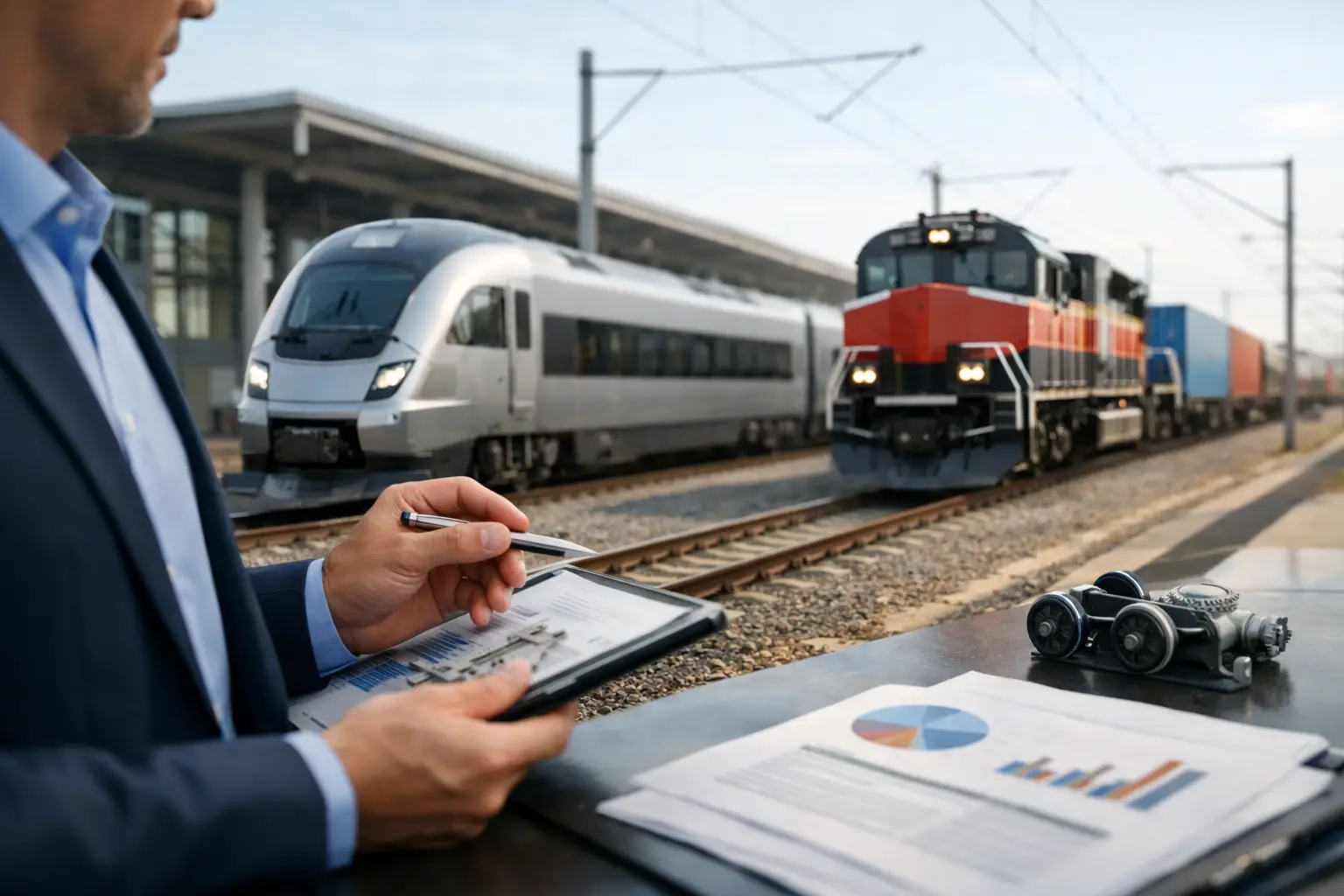
Guide to Choosing a Railway Supplier
When an industrial operation depends on rail, choosing the wrong supplier does not just create cost overruns. It causes shutdowns, switching delays, regulatory noncompliance and a chain of corrective decisions that consume management time. That is why this guide to choosing a railway supplier starts from a simple idea: it is not about buying an isolated service, but about ensuring operational continuity with real technical backing.
In the industrial rail environment, the decision is rarely limited to comparing prices. A supplier may quote lower for a track rehabilitation but lack the capacity to respond later with maintenance, spare parts, inspections or operational adjustments. That is where hidden costs appear. For an operations director or logistics manager, the right criterion is not who sells something once, but who can sustain the performance of the asset and the terminal over time.
What a Railway Supplier Should Solve
Before evaluating companies, it is worth defining the problem precisely. Needing construction of a new terminal, a yard expansion, industrial track rehabilitation, preventive maintenance, materials supply, signage, switching equipment or regulatory support are not the same thing. Many railway purchases go wrong because general suppliers are sought for highly specific needs.
The right supplier must match the complexity of the operation. If your plant moves high volumes, operates critical loading windows or depends on coordination with concessionaires and authorities, the selection standard must rise. In these cases, field experience, responsiveness and regulatory expertise carry more weight than a commercial proposal that looks attractive on paper.
A Guide to Choosing a Railway Supplier Without Fragmenting the Operation
The first serious filter is to check whether the supplier works as a partial contractor or as an operating partner. The difference matters. A partial contractor executes a job or delivers a material. An operating partner understands how each decision affects track availability, switching, safety, maintenance and future expansion.
In industrial railway projects, fragmenting the supply chain too much usually increases risk. If one company designs, another builds, another supplies hardware, another handles maintenance and another manages permits, coordination slows down and blind spots multiply. It is not always best to concentrate everything in a single party, but it is advisable to prioritize suppliers with a comprehensive scope or a proven ability to coordinate critical interfaces.
Verifiable Technical Capability
Experience should be validated on work comparable to yours. Years in the market are not enough. What matters is whether the supplier has worked in industrial environments with similar demands in terms of load, safety, execution times and operating conditions.
Ask for concrete evidence: types of projects completed, maintenance scopes, materials supplied, equipment serviced and sectors served. A company familiar with automotive terminals does not necessarily master the needs of steel, food or hydrocarbons. Each segment has its own requirements for safety, traffic, availability and compliance.
It is also key to review the quality of the technical team. Engineering, construction supervision, specialized maintenance and after-sales support cannot depend solely on third parties. The more critical your operation, the more valuable a supplier with its own personnel, a clear methodology and direct response capability becomes.
Regulatory and Documentation Expertise
In the railway field, technical execution without regulatory compliance is an incomplete solution. Permits, filings, specifications, operational compatibility and safety documentation are part of the project, even though they are often left out of the initial comparison.
A serious supplier does not wait for the client to discover the regulatory requirements on their own. It anticipates them, translates them into design decisions and integrates them into the schedule. This reduces rework and prevents a completed project from being limited by documentation findings or unforeseen operating criteria.
This is where it pays to ask direct questions. Who is responsible for the detailed engineering? Who supports document management? Who validates that materials, accessories and switching solutions match the facility’s actual use? If the answers are ambiguous, so is the risk.
Beyond Price: Total Cost of Operation
A good guide to choosing a railway supplier should focus on total cost, not just the initial offer. In railway infrastructure and equipment, cheap can turn out expensive in three ways: shorter service life, more interruptions and greater dependence on urgent corrective work.
This applies to track rehabilitation as well as to the supply of materials or switching equipment. A lower-quality component, an imprecise specification or an installation without operational judgment may seem like reasonable decisions in procurement, but later become issues for maintenance and operations.
The right analysis includes the expected frequency of intervention, spare parts availability, response times, technical support, personnel training and the potential for future scaling. A supplier that supports the asset throughout its service life usually adds more value than one that disappears after delivery.
Response Times and Field Support
In an industrial operation, not every emergency can wait. That is why after-sales support capability is a selection criterion, not a nice-to-have. If there is a track failure, an operational adjustment in the yard or a critical need for spare parts, the supplier must have the structure to respond.
Sales talk is of little use here. What matters is real coverage, technician availability, access to materials and experience resolving issues in short windows. A railway supplier that understands plant and logistics pressure does not just “handle tickets.” It acts with operational sense.
Integration of Infrastructure, Equipment and Maintenance
One of the most common mistakes is evaluating each rail need as a separate front. Track, switching, maintenance, materials supply and operational safety are connected. If the supplier does not see that relationship, the client ends up managing incompatibilities between solutions.
That is why the model of companies that integrate design, construction, rehabilitation, maintenance and equipment within a single technical ecosystem is gaining ground. This integration does not just simplify purchasing. It improves the traceability of decisions, speeds up adjustments and reduces friction between the client’s internal departments.
In complex operations, having such a partner can make a difference. Track Speq, for example, has positioned itself precisely at that intersection of infrastructure, specialized supply, technical support and operational assistance, which is where many railway projects are either defined or complicated.
Warning Signs When Comparing Proposals
There are indicators worth taking seriously. One is a generic quote with no clear understanding of the site’s rail use. Another is the promise of aggressive timelines without reviewing permits, access, construction logistics or material availability. A lack of clarity about who is responsible after delivery should also be a concern.
Another warning sign is apparent specialization. Some companies sell railway products but have no installation or support capability. Others build but do not support operations. Others offer maintenance but depend on third parties for critical parts. None of these models is necessarily wrong, but each must be evaluated honestly against the project’s real needs.
The right supplier does not try to force-fit a standard solution. It asks questions, identifies constraints, lays out scenarios and explains trade-offs. In rail, many decisions depend on context: axle load, frequency of use, interaction with switching equipment, industrial environment, budget and growth horizon.
How to Make a Lower-Risk Decision
A solid selection combines technical review, operational validation and commercial evaluation. Operations, maintenance, procurement and engineering should all be involved. When the decision is made by a single department, critical variables are often missed. Procurement may optimize price, but operations sees the impact on availability. Engineering evaluates the specification, while maintenance anticipates recurring failures.
Ask for a proposal that states not only what will be done, but how, with what materials, in what sequence and with what follow-up support. Request clear scopes, explicit exclusions and defined responsibilities. Ambiguity in a railway proposal almost always ends in additional cost or a scope dispute.
It is also advisable to assess the quality of the technical conversation. A good supplier does not push to close quickly while key definitions are still missing. It prefers to align the project from the start, because it knows that in this sector improvisation is expensive.
The best decision is not always the largest option or the cheapest. It is the one that offers technical compatibility, execution capability, regulatory compliance and sufficient support for the criticality of your operation. If rail is a strategic part of your logistics chain, choosing a supplier should be treated with the same rigor as a business continuity decision.
In the end, a valuable railway supplier does not just deliver construction, materials or equipment. It helps keep the operation moving when the margin for error is minimal.
Track Speq Helps You Make a Lower-Risk Railway Decision
Track Speq helps clients turn supplier selection into a technical process, not just a commercial one. The starting point is understanding the real operation: volumes, switching frequency, type of cargo, track condition, maintenance windows, interaction with concessionaires and level of criticality for the plant. With that understanding, the recommendation is no longer based on a generic solution, but is geared toward compatibility, safety, continuity and operational return.
Through Rail Infra, support can cover infrastructure diagnostics, conceptual engineering, feasibility studies, permits, detailed design, construction, rehabilitation and maintenance of tracks or terminals. This allows CAPEX decisions to consider their effect on OPEX from the outset: component service life, accessibility for maintenance, construction sequence, future capacity and fewer interruptions.
When the challenge lies in materials, spare parts or tools, Rail Depot provides specialized supply and technical traceability to avoid scattered purchases or out-of-spec components. If the bottleneck is in switching, Rail Movers integrates railcar movers, technical support, spare parts and operator training, including Shuttlewagon solutions when the operation requires autonomy, safety and less dependence on locomotives in the yard. And when the need involves logistics flow, yards or terminals, Rail Terminal makes it possible to analyze the operation as a system: receiving, spotting, loading, unloading, release and maintenance.
The result for the client is a decision with less uncertainty: a single technical ecosystem capable of connecting design, construction, supply, equipment, operations and support. This integration reduces critical interfaces, facilitates coordination among procurement, maintenance, engineering and operations, and makes it possible to sustain rail performance after the initial delivery. If your company is evaluating a railway supplier for infrastructure, switching, materials, maintenance or terminals, it is worth reviewing the project from a comprehensive perspective before committing CAPEX or taking on new operational risks. For a technical assessment, visit en.trackspeq.com or contact the team at ventas@trackspeq.com.
