
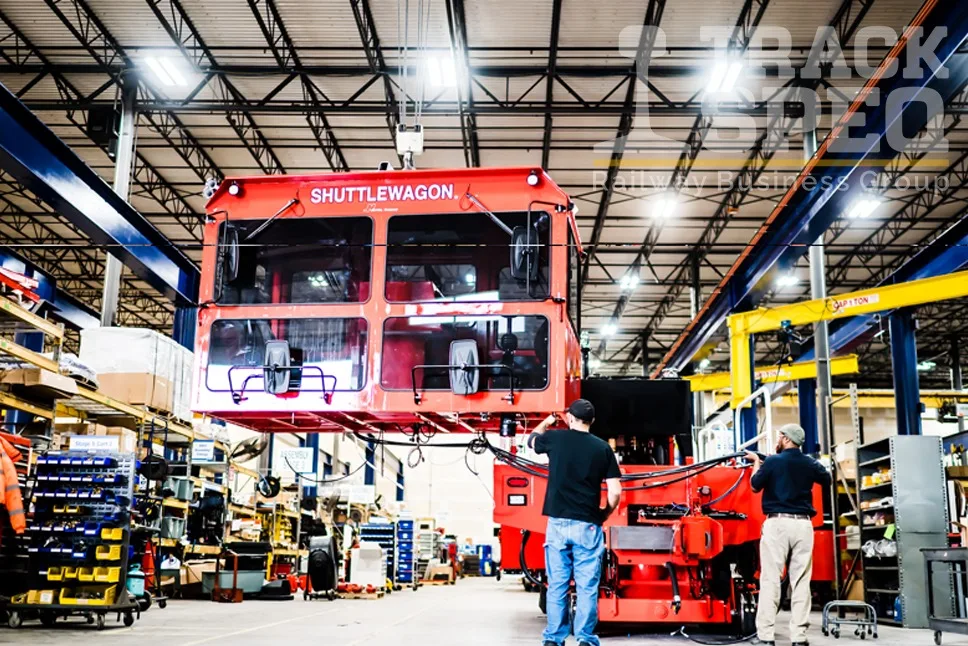
When a Shuttlewagon stops because of a seemingly minor part, the problem is rarely that part. What is put at risk is the continuity of switching, track occupancy, loading schedules and, in many cases, the overall performance of the industrial operation. That is why a Shuttlewagon spare parts guide should not be limited to a list of components. It should help decide what to keep in stock, what to inspect more frequently, and how to reduce downtime without oversizing inventories.
In industrial environments, managing spare parts for rail switching equipment requires a different approach than for a conventional vehicle. A Shuttlewagon works under heavy loads, repetitive cycles, and exposure to dust, humidity, vibration and, depending on the industry, very narrow operating windows. In that context, buying parts when a breakdown occurs usually costs more than properly planning the availability of critical components.
What a Shuttlewagon spare parts guide should cover
A useful guide starts from three variables: operational criticality, replacement frequency, and supply lead time. Not all spare parts deserve the same treatment. Some components have predictable wear, others are tied to preventive maintenance, and others, although they fail less often, have a direct impact on equipment availability.
The real priority does not always coincide with the most expensive part. A sensor, a hose, or a filter element can immobilize a railcar mover just as much as a major component. The difference is that many of these issues can be anticipated if inventory is defined based on operating history, service hours, and site conditions.
It is also advisable to distinguish between original spare parts, maintenance consumables, and major repair components. That distinction helps purchasing, maintenance, and operations speak the same language. If everything is classified as a “spare part,” control loses precision and replenishment becomes reactive.
Critical spare parts by function
Engine and combustion system
Engine-related items account for a significant share of recurring maintenance. Air, oil, and fuel filters, belts, hoses, clamps, sensors, and cooling components must be checked with discipline. These are parts with known wear and a direct relationship to the equipment’s day-to-day reliability.
The common mistake here is waiting for a failure signal instead of working by condition and by interval. In an intensive operation, thermal degradation or a flow restriction does not always show up immediately, but it does accelerate wear on more expensive systems. Keeping these components in stock is usually an easy decision because their turnover is predictable.
Transmission, traction, and hydraulic system
On a Shuttlewagon, switching capability depends on consistent power delivery and hydraulic response. Pumps, seals, hydraulic hoses, valves, gaskets, hydraulic filters, and certain actuators should be treated as parts of high operational importance. A small leak or a drop in pressure can reduce performance before causing a complete shutdown.
Not all of these components require the same level of inventory. It depends on the duty cycle and whether the plant has operational redundancy. If there is only one piece of switching equipment, the tolerance for risk is much lower and spare parts coverage must be broader.
Braking, running gear, and coupling
Brake systems, wheels, contact elements, and coupling components are critical for both availability and safety. It is not enough to replace them when wear is visible. They must be measured, trends must be recorded, and action must be taken before degradation affects the maneuverability or control of the equipment.
In this group, technical criteria must take precedence over unit cost. Delaying the replacement of a braking part or a load-bearing mechanical element can lead to a more extensive repair, as well as compromise operational safety.
Electrical and control
Batteries, relays, connectors, wiring, control modules, switches, lighting, and sensors are among the issues that cause the most frustration, because they often seem minor until they take the equipment out of service. In operations with dust, humidity, or temperature changes, these failures become more frequent.
The best practice here is to combine physical inspection, technical cleaning, and the availability of quick-replacement parts. A fast diagnosis is only useful if the right part is available.
How to define the right inventory
A good Shuttlewagon spare parts guide does not recommend stocking everything. It recommends stocking the right things. The optimal inventory depends on the switching profile, the number of shifts, the work environment, the age of the equipment, and the acceptable amount of downtime.
If the equipment operates in a terminal where an hour of downtime affects shipments, the yard, personnel, and track occupancy, the inventory should be broader. If there is backup equipment or less operational pressure, a more selective stock can be used. The decision is not just technical. It is financial and operational at the same time.
The most effective approach is usually to build three tiers. The first includes consumables and frequently replaced parts. The second groups critical components with a high impact on availability. The third is reserved for major repair parts, whose purchase can be scheduled based on condition, history, and support from the manufacturer or authorized distributor.
Signs that the spare parts plan is poorly sized
There are very clear symptoms. The first is repeatedly making urgent purchases. The second is having parts sitting idle for years while components that actually fail are missing. The third is relying entirely on disassembly to identify needs, without a solid routine of prior inspection.
Another indicator is when maintenance and purchasing work with different catalogs or ambiguous descriptions. With specialized equipment, an identification error delays the intervention and increases the risk of ordering the wrong part. Traceability by part number, equipment serial number, and exact configuration is not an administrative detail. It is part of technical control.
The role of preventive maintenance
Spare parts should not be seen as an isolated response to a breakdown. They are part of the maintenance plan. When inspections are done well, parts stop being an emergency and become a planned replacement. That shift reduces indirect costs, improves availability, and gives visibility to purchasing and operations.
With Shuttlewagon equipment, this is especially relevant because actual use rarely matches a generic calendar. Some plants have light switching and others have continuous demand, frequent pulls, and harsh environmental conditions. That is why intervals must be adjusted to how the equipment behaves in the field, not just to a standard frequency.
A good program combines operating hours, condition-based inspections, and analysis of recurring incidents. If the same hose, connection, or electrical element fails repeatedly, simply changing the part is not enough. Installation, temperature, vibration, contamination, and usage patterns must be reviewed.
Genuine parts, compatibility, and technical support
In spare parts for rail switching, saving money on the wrong part can be costly. For some components, functional equivalence may be acceptable, while for others the exact specification is essential to preserve performance, safety, and service life. The criteria must be backed by technical knowledge, not just commercial availability.
This is especially important in hydraulic, electrical, and control systems, where small differences in material, calibration, or connection cause intermittent failures that are hard to diagnose. For a maintenance manager, the relevant cost is not just the purchase price. It is the total cost of downtime, repeated labor, and operational risk.
That is why it is key to work with a partner that knows the equipment configuration, its actual application in the plant, and the logic of maintenance. In the Mexican market, Track Speq provides that value by integrating supply, technical support, and rail operations expertise within the same industrial environment.
How to buy Shuttlewagon spare parts more effectively
Smart purchasing starts long before a purchase order is issued. It is advisable to have a validated base inventory, a master list by part number, historical consumption, and clear criticality criteria. With that structure, purchasing stops reacting and can better negotiate lead times, priorities, and replenishment.
It also helps to review the past year’s shutdowns. If the cost of downtime clearly exceeds the value of a preventive stock, the decision becomes obvious. It is not about filling warehouses, but about protecting the continuity of an operation that depends on moving freight on time.
With switching equipment, the right question is not “which part costs less,” but “which part can I not afford to be without.” That approach completely changes spare parts management.
A terminal’s profitability does not depend only on track, motive power, or volume. It depends on the discipline with which the assets that make every switching move possible are sustained. Mature spare parts management turns maintenance into an operational advantage, not a constant source of emergencies.
