
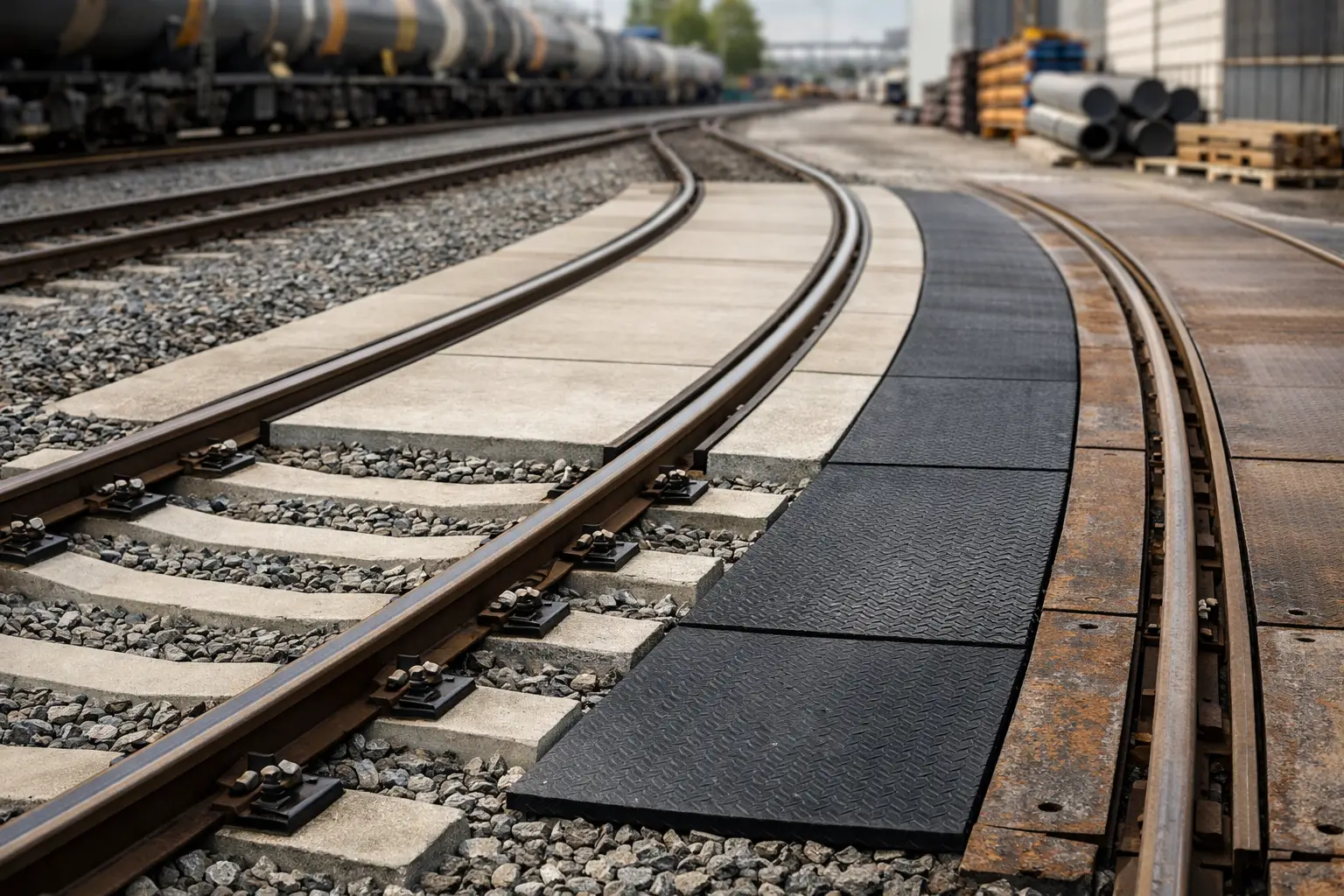
When an industrial track fails, the problem rarely starts in operations. It starts much earlier, in the specification. Choosing the best materials for industrial tracks is not a matter of picking from a catalog, but of axle load, switching frequency, type of product moved, working environment and maintenance strategy. A sound decision reduces downtime, extends the asset’s service life and avoids premature rehabilitations that end up costing more than a good initial selection.
In industrial and logistics environments, the track does not work under ideal conditions. It withstands repetitive switching, braking, acceleration, fouling by fines, crossings with internal traffic, irregular drainage and, in many cases, very limited maintenance windows. That is why discussing materials requires going beyond unit price. What really matters is the total cost of ownership and the operational stability those materials can sustain for years.
What Defines the Best Materials for Industrial Tracks
There is no single combination that works for every terminal. The best materials for industrial tracks are those that match the actual operating profile. A plant with intensive movement of loaded railcars, frequent turnouts and exposure to corrosive agents needs different criteria than a facility with moderate traffic and occasional switching.
Five variables drive the specification: annual tonnage, axle load, operating speed, ground conditions and service criticality. If the track serves a continuous process, such as steel, automotive or hydrocarbons, the margin for error is minimal. In those cases, the selection of rail, ties, fasteners and ballast must be approached as a system, not as independent parts.
It is also important to distinguish between new track, expansion and rehabilitation. In new construction, there is more freedom to design the right solution from the subgrade up. In rehabilitation, by contrast, the constraint usually lies in the existing asset, the available geometry and the need to keep operating while the work is carried out.
Rail: Strength, Wear and Availability
Rail is the most visible component, but not always the only one that is pushed beyond its limits. Even so, its selection is critical. On industrial tracks, lighter rail sections may seem sufficient in an initial evaluation, but they fall short when switching cycles increase or heavier equipment is introduced.
For operations with recurring industrial traffic, the choice usually leans toward sections that offer greater wear resistance and better performance under lateral forces, especially in curves, crossovers, loading areas and turnouts. A heavier rail section provides stiffness and service life, but it also requires a consistent support structure. Installing an oversized rail on a deficient base does not solve the problem.
This is where one of the first technical trade-offs appears. A heavier section may involve a higher initial investment, although it often pays off in operations where replacement due to wear or fatigue would directly impact production. In plants with lighter traffic, a tighter specification may be reasonable, provided that geometry, maintenance and drainage are properly addressed.
Metallurgical quality also matters. Not all rails respond the same way to corrugation, repetitive low-speed contact or highly contaminated environments. In industrial yards, where switching generates very specific stresses, it is advisable to prioritize manufacturing consistency, traceability and compatibility with the rest of the system.
Ties: Wood, Concrete or Steel
The tie remains a key decision point because it determines the track’s stability, maintenance and long-term performance. In the industrial setting, the answer is not automatic.
The wood tie retains practical advantages in certain scenarios. It is versatile, makes interventions easier and can perform well in yards, turnouts and areas where the system’s elasticity helps absorb stresses. In rehabilitation, it also adapts relatively easily to existing infrastructure. The problem arises when material quality, treatment or environmental conditions are not favorable. Moisture, chemical contamination and intense load cycles can shorten its service life.
The concrete tie offers geometric stability, uniformity and good performance in demanding operations. It is usually a solid option for heavily used main sections, provided that the roadbed and ballast are designed to work with it. Its greater stiffness can be an operational advantage, but in some industrial environments it also requires more control over differential settlement and transitions between zones with different structures.
The steel tie is an alternative in specific cases, especially where particular strength or less conventional solutions are needed. It is not usually the general-purpose option, but it can make sense in projects constrained by space, interferences or specific installation requirements.
The right decision depends on the environment. If the priority is ease of replacement and compatibility with existing track, wood can remain competitive. If the goal is stability and less geometric variation in an intensive operation, concrete usually carries more weight.
Ballast and Subballast: Where Stability Is Won or Lost
Many issues attributed to the rail or tie actually start in a poorly executed substructure. Ballast is not fill. It is a functional component that distributes loads, promotes drainage and helps preserve geometry.
Poor-quality ballast, with inadequate gradation or a high content of fines, loses confinement capacity, fouls the system and accelerates deformation. At an industrial terminal, this translates into more frequent tamping, operating restrictions and accelerated wear of fasteners and turnouts.
The subballast and roadbed preparation are just as important. If the subgrade has moisture, low bearing capacity or excessive variability, the track becomes unstable even if the upper materials are top quality. That is why, in serious projects, the materials specification must start with the soil and drainage.
In areas with heavy traffic and highly repetitive loads, it is wise not to cut corners on aggregate quality, structural thickness and compaction control. It is one of those line items that does not always stand out in the initial investment, but it makes the difference in operational availability.
Fastening Systems and Hardware
Fasteners usually receive less attention than they deserve. However, they are decisive in maintaining gauge, controlling movement and ensuring proper interaction between rail and tie. On industrial track, where there is vibration, localized impacts and continuous switching, choosing compatible, quality hardware is a matter of reliability.
A fastening system must suit the type of tie, the rail section and the environment. An indoor plant track exposed to corrosive products is not the same as an open yard with dust, moisture and constant traffic from auxiliary equipment. Mechanical strength is essential, but so is ease of inspection and replacement.
When fasteners degrade, the track loses consistency and the problem spreads. Movement, gaps, irregular wear and greater maintenance demand appear. That is why, in technical procurement, it is not advisable to evaluate only the unit cost of hardware. What matters is its in-service performance and its availability for replacement.
Turnouts, Crossing Plates and Critical Zones
If there is one place where materials make an immediate difference, it is at turnouts, crossovers and crossings. These are points with concentrated stresses, repeated contact and greater sensitivity to geometric deviations. Here it is not enough to specify the right materials for plain track and relax the criteria for turnouts.
Frogs, switch points, guard rails and plates must match the actual switching pattern. At many facilities, these zones are the first to show wear because they endure braking, off-center loads and frequent low-speed moves. An inadequate material or poor manufacturing quickly translates into operational issues.
In loading and unloading areas, or where track interacts with industrial pavement, it is also wise to check compatibility between the rail structure and logistics use. Embedded track, for example, requires specific solutions to avoid drainage problems, contamination and constant corrective maintenance.
How to Choose Materials Based on the Type of Operation
A terminal with moderate traffic and ample maintenance windows can optimize its investment with balanced solutions and planned replacements. By contrast, a continuous operation, where a rail failure halts shipments or the receipt of raw materials, needs materials with a greater service margin and less sensitivity to premature degradation.
The client’s strategy also plays a role. Some companies prioritize limited capex and accept more intensive maintenance cycles. Others seek to maximize the asset’s service life, reduce interventions and ensure continuity. Neither approach is wrong, but each leads to a different specification.
That is why the best technical decision does not come from asking which material is “the best” in the abstract, but which combination delivers the best performance for a specific operation. This is where a partner with design, supply, installation and maintenance capabilities adds more value than a supplier focused solely on selling components. In that model, companies like Track Speq can align specification, execution and support with a life-cycle logic rather than an isolated purchase.
Before finalizing a specification, it is worth putting it to three simple questions: what real load the track will carry, how much an interruption would cost, and what maintenance capability truly exists in the operation. Once those answers are on the table, the choice of materials stops being a construction line item and becomes a strategic decision.
