
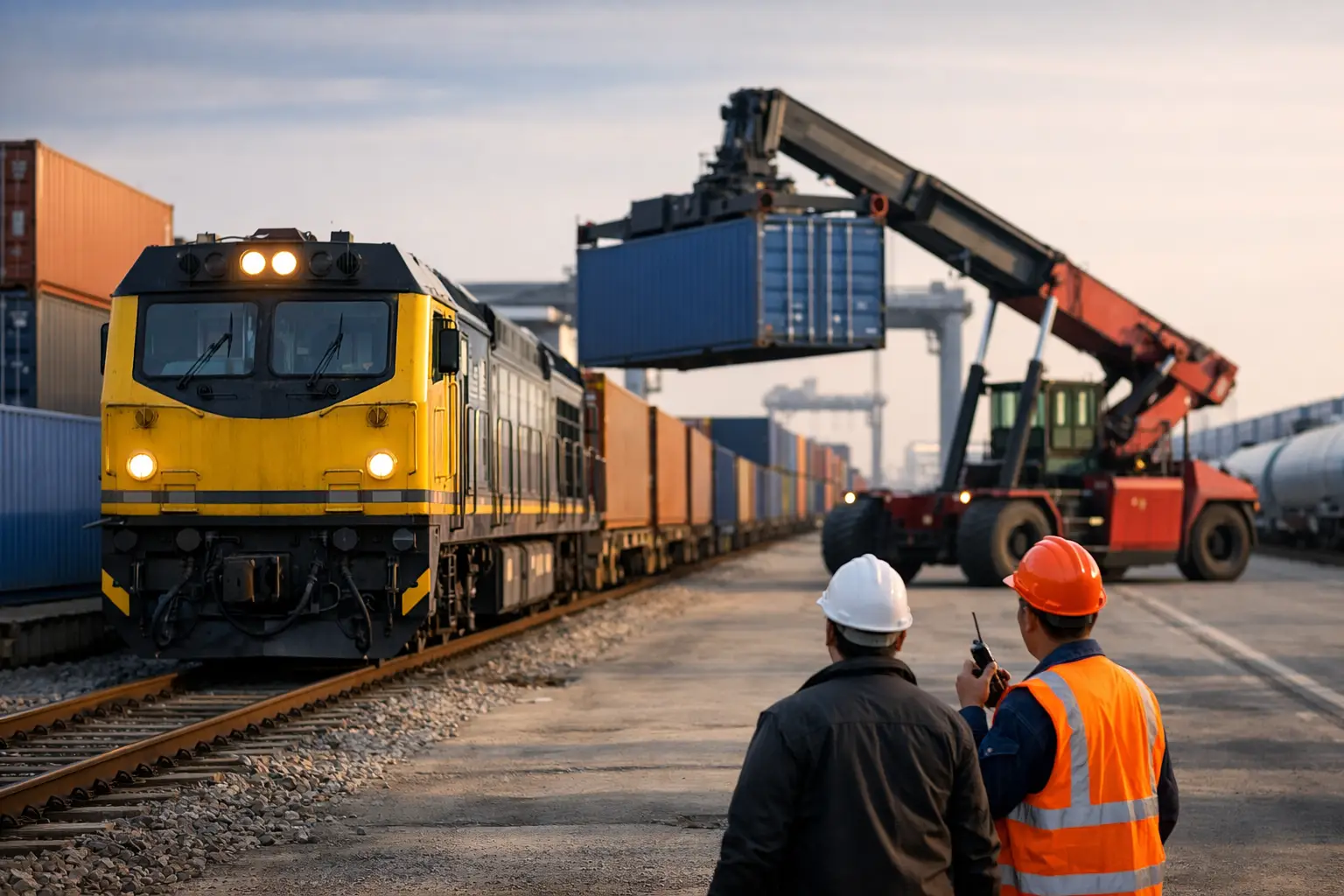
A railcar stopped at the wrong spot can delay a load, block an internal crossing and turn a planned operation into a chain of waits. Rail switching is the set of moves that makes it possible to classify, spot, couple, uncouple and pull railcars within a terminal, plant or industrial yard. When well executed, it stops being a support task and becomes a direct lever for capacity, safety and meeting logistics commitments.
For operations management, the goal is not simply to move more railcars. It is to ensure that each unit reaches the dock, unloading area, inspection point or interchange track at the scheduled time, without compromising people’s safety, cargo integrity or infrastructure availability.
What Defines Efficient Rail Switching
A terminal’s productivity does not depend solely on the number of tracks or how often the rail operator arrives. It depends on how internal movement is managed between receiving, classification, loading or unloading, and shipping. Poorly designed switching creates idle time, unnecessary travel, improvised priority changes and prolonged occupancy of critical tracks.
An efficient operation starts with a specific question: what moves must be made to meet the daily schedule with the fewest movements, conflicts and risks? The answer changes by industry. A steel plant may prioritize continuous supply to production; an automotive terminal needs precise loading sequences; a bulk facility must coordinate spotting with its unloading and cleaning systems.
The design must consider four variables that work together:
- The configuration of tracks, crossovers, turnouts, grades and loading areas.
- Daily volume and variability of railcars by type of commodity.
- The capacity of the motive power equipment and the availability of qualified personnel.
- Safety, access and maintenance restrictions, and coexistence with internal traffic.
There is no universal solution. A terminal with few consists and short runs can work with a different strategy than a plant with several loading areas, limited interchange windows and continuous operations. The right approach is the one that reduces the total cost of the operation without shifting problems to safety, maintenance or customer service.
Equipment, Track and Operations: A Single System
Rail switching is often analyzed as an equipment decision. However, a high-capacity railcar mover does not make up for track with poor geometry, worn turnouts or operating areas without room for safe moves. Likewise, properly built infrastructure loses performance if the equipment is not suited to the load, curve radius, grade or required pace of work.
Choosing the Right Motive Power Equipment
The choice between a locomotive, a railcar mover or another traction solution should be based on the actual operating profile. What matters is the required tractive effort, the number and weight of railcars, cycle frequency, adhesion conditions and the need to travel through areas shared with road vehicles and plant activity.
Railcar movers offer a clear advantage at industrial terminals that need flexibility, operational visibility and quick response. Their usefulness increases when moves are frequent, distances are short and the equipment must fit into a demanding industrial environment. Even so, sizing must be technical: oversizing raises investment and operating costs; undersizing limits capacity precisely when production demands more agility.
Infrastructure Shapes Every Move
Switching capacity is built from the track layout. Usable track lengths determine how many railcars can be received or classified without blocking access. Crossovers make it possible to release a consist without additional moves. Turnouts, signaling, bumpers and drainage directly affect safety and availability.
Track rehabilitation can offer more value than an expansion if it eliminates constraints that force moves to be repeated. Before investing, it is worth reviewing the condition of the rail, ties, fasteners, ballast, turnouts and leveling. Switching imposes repetitive loads and does not tolerate well the defects that go unnoticed in a superficial inspection.
Planning Switching from the Loading Schedule
Scheduling should begin before railcars enter the facility. Knowing the expected consist, railcar type, internal destination and interchange window makes it possible to sequence moves sensibly. The yard should not be used as a holding area without rules, but as an asset with limited capacity that requires disciplined allocation.
A useful daily plan defines the sequence for receiving, classification, spotting at service points and preparation for departure. It also accounts for contingencies: an unloading that runs long, a turnout issue, a railcar unfit for loading or a change in production priority. The difference between a controlled interruption and an unproductive day usually lies in the ability to replan without losing control of occupied tracks.
Communication among logistics, production, maintenance and the switching supervisor must be operational, not bureaucratic. If production changes the order of consumption without timely notice, the terminal may have railcars correctly spotted for a plan that no longer exists. A brief coordination meeting each shift, backed by up-to-date information, prevents much of this friction.
Safety: The Non-Negotiable Condition
At an industrial terminal, rail switching shares space with pedestrians, forklifts, trucks, loading machinery and maintenance operations. Risk is not controlled by operator experience alone. It requires clear procedures, defined zones, visible signage, reliable communications and disciplined execution.
Instructions must establish who authorizes each move, how an occupied track is protected, what checks are performed before coupling or uncoupling and how the presence of personnel in a danger zone is managed. They must also cover securing railcars, correct use of wheel chocks, pre-move inspections and the response to weather conditions or reduced visibility.
Training is especially important when new equipment is introduced or the terminal’s configuration changes. Personnel need to understand not only how to operate a machine, but why a certain sequence protects a crossing, prevents a collision or preserves a loading area. Safety matures when the procedure becomes part of the normal work rhythm and is not perceived as an interruption.
Measuring to Correct Before Losing Capacity
What is not measured ends up being managed by perception. To evaluate a switching operation, it is worth tracking simple but meaningful indicators: time from arrival to spotting, number of moves per railcar, track occupancy, compliance with interchange windows, equipment downtime and safety incidents.
The number of moves per railcar is a particularly revealing indicator. If it increases without growth in volume or cargo complexity, it may point to poor classification, lack of capacity on support tracks or poorly coordinated priority changes. The solution is not always to acquire more equipment: sometimes it lies in redesigning the sequence, restoring a crossover or adjusting loading schedules.
Investment Decisions with a Life-Cycle Perspective
Purchasing equipment or expanding a terminal should be evaluated by its impact on the entire operation. The initial price is relevant, but it does not sum up the decision. It is necessary to assess spare parts availability, maintenance capability, training, technical support, fuel consumption, ease of operation and compatibility with existing infrastructure.
The usage model also matters. Some companies need an owned asset to ensure permanent availability; others can benefit from rental, assisted operation or contracted maintenance arrangements when demand is seasonal or volume is still growing. The decision depends on how critical switching is and on the real tolerance for an operational shutdown.
At Track Speq, the evaluation is approached as a complete system: infrastructure, switching equipment, materials, maintenance and technical support. This perspective prevents an isolated decision from creating new constraints elsewhere in the terminal.
Turning Switching into an Operational Advantage
A competitive rail terminal is not the one with the most tracks or the most powerful equipment. It is the one that can receive, move and ship railcars with predictability, safety and disciplined use of its resources. To achieve this, track engineering, the production schedule, motive power equipment and field procedures must all follow the same plan.
Reviewing rail switching with real operating data usually reveals concrete opportunities: moves that can be eliminated, tracks that need rehabilitation, equipment that needs a different maintenance regime or purchasing decisions that deserve a more precise specification. That is where an operation stops reacting to railcars and starts controlling its logistics capacity.
