
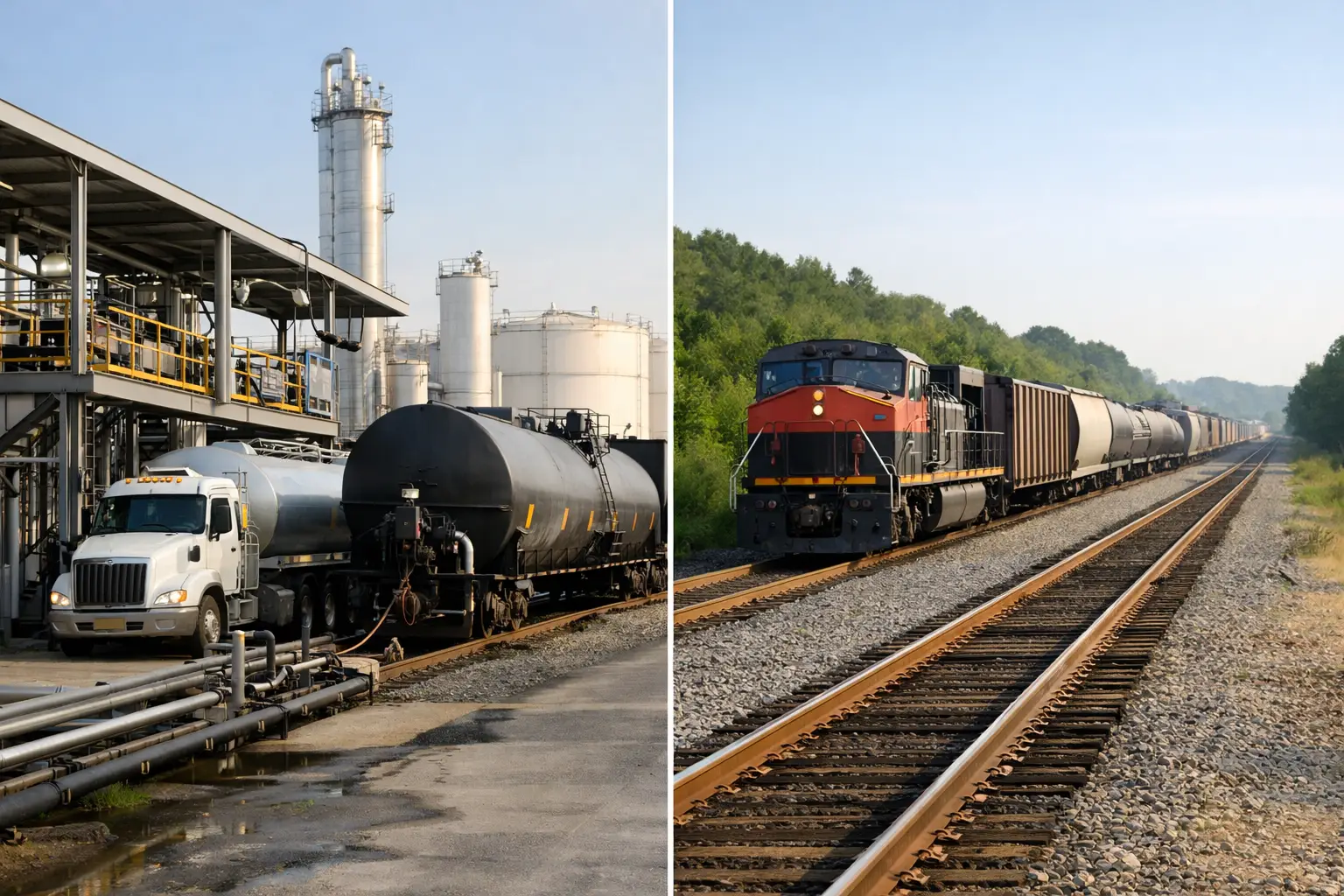
The decision between a transload terminal or private spur is not settled just by comparing meters of track or initial investment. It defines how goods will enter and leave a plant, how much control the company will have over its switching, and how far its operation can grow without creating rail bottlenecks.
For a director of operations, logistics, or industrial expansion, the central question is different: which configuration best protects supply continuity, reduces total cost per ton, and meets safety, capacity, and regulatory requirements? The answer depends on cargo flow, location, the connection to the network, and the operating model the company intends to sustain over the coming years.
What changes between a transload terminal and a private spur
A transload terminal is a facility designed to receive rail cargo and transfer it to another mode of transportation, to storage, or to an industrial process. It can handle containers, bulk materials, steel products, automotive cargo, construction materials, liquids, or goods with special requirements. Its value lies in concentrating equipment, loading and unloading areas, truck access, weighing, storage, and operating procedures at a controlled point.
A private spur, also called an industrial lead or private industrial track depending on the market, is a rail connection that links the main network or an interchange track to a company’s facilities. It allows railcars to arrive directly at the plant, the warehouse, or the operating yard. It does not necessarily replace a terminal: it can be the rail access that feeds an internal terminal or a specific loading area.
The practical difference is clear. The terminal handles the handling and transfer of goods; the private spur handles rail access to the property and control of the rail last mile. In complex operations, both types of infrastructure usually work together.
When a transload terminal makes sense
A terminal is appropriate when the company needs to consolidate, deconsolidate, or redistribute cargo among rail, truck, warehouse, and production. It is an especially valuable solution for logistics operators, industrial parks, materials distributors, importers, and companies whose cargo goes to multiple final destinations.
It also makes sense when rail volume does not yet justify an exclusive direct connection to each plant. Sharing a terminal can reduce initial investment and speed up entry into rail, as long as capacity, schedules, and service conditions are well defined. The capital savings can be significant, but they come at the cost of less operational autonomy.
In a bulk terminal, for example, the design must account for unloading, hoppers, conveyor belts, silos, dust control, drainage, and safe vehicle circulation. In a steel products operation, the priority may be storage areas, cranes, securing equipment, and truck turning radii. The infrastructure must respond to the actual cargo, not to a generic yard layout.
The risk of oversized or undersized infrastructure
An oversized terminal ties up capital in tracks, equipment, and surfaces that generate no return. An undersized facility, on the other hand, causes railcar delays, additional movements, track occupancy, and exposure to penalties or supply disruptions.
That is why sizing must be based on operating data: railcars per week, annual tonnage, seasonality, unloading time, available hours, target inventory, number of truck destinations, and growth forecast. The rail design has to handle peaks, not just the monthly average.
When a private spur delivers greater value
A private spur becomes more relevant when rail is critical for supplying a plant or shipping out production on a recurring basis. In sectors such as steel, automotive, cement, food, energy, industrial gases, or hydrocarbons, receiving railcars on the company’s own premises can reduce handling, improve traceability, and avoid dependence on third-party operating windows.
The main benefit is control. The company can design its yard around its own receiving, loading, unloading, classification, and storage rhythms. It can separate goods zones, schedule switching outside peak internal activity hours, and establish safety protocols tailored to its processes.
However, a spur is not just a track that reaches the property. It requires studying the connection point, geometry, grades, curve radii, usable siding length, drainage, soil bearing capacity, and compatibility with locomotives or switching equipment. A seemingly minor decision, such as leaving a track too short for the planned consist, can force split movements for the entire life of the facility.
Switching determines real productivity
The ability to move railcars within a plant is as important as the connection to the network. If the facility depends on an outside locomotive with limited availability, the unloading schedule may be constrained by factors outside the industrial operation.
Railcar movers make it possible to handle last-mile switching with greater flexibility in many industrial yards. The choice among a locomotive, a railcar mover, or a contracted service depends on the weight of the cuts, the frequency of movements, the grade, the coupler type, the work environment, and the required level of availability. There is no universally correct piece of equipment: there is the right equipment for a precisely defined operation.
Factors that should drive the investment decision
Choosing among a transload terminal, a private spur, or a hybrid model should go through a complete technical and economic evaluation. Construction cost is relevant, but it represents only part of the total cost of ownership.
First, it is advisable to analyze volume stability. A plant with constant, predictable rail flows can more easily justify its own connection. If volumes are variable, seasonal, or dependent on short-term contracts, a shared or modular terminal can limit financial exposure.
Next, the complete logistics cost must be evaluated. This includes rail freight, transloads, trucking, inventory, handling, equipment rental or purchase, track maintenance, insurance, personnel, waiting times, and possible demurrage charges for idle railcars. Eliminating a truck leg may look attractive, but it will not make up for poorly utilized infrastructure.
Land availability also shapes the decision. A spur needs space for the connection, usable track length, safety zones, access points, and, in many cases, future expansion. Building right up to the property line usually makes every later modification more expensive.
Finally, safety and regulatory compliance must be integrated from the start. Authorizations, the rail infrastructure manager’s requirements, hazardous materials regulations, environmental conditions, and internal operating rules cannot be treated as formalities after design. A project that does not address these requirements from the basic engineering stage may suffer delays, redesigns, and avoidable costs.
Designing to operate, maintain, and grow
Profitable rail infrastructure is infrastructure that can operate safely every day, be maintained without stopping the plant, and be expanded without redoing critical elements. This requires coordinating civil engineering, track, drainage, signaling, power, access, loading and unloading equipment, and switching procedures.
Maintenance deserves particular attention. Track geometry, turnouts, hardware, ballast, internal grade crossings, and signage directly influence operational availability. Postponing preventive maintenance may seem like a cost-saving decision, but it increases the risk of speed restrictions, derailments, railcar damage, and unplanned shutdowns.
Track Speq approaches these types of projects from a comprehensive perspective: design, permits, construction, equipment, maintenance, and operations support. For the industrial client, centralizing these capabilities reduces fragmentation among suppliers and makes it easier for each infrastructure decision to respond to a specific operational need.
The right decision is not always a single one
A transload terminal offers flexibility to consolidate cargo and serve multiple destinations. A private spur offers control, direct access, and a growth platform for recurring rail operations. The hybrid model can be the most efficient when a company needs its own access to the network but also needs to transfer part of its cargo to truck or manage inventory in a specialized yard.
The best decision starts by modeling the future operation with real figures, not by choosing an off-the-shelf solution. When infrastructure is designed around the flow of goods, switching, and plant continuity, rail stops being a source of uncertainty and becomes a sustained operational advantage.
