
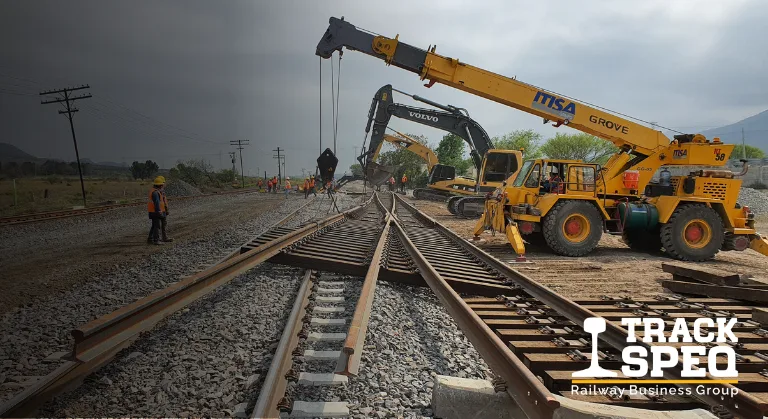
The first time a railway project falls behind for lack of equipment, the lesson is almost never recorded as “we were missing a ballast regulator” or “the tamper didn’t arrive on time.” It is recorded as a cost overrun, a contractual penalty or a maintenance window that closed without the yard being left operational. Railway machinery rarely appears in a project’s financial report, but it is almost always behind the variance between the planned budget and actual spending.
For an operations director, infrastructure director or supply chain lead evaluating a track project (whether building a new spur, expanding an industrial yard or running an annual maintenance program), the relevant question is not what machine exists on the market. It is which machine is involved at each stage of the project, what happens if it is not available at the right time, and which acquisition model (purchase, rental or a service agreement with a full-service supplier) best protects the budget and the schedule.
That is the question this article answers. It is not a heavy equipment catalog or a list of technical specifications for an operator who already knows how to run a tamper. It is about understanding railway machinery as a business decision variable: how critical its availability is, what risk its absence represents and what real difference there is between hiring a supplier with its own fleet and relying on one-off subcontracting every time a section of track requires it.
Track Speq operates in Mexico and Latin America on the four fronts that connect this discussion: track design and engineering, construction and maintenance of railway infrastructure, representation of Shuttlewagon for industrial switching, and its own fleet of track construction and maintenance machinery. That position (as a full-service supplier and not an intermediary) is what makes it possible to speak precisely about what actually happens when the right machinery arrives late, or doesn’t arrive at all.
This article reviews railway machinery at two different points in the track life cycle (construction and maintenance), the three acquisition models usually evaluated in an industrial project (purchase, rental and a service agreement with a full-service supplier), the cost that is almost never accounted for when machinery is not available, and the criteria that make it possible to evaluate a supplier with a minimum of technical rigor. The goal is not for the reader to finish knowing how to operate a tamper, but to finish with sounder criteria for deciding how to ensure that the tamper, or whatever machine is needed, is available when the project needs it.
Railway Machinery as a Business Decision, Not Just a Field Decision
When a track project is planned, the conversation about machinery is often delegated almost entirely to the technical department: track engineering defines specifications, the site superintendent coordinates equipment, and management only hears about it when there is a delay to explain. That pattern has a cost that is rarely quantified in time.
Railway machinery (ballast regulators, tampers, railway cranes, telehandlers, backhoes adapted for track work) is not an interchangeable input the way a minor tool might be. Each machine serves a specific function within the track geometry, the gauge (the standard distance between rails) and the construction sequence. Replacing a ballast regulator with manual labor, for example, is not a lower-cost alternative: it is a decision that multiplies execution time and compromises the uniformity of the ballast profile, which later translates into track geometry out of tolerance and premature corrective maintenance.
From an executive perspective, railway machinery should be evaluated with the same logic as any other critical operating asset: how available it is, how specialized the learning curve is for whoever operates it, what the replacement cost is if it fails in the field and how exposed the project is if the supplier providing it has no local technical support. In industrial railway projects (automotive terminals, steel plants, bulk or liquid transloading yards), the work window is usually short and negotiated with the end customer or the railroad concessionaire. Equipment that doesn’t arrive on time doesn’t just delay the work: it can mean losing the operating window and having to renegotiate it, with the commercial cost that entails.
That is why the selection of railway machinery should be part of the risk assessment of any track infrastructure project, at the same level as material availability or the validity of permits. It is not exclusively an operational issue: it is a variable that conditions the schedule, the budget and, ultimately, the commercial relationship with the customer or the concessionaire.
The case of an agricultural bulk terminal illustrates this point well. A track expansion project inside the terminal, planned for the period of lowest activity between harvests, depends on the construction machinery being available in exactly that period: if the supplier cannot mobilize the tamper or ballast regulator in time, the window closes and the project has to wait for the next agricultural cycle, with months of difference in the return on investment. The same happens, on a different time scale, in a chemical or energy plant where track maintenance can only be performed during a scheduled plant shutdown: the machinery has to be ready from the first day of the window, not arrive halfway through it.
New Track Construction: Which Machines Are Involved and What Each Stage Means
Construction of an industrial railway track (whether a spur connecting to a plant, a yard siding or a terminal expansion) follows a relatively standardized construction sequence, and each stage depends on different machinery. Understanding this sequence makes it possible to anticipate at what point in the project equipment availability becomes critical, instead of discovering it once it has already caused a stoppage.
Earthwork Preparation and Tie Placement
Before there is track, there is earthwork: the work of leveling, compacting and preparing the subgrade on which the ballast is later laid. This stage involves backhoes and telehandlers adapted for railway work, capable of operating both on open ground and, in later phases, on track already laid (what is known in railway operations as HiRail equipment, meaning vehicles that can travel on both road and rail). These machines are responsible for moving material, preparing the base and positioning ties (the transverse elements, traditionally made of wood or concrete and increasingly of steel, that hold the rail and transmit the load to the ballast).
A common mistake in this phase is underestimating earthwork preparation time because it “can’t be seen” in the visual progress of the project: there is no rail laid yet. However, poor compaction at this stage translates, months later, into differential settlement that causes loss of track geometry and the need for early corrective maintenance. Earthwork machinery is not a minor project cost: it is what determines the service life of everything built on top of it.
In projects inside operating plants (an automotive terminal expanding its receiving yard, for example), this stage has an additional complication: earthwork machinery must coexist with the plant’s normal operations, which requires coordinating schedules, access and safety protocols with the customer. A telehandler or backhoe that is not designed to operate under those space and time constraints becomes an additional bottleneck, not a solution.
Rail Laying and Alignment
Once the ties are in place, the track requires rail to be laid, fastened and geometrically aligned to ensure that gauge, cross level (superelevation) and horizontal alignment comply with applicable regulations (in Mexico, generally referenced to AREMA standards: the American Railway Engineering and Maintenance-of-Way Association, which publishes the technical reference manual for track design and maintenance in North America). At this stage, railway cranes come into play for rail handling, along with construction tampers, specialized equipment for lifting, aligning and compacting ballast under the tie to set the final track geometry.
The tamper is probably the machine least understood by those who don’t work in the field and the one with the greatest impact on the final quality of the track. Its function (slightly lifting the rail-and-tie assembly, inserting and compacting ballast underneath and leveling) is what determines whether a track will operate with an adequate ride quality or will require constant corrective adjustments from the first year of operation. A project that cuts this stage short to save construction time ends up paying for that saving, with interest, in the first maintenance program.
The rail laying and tamping sequence also determines the speed at which the track can operate once delivered. A track built without the full tamping and geometric verification step can go into service, but it typically does so under a speed restriction until the ballast stabilizes with initial car traffic, a period that a well-planned schedule accounts for and that an optimistic schedule usually ignores until the customer asks why the cars are moving more slowly than expected in the first month of operation.
Maintenance of Track in Service: Machines That Sustain Continuity
Building the track is only the first stretch of the asset’s life cycle. Once the track enters service, railway machinery changes function: it is no longer about building geometry but about preserving it against the wear caused by car traffic, environmental exposure and progressive ballast compaction.
Scheduled Preventive Maintenance
Preventive track maintenance depends on two families of equipment that work in a complementary way: the ballast regulator and the maintenance tamper. The ballast regulator redistributes material along the track profile, correcting the ballast section and shoulder displaced by passing cars and by weather. The maintenance tamper, for its part, corrects the geometry lost through natural settlement: surface, alignment and superelevation on curves.
A well-designed preventive maintenance program, based on periodic inspections and criticality criteria, makes it possible to schedule these interventions before the loss of geometry translates into speed restrictions or derailment risk. For an operations executive, the value of this type of maintenance lies not in the machine itself but in what it prevents: unplanned stoppages, reduced operating speeds imposed by track condition and the cost (almost always higher) of emergency corrective maintenance.
In an intermodal logistics center, where multiple users share the same track infrastructure, preventive maintenance also has a contractual dimension: track availability is usually committed to several customers at the same time, and a ballast regulator or maintenance tamper intervention has to be scheduled in windows that do not interrupt any of their receiving and shipping commitments. This requires the maintenance supplier to have not only the machine but also the planning capability to fit it into an already crowded operating calendar.
Emergency Corrective Maintenance
When the track develops a failure that compromises operational continuity (a localized sinkhole, a rail joint with critical wear, a section with severe loss of gauge), maintenance stops being preventive and becomes emergency corrective maintenance. This is where the real availability of railway machinery, and not just its existence in a catalog, becomes decisive.
A supplier that subcontracts equipment every time an emergency arises faces a structural problem: the availability of that machinery does not depend on it, but on the third-tier supplier it turns to, and that supplier has its own commitments to other customers. By contrast, a supplier with its own fleet and local response capability can mobilize equipment in hours, not days, because it is not negotiating availability: it is managing its own asset. This difference, which seems operational, has a direct financial impact: every hour of a yard stopped by an inoperable track has a measurable cost in production, in inbound and outbound material logistics and in contractual penalties if the operation depends on commitments to external customers.
Speed of response in an emergency also depends on the supplier having an inventory of critical spare parts for its own machinery. A tamper or ballast regulator that is out of service for lack of a specific spare part stops being an available asset, even if it is physically sitting in the supplier’s yard. That is why evaluating a corrective maintenance supplier should not be limited to asking what machines it has, but how prepared it is to keep those machines running under pressure.
Rent, Buy or Service Agreement: How to Decide Based on the Project Profile
The decision on how to acquire railway machinery (buying it, renting it per project or contracting it as part of a maintenance agreement with a full-service supplier) has no single answer. It depends on the project profile, the expected frequency of use and the organization’s risk appetite regarding CAPEX (capital investment recorded as a fixed asset) versus OPEX (recurring operating expense recorded in the period in which it is incurred).
Buying machinery makes sense when the organization has a sustained track construction or maintenance program, with enough volume to justify the investment, maintenance of its own fleet and training of operating personnel. It is a CAPEX decision that ties up capital but, over the long term, reduces the unit cost of each intervention and eliminates dependence on third parties for recurring projects.
Renting is the most reasonable option for one-off projects: building a new spur, a specific yard expansion or a corrective maintenance program that does not recur often enough to justify a purchase. Here the financial analysis favors OPEX: you pay for actual use of the equipment, without the maintenance, storage or depreciation cost of an asset that would later be underused.
The third option, and the one that often offers the best balance for industrial operations with recurring but not permanent needs, is to contract a maintenance agreement with a full-service supplier that already has its own fleet. Under this arrangement, the organization neither buys nor rents machine by machine: it contracts the guarantee that, when the maintenance program requires it or when an emergency arises, the supplier will mobilize the right equipment with the necessary technical support and spare parts. This model shifts the risk of machinery availability from the client to the supplier, which has the scale and specialization to manage it.
None of the three options is categorically superior. The question that should guide the decision is one of frequency and risk: how regularly will this machinery be needed over the next three to five years? How critical is response time if the need arises without warning? How exposed is the operation to a single outside supplier, without its own fleet, not having the equipment available when needed?
The following table summarizes the general criteria usually applied when evaluating industrial projects, without replacing a specific financial analysis for each case:
| Acquisition model | When it usually makes sense | Main risk to watch |
|---|---|---|
| Purchasing machinery | Sustained construction or maintenance program, with recurring volume that justifies tying up capital | Underuse of the asset and in-house maintenance costs if the volume of work decreases |
| Rental per project | One-off, non-recurring intervention with a defined date and scope | Availability of the equipment on the market on the exact date the project requires |
| Agreement with a full-service supplier | Recurring but variable need, without enough volume to justify an in-house fleet | Whether the chosen supplier actually has its own fleet and does not subcontract in a cascade |
Regardless of the model chosen, it is advisable to document the analysis behind the decision: what volume of use was projected, what alternatives were compared and what risk was consciously accepted. That record is what makes it possible, a year later, to assess whether the decision was right or whether the project profile changed enough to revisit it.
What Happens When Machinery Is Not Available: The Hidden Cost of Discontinuity
The cost of not having timely access to railway machinery rarely appears as an explicit line in a project budget. It appears scattered, hidden in other categories: in the cost of a contractual schedule extension, in the premium for subcontracting last-minute equipment at emergency rates, in lost production at a plant that depends on the rail yard being operational to receive or ship material, or in the strain on the commercial relationship with a customer who expected a delivery date and didn’t get it.
This hidden cost has a recognizable pattern in industrial railway operations. A yard that cannot receive cars because a section of track has a speed restriction that was not repaired in time creates a bottleneck that propagates backward through the entire logistics chain: raw material arrival, production and finished-product shipping. In sectors such as automotive, steel or petrochemicals, where rail operations are a direct extension of the production line, one day of an inoperable yard can represent an economic impact far greater than the cost of having had the right machinery available from the start.
Discontinuity also has a reputational cost that executives tend to underestimate at the planning stage. A railway infrastructure supplier that misses deadlines for lack of equipment doesn’t just deliver late: it sends a signal about its execution capability that affects trust for future projects, especially in a sector where the relationship between client and infrastructure supplier usually extends for years, through construction, maintenance and supply contracts that are renewed on a recurring basis.
In an energy plant with rail receipt of fuel or critical inputs, this risk becomes even more sensitive: the track is not a logistics convenience, it is the only supply channel for a process that cannot stop without a major cost. When the availability of maintenance machinery determines the ability to react to a track failure in that context, the conversation is no longer about productivity and becomes a conversation about business continuity.
Anticipating this risk does not depend on contracting more machinery than necessary “just in case.” It depends on choosing, from the project planning stage, a supplier whose structure (its own fleet, response capability and local technical support) reduces the likelihood that the availability of a specific machine becomes the breaking point for the entire schedule.
How to Evaluate a Railway Machinery Supplier
Evaluating a railway machinery supplier requires going beyond comparing rental rates or equipment sale prices. The question an executive should ask before signing a construction, maintenance or machinery supply contract is whether that supplier can sustain its availability commitment when conditions are not ideal, which is precisely when it is needed most.
A competitive quote under normal conditions says nothing about what happens when the project gets complicated: when site access changes, when the customer moves the operating window or when two of the same supplier’s projects coincide in time and compete for the same machine. That is why due diligence on a railway machinery supplier should go beyond the purchasing department and reach the table where the risk of the entire project is evaluated.
Some technical and commercial criteria worth reviewing explicitly:
- Fleet ownership. A supplier with its own machinery, and not exclusively subcontracted equipment, has direct control over the availability, maintenance and calibration of its equipment. This reduces dependence on third parties at critical moments.
- Local technical support. The geographic proximity of technical support and original spare parts determines response time when a failure occurs. A supplier with offices or operating centers in several regions of the country reduces mobilization time compared with one that operates centrally.
- Certifications and regulatory compliance. Certifications such as ISO 9001, or recognition from railroad concessionaires such as CPKC or Ferromex, are not a decorative seal: they reflect that the supplier has been evaluated against quality and operational safety criteria that also protect the client.
- Track record on comparable projects. Prior experience in sectors with similar requirements (automotive, steel, bulk or liquid terminals, high-turnover industrial yards) is a more reliable indicator than a generic list of services offered.
- Service integration. A supplier that combines machinery, materials, engineering and specialized labor under a single commercial relationship reduces the points of friction and diffuse responsibility that appear when a project depends on multiple fragmented suppliers.
None of these criteria replaces a technical visit to the supplier or a direct reference check with previous customers. But they do provide an evaluation framework that goes beyond the hourly rental price, which is often the only criterion compared in a quick quote.
It is worth pointing out that the cheapest supplier in the short term is not always the one that reduces the total cost of the project. When the comparison includes the risk of an uncovered stoppage, a schedule extension or a contractual penalty, the rate difference between two suppliers usually becomes marginal compared with the cost of the right machinery not showing up on the day it is needed.
Track Speq: Full Execution Capability in Railway Machinery
Track Speq operates its own fleet of track construction and maintenance machinery, including surfacing and tamping equipment (production tampers and maintenance tampers), ballast regulators, railway cranes, telehandlers and backhoes adapted for track work. This fleet adds to its exclusive representation of Shuttlewagon in Mexico and Latin America for industrial switching, and to the design, engineering and permitting capabilities that make up the company’s infrastructure division.
That combination (construction machinery, maintenance machinery, switching equipment and engineering capability) is what allows Track Speq to support a railway project from start to finish, without the client having to separately coordinate a construction contractor, a machinery rental supplier and a different company for subsequent maintenance. Track Speq has carried out industrial railway infrastructure construction, installation and maintenance projects for companies such as BMW, Mazda, Metalsa, DeAcero, Nissan, Alstom, Steel Technologies and IRASA, in addition to active maintenance agreements with customers in the automotive, steel and industrial logistics sectors.
This track record does not eliminate the need for each organization to evaluate its own project profile and decide, with its own judgment, whether the best option is to buy, rent or contract a maintenance agreement. But it does offer a point of reference: the availability of railway machinery should not be a variable a project discovers as a problem halfway through construction. It should be part of the supplier evaluation from the first day of planning.
Operating its own fleet also changes how preventive maintenance of the machinery itself is planned. Track Speq schedules maintenance of its own equipment with the same criticality logic it recommends applying to its customers’ track infrastructure: periodic inspection, availability criteria and critical spare parts in stock, so that the machine a project needs does not also depend on whether that machine happens to be working at the exact moment it is required.
Evaluate Machinery Before It Becomes the Bottleneck
Railway machinery is not an execution detail to be resolved as the need arises. It is a structural variable that determines whether a track construction project is delivered on the committed schedule, whether a maintenance program manages to sustain the operational continuity of an industrial yard and whether the chosen supplier can respond when conditions are not as planned.
Evaluating in advance which equipment is involved at each stage of the project, which acquisition model makes sense based on the usage profile and how solid the supplier’s real response capability is, is a decision that belongs to the executive table as much as to field technical coordination.
At Track Speq, we support the evaluation of railway track construction and maintenance projects with our own machinery, specialized engineering and local technical support. If your organization is about to start a railway infrastructure project or needs to review machinery availability for its maintenance program, reach out to our technical team.
en.trackspeq.com · ventas@trackspeq.com · +52 81 1600 5603
