
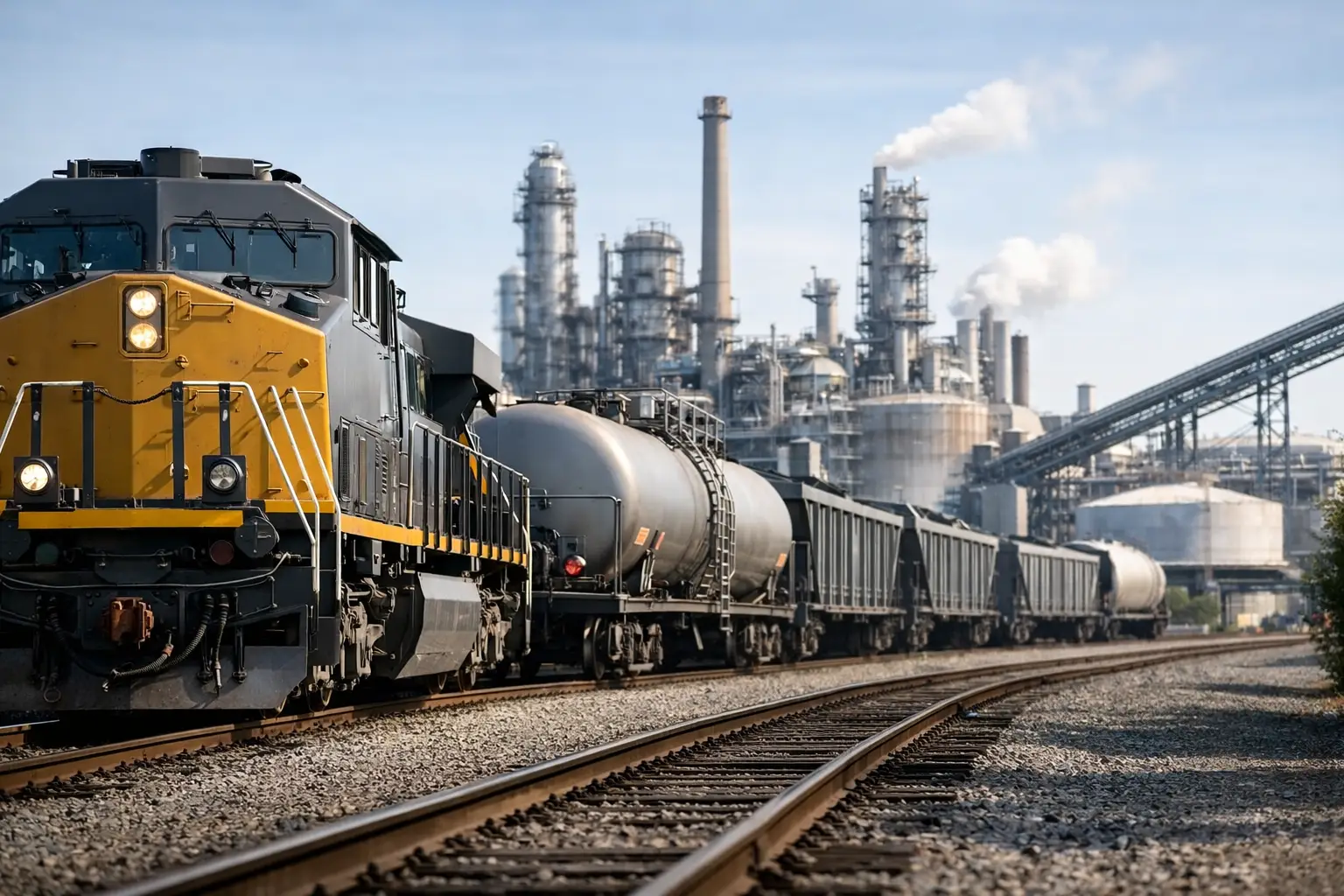
A plant can have its own track and still lose capacity every time it has to move a railcar. The problem rarely lies in a single component: it usually stems from a combination of slow switching moves, poorly sized equipment, hardware with no condition monitoring and infrastructure that does not match the actual volume of the operation. That is why railway equipment for industrial plants should be evaluated as part of an operating system, not as an isolated purchase.
For an operations director or engineering manager, the decision affects shipping continuity, personnel safety, availability of docks and silos, compliance with applicable requirements and the total cost of the terminal. Choosing well means aligning equipment with the load, the track geometry, switching frequencies and the plant’s growth plan.
What Railway Equipment for Industrial Plants Includes
The equipment of an industrial rail facility brings together the elements that make it possible to receive, position, inspect, load, unload and ship railcars in a controlled way. It includes track materials, turnouts, hardware, signage, specialized tools, protective devices and switching machinery.
Its relevance changes depending on the process. An automotive terminal needs precision in car spotting and strict flow management. A steel facility may prioritize wear resistance, load capacity and continuous availability. In food, fertilizers, dry bulk or hydrocarbons, switching safety and coordination with loading and unloading points directly determine performance.
The purchase should not start with the catalog. It should start with operational questions: how many cars are moved per day, in what time windows, what grades exist, where bottlenecks occur and what happens if a piece of equipment goes out of service. With these answers, the specification stops being generic and becomes a solution for the plant.
Track Materials and Hardware: The Foundation That Supports the Operation
Rail, ties, fasteners, plates, joints, bolts, tie plates and retaining elements work as a system. Replacing only the visible part that shows wear may solve an isolated incident, but it does not necessarily eliminate the cause. The type of traffic, axle load, ground conditions, drainage and geometry determine which materials and configurations are appropriate.
Turnouts require special attention. A switch with deteriorated components, poor adjustment or irregular wear can limit switching moves, lead to speed restrictions and increase operational risk. In addition to selecting compatible materials, the plant needs traceability of interventions and clear criteria for inspection, lubrication, adjustment and replacement.
Signage and Protection in Switching Areas
In an industrial terminal, visibility and operational communication are not minor details. Railway signage, bumping posts, wheel chocks, position indicators and boundary markers must respond to actual working conditions: personnel traffic, auxiliary machinery, night operations, dust, rain or areas with reduced visibility.
Signage must be integrated with switching procedures. Placing a sign without defining who interprets it, when it is inspected or what action it requires creates a false sense of control. Effectiveness comes when the equipment, personnel training and operating discipline all follow the same safety criterion.
Switching Equipment Determines Real Capacity
A road locomotive is not always the most efficient option for moving cars within a plant. Windows with the railroad concessionaire, crew availability, the need for repetitive moves and short distances between tracks can justify in-house switching equipment.
Railcar movers make it possible to perform spotting moves with high tractive capacity and agile response in industrial environments. Their usefulness is especially clear when the plant needs to load or unload without depending on external schedules, maintain production flow or retrieve cars from hard-to-reach locations.
However, selection depends on specific technical variables: weight to be towed, maximum grade, available adhesion, curve radii, frequency of use, operating space and environmental conditions. Oversizing a piece of equipment ties up capital and can increase maintenance costs; choosing one that is insufficient compromises safety and reduces productivity. The right analysis must also consider spare parts, maintenance, operator training and technical support.
Track Speq provides an integrated approach to this type of decision, combining infrastructure, materials, switching equipment and technical support throughout the operating life of the terminal.
How to Specify Equipment Without Creating a Fragmented Purchase
Fragmentation is one of the most common risks. One supplier provides hardware, another works on the track, a third sells the switching equipment and the plant has to sort out compatibility, warranties and responsibilities on its own. The result is usually more internal coordination, slow responses to failures and an incomplete view of the railway asset.
A solid specification should link each element to the operating objective. Before requesting bids, it is advisable to define at least these four criteria:
- Capacity and frequency: number of cars, tons, daily cycles and expected seasonal peaks.
- Infrastructure condition: track condition, grades, clearances, drainage, curve radii and conflict points.
- Safety and compliance: switching procedures, internal requirements, permits and conditions applicable to the terminal.
- Maintainability: spare parts availability, ease of inspection, response times and required training.
On this basis, proposals can be compared by expected performance and life-cycle cost, not just by initial price. A cheaper part may make sense for a secondary track with occasional use. On a critical freight spur, by contrast, the priority is usually availability, consistency of supply and the ability to replace parts quickly.
Think About the Life Cycle, Not Just Commissioning
The acquisition cost represents only part of the decision. Over the years come inspections, adjustments, replacements, traffic wear, technical assistance and possible expansions. If the chosen equipment lacks specialized support, every incident can translate into downtime, rescheduled switching moves and pressure on production or shipping.
Preventive maintenance makes it possible to anticipate many of these losses. Periodic inspections of fasteners, alignment, turnout condition, safety elements and switching equipment performance help prioritize interventions before an anomaly becomes an interruption. Corrective maintenance will still be necessary, but it should not be the dominant management model.
It is also wise to plan for growth. A plant planning to expand yards, add new products or increase shipments should avoid solutions that force the infrastructure to be rebuilt within a short time. Designing with expansion phases may require a larger initial investment, but it reduces future interference and protects business continuity.
The Decision Point: Productivity with Operational Control
Railway equipment pays off when it allows freight to be moved at the required time, with safety, repeatability and a manageable maintenance structure. It is not about accumulating assets but about eliminating friction between the track, switching and the industrial process.
The best decision starts by observing the operation as it actually works on the ground: where the car waits, which move depends on third parties, which component fails most often and what capacity would be lost in the event of a breakdown. Turning those answers into a complete technical specification is the most direct way to transform the plant’s railway into a sustained operational advantage.
