
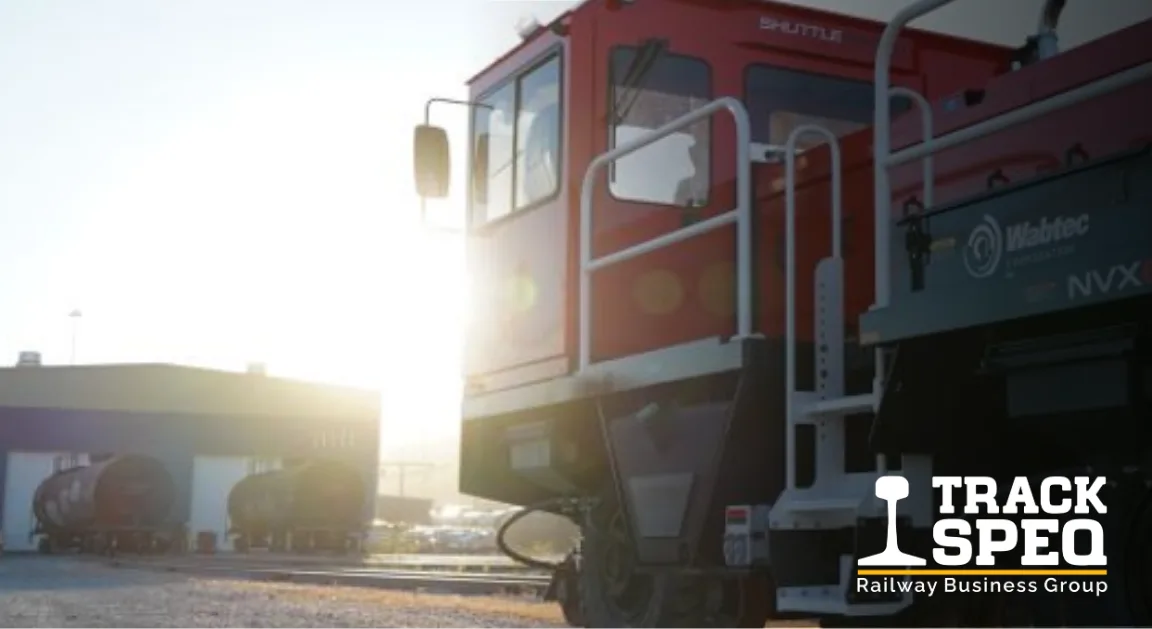
An industrial rail yard does not come to a halt because it lacks track. It comes to a halt because no one can move the cars that are already there. The most common cause is not a derailment or a structural failure: it is the lack of switching capacity at the moment it is needed. When that capacity depends on a third party—a concessionaire’s locomotive, an outside contractor, equipment shared among several plants—the operation takes on a point of exposure that rarely appears on the risk chart, even though it directly affects production, invoicing, and compliance with loading and unloading windows.
The railcar mover—specialized equipment, distinct from a locomotive, designed to move railcars within industrial yards, terminals, and plants without relying on external traction—is often presented to leadership as a decision already settled by the technical team: the model, the brand, the spec sheet. That approach has its place, but it comes too late. Before comparing specifications, leadership needs to answer a different question: what risk is the operation taking on today by not having direct control over its internal switching, and what commitment does it make by bringing in this equipment?
This article is not a technical selection guide or a comparison of models or brands—Track Speq has developed that content elsewhere. It is an evaluation framework aimed at whoever authorizes the spending: what questions to ask before signing, what information to demand from the technical team and the supplier, and what indicators must be established from day one of operation. It applies both to plants evaluating their first railcar mover and to operations that already have one and need to review whether the way they manage it truly protects the continuity it is supposed to guarantee.
Internal switching is a single point of failure that is rarely audited as such
When an operations leadership team builds its risk matrix, it usually covers production machinery, critical raw material suppliers, and utility infrastructure in detail. The internal movement of cars—the switching that connects raw material receiving to the line, or the line to shipping—rarely receives the same level of analysis, even though a yard without available switching capacity stops both inbound and outbound product, no matter how well the rest of the plant performs.
Relying on third parties for this function introduces variables the plant does not directly control: the availability of the concessionaire’s locomotive in the agreed window, the priority that equipment receives over other customers on the same line, the response time to an off-schedule request. None of these variables is necessarily negative—many operations run this way reliably for years—but they represent a level of exposure that leadership must understand and decide on consciously, rather than inherit through administrative inertia.
Consider the case, common in automotive terminals and heavy manufacturing plants, of a production line that receives auto parts or inputs by rail several times a week. If yard switching depends on a third party and that third party prioritizes another customer in the same window, the plant loses more than the time of the switching move: it loses the synchronization of its production line, which in lean manufacturing schemes can translate into hours of downstream downtime. The real cost of dependence does not show up on the switching service invoice; it shows up on the stopped production line, and that cost is almost never correctly attributed to its cause.
The same logic applies, with variations, to a bulk terminal that receives agricultural or mineral raw material by rail to transfer it to processing, or to a chemical plant that depends on strict unloading windows for process safety reasons: in both cases, yard switching is not a support activity—it is the hinge between the external supply chain and internal operations. When that hinge depends on a third party without clear service agreements, leadership is, in effect, outsourcing part of the control over its own production schedule.
The course on management and maintenance of railway infrastructure in industrial yards taught by Track Speq documents this point precisely: track in poor condition or an uncontrolled switching operation creates simultaneous impact on safety (derailment, entrapment, harm to personnel or equipment), on operations (reduced speed, track closure, additional switching moves), on logistics (loading and unloading delays, missed rail windows), on maintenance (urgent repairs, higher consumption of spare parts), and on finances (penalties, lost productivity, unplanned CAPEX—that is, unbudgeted capital expenditure). The right takeaway for leadership is not that a railcar mover solves all of these fronts on its own—it does not—but that switching capacity is one of the variables that multiplies or contains that impact, depending on how directly the operation controls it.
Evaluating the addition of a railcar mover, then, should not start with the equipment’s spec sheet. It should start with a governance question: if the plant lost the ability to move cars within its yard for 48 hours today, what would happen to production, to customer commitments, and to compliance with receiving windows? The answer to that question—not the supplier’s catalog—is what determines whether the investment is justified and how urgent it is.
What a railcar mover is and the role it plays compared to a locomotive
A railcar mover is equipment specifically designed to move railcars within industrial yards, terminals, and plants without having to use a conventional locomotive. It combines pulling power, maneuverability, and precise control, enabling it to perform repetitive switching moves—coupling, moving, uncoupling, repositioning—with greater efficiency, greater safety, and lower operating cost than deploying a locomotive for short-distance internal tasks.
Bimodal operation: the structural difference from a locomotive
Its distinguishing feature compared to a locomotive is bimodal operation: it travels both on the railroad track, riding on steel wheels, and off it, on rubber tires, within the same facility. This on/off-rail capability—on and off the track, in the same unit—allows it to get on and off the track without relying on additional turnouts or personnel to reposition itself, which is especially useful in yards with limited space, tight curves, or multiple industrial spurs.
The difference from a locomotive is not one of superiority but of function. A locomotive is designed for long runs, high speed, and sustained hauling on the open network; a railcar mover is designed for short, repetitive, precision switching within a facility. Track Speq has developed specific content comparing both types of equipment in operational and total-cost detail—repeating that comparison is not the purpose of this article—but leadership should keep one point in mind: the relevant question is not which equipment is better in the abstract, but which one fits the function the plant needs to address within its own yard.
As the exclusive representative of Shuttlewagon in Mexico and Latin America, Track Speq offers the SWX and NVX lines, which cover different levels of tractive effort and pulling capacity, available for both sale and rental, with associated maintenance, training, and spare parts options. This variety matters to leadership not as a purchasing catalog, but as evidence that the decision is not a binary choice between having a railcar mover or not: there are different ways to access the asset—purchase, rental, hybrid arrangements—that fit each plant’s different levels of risk exposure and investment horizons.
The questions leadership should ask before approving the investment
Once it is clear what the equipment is and what function it serves, leadership’s task is not to choose a model, but to structure the questions that will determine whether the investment—under any of the available models—is justified, properly sized, and backed by the right supplier.
Exposure to the risk of not having in-house switching capacity
Before evaluating models, leadership should have a documented answer—not an estimate from memory—to one question: how many hours of operation have been lost in the past twelve months due to a lack of switching availability, whether because of the outside provider, a failure of in-house equipment, or saturation of the assigned window? This figure rarely exists in consolidated form because production, logistics, and maintenance record it differently, when they record it at all. Requesting it—and requiring that it be built if it does not exist—is the first governance exercise that should accompany any decision to invest in switching equipment. Without that data, the decision is made on perception rather than evidence, and the business case is left open to challenge in any subsequent review.
Technical support and supplier continuity
A railcar mover is a heavy-use asset: it operates in repetitive cycles, with constant mechanical demand on the transmission, brakes, and coupling system. Its availability depends not only on the condition of the equipment at the time of purchase, but on the supplier’s ability to sustain genuine spare parts, technical service, and field response over the asset’s entire life cycle, which is measured in years, not months. Leadership must require the supplier to provide verifiable evidence of that capability—not just a sales promise: a service and support center, critical spare parts kits in stock, documented response times, and references from comparable industrial operations where the equipment has been in service for some time. Without local technical support, a railcar mover stops being an operational continuity asset and, over time, becomes an unplanned maintenance liability.
Total cost of ownership versus purchase price
The most common mistake when approving this type of investment is comparing list prices across suppliers without normalizing what each price includes. The real cost of a railcar mover over its service life combines the purchase or rental price, fuel consumption, the preventive maintenance program, the cost of genuine spare parts versus generic parts—with the compatibility and warranty risk the latter entail—the required operator structure, and the equipment’s residual value at the end of its service life or rental contract. Two railcar movers with similar tractive effort can have markedly different total cost structures depending on support availability, drivetrain design, and fuel efficiency. Leadership that approves based solely on purchase price unknowingly shifts the risk of that difference to the operating budget of the following years, where it becomes much harder to trace back to its source.
Sizing: what the technical team must deliver before leadership signs
Leadership does not need to become an expert in railway specification, but it must require that, before signing, the technical team deliver documented sizing rather than a verbal recommendation: maximum weight of the cars to be moved, curve radii and grade of the specific yard, current track condition, and expected switching frequency per shift. That sizing is what makes it possible to verify objectively whether the tractive effort quoted by the supplier matches the plant’s actual operation or was calculated on generic conditions. Track Speq performs this analysis as part of the evaluation prior to any quote, precisely because a properly sized railcar mover avoids two costly scenarios: acquiring insufficient capacity that forces additional switching moves, or paying for capacity the operation never uses.
From capital expenditure to operational continuity: how to read the CAPEX and OPEX of a railcar mover
The decision to buy or rent a railcar mover is resolved, in practice, by comparing two spending structures: upfront capital (CAPEX, the outlay to acquire an asset) versus distributed operating expense (OPEX, the recurring cost of operating and maintaining that asset, or of paying for its use through a rental). Neither option is universally superior; the right one depends on the expected duration of the project, the availability of capital, and the level of certainty the plant has about its switching volume in the medium term.
Purchasing makes sense when the operation is permanent, the switching volume is stable and predictable, and the plant has the internal structure—trained operator, maintenance program, spare parts budget—to sustain the asset over its full service life. Renting, on the other hand, is more suitable when the project has a defined duration, when switching volume is still uncertain, or when the plant prefers to transfer availability and maintenance risk to the supplier through a service arrangement. Track Speq offers both routes to the asset, along with annual maintenance plans, certified training, and spare parts supply, precisely because the right decision varies according to each operation’s profile, and there is no single answer that applies to every plant.
One element leadership should explicitly request—and that is often left out of the sales conversation—is the equipment’s tractive effort, expressed in pounds of tractive force, and not just its horsepower. Horsepower describes how much energy the engine delivers; tractive effort describes how much of that energy is converted into actual pulling capacity on the rail, which is the variable that determines whether the equipment can move the car weight the operation needs to move, under the grade and curvature conditions of the specific yard. Two railcar movers with engines of similar horsepower can have different pulling capacities depending on their transmission design, adhesion system, and axle configuration.
For reference, the Shuttlewagon range that Track Speq represents in Mexico covers a broad span of tractive effort depending on model and configuration: from lighter units geared toward less demanding switching to higher-pulling equipment for high-volume yards or steep grades. Track Speq has commercially positioned its highest-capacity units with a reference tractive effort of 60,000 pounds of force, a figure the company itself associates, in its sales material, with a pulling capacity equivalent to that of a locomotive of approximately 100 tons. This equivalence should be validated with the technical team before publishing the article, since it compares different magnitudes—tractive force versus locomotive weight class—and its validity depends on the specific model and the track conditions under which it is measured.
For leadership, the operational point is not to memorize catalog figures, but to require that the quoted tractive effort be validated against the actual weight of the cars the plant moves, under the specific conditions of its yard—grade, curvature, track condition—and not against a generic brochure figure that may not correspond to the real application.
Telemetry and traceability: what visibility leadership should demand over the asset
A railcar mover operating without electronic traceability puts leadership in the same position as any critical asset without monitoring: it depends on manual reports, the operator’s memory, and occasional audits to know how the equipment is being used. That limitation is no longer acceptable when telemetry solutions designed specifically for this type of machinery exist.
ShuttleTrak, Shuttlewagon’s telemetry platform, makes it possible to monitor the equipment from a single screen, accessible from any computer or device with an internet connection, with no additional installation required in the field. Its core functions directly answer several of the questions leadership should have about the actual use of the asset: real-time GPS tracking, which shows the equipment’s exact location within the facility; geofencing (the virtual delimitation of a geographic area), which generates an automatic alert when the railcar mover leaves its designated operating zone; configurable alarms via text message or email when predefined conditions are met; and electronic reports of actual operating time, which replace manual logs and show precisely how many hours the equipment was actually in use, not just switched on.
For leadership, this information has value beyond day-to-day operational control: it turns the railcar mover into an auditable asset. Operating hours recorded by telemetry are the correct technical basis for scheduling preventive maintenance by actual use—not by a generic calendar—for supporting fleet renewal decisions with data instead of perception, and for answering, with evidence, the availability question that every internal audit eventually raises: how much time was this critical asset available during the period under review, how much time was it out of service, and why.
This availability reading also has a direct effect on the maintenance budget. A preventive maintenance program based on actual operating hours—rather than a fixed calendar that assumes average use—reduces unnecessary interventions on equipment that worked less than expected and anticipates wear on equipment that worked more. For leadership, aligning maintenance with actual use is one of the most concrete ways telemetry turns operational data into budget control, something a manual hours report, subject to the operator’s judgment, cannot offer with the same level of confidence.
When evaluating the addition of a railcar mover, leadership should require that telemetry not be an optional feature of the equipment, but a condition of the purchase or rental. An asset that determines the operational continuity of an industrial yard should not operate outside the visibility of those responsible for that continuity to the rest of the organization.
Operational governance: training, procedures, and stop-work authority
No railcar mover, regardless of its technical specifications, replaces the operational discipline of the person running it. Operator training, clear switching procedures, and recognized stop-work authority—the ability, exercised without hierarchical friction, to halt a switching move in the face of an unsafe condition—are as decisive for operational continuity as the mechanical condition of the equipment.
In Mexico, railcar mover operator training must be backed by documented evidence under the DC-3 scheme (the certificate of job skills that Mexican labor regulations require to prove acquired competencies), which is both a regulatory compliance requirement and a practical safety condition. A formally trained operator recognizes the warning signs of track in poor condition, follows coupling and braking procedures, and knows when to escalate an unsafe condition instead of trying to resolve it alone. Track Speq develops certified training programs for Shuttlewagon railcar mover operators precisely because the equipment alone does not reduce operational risk if the person operating it lacks the corresponding training and procedures.
As part of implementing any new railcar mover, leadership should require three elements that are often taken for granted without being explicitly verified: documented, up-to-date switching procedures—not ones passed down from operator to operator as institutional memory—evidence of current training for each operator authorized to use the equipment, and a delimited, marked work zone during every switching move, with clear stop-work authority for anyone present in the area, without the need to escalate the decision before stopping the movement.
These three elements do not depend on the equipment supplier; they depend on the operation’s internal discipline. A state-of-the-art railcar mover operated without clear procedures represents, in some scenarios, a greater risk than older equipment operated with discipline and control, because additional power without operational governance amplifies the consequences of an error rather than reducing them. Investing in the equipment without a parallel investment in training and procedures solves only part of the problem leadership set out to solve.
The context that makes this decision more urgent: industrial growth and pressure on switching capacity
The urgency of making this decision correctly does not depend solely on the internal condition of each plant. The growth of industrial corridors in Mexico—driven, among other factors, by the relocation of supply chains known as nearshoring (moving manufacturing and logistics operations to locations geographically closer to the destination market)—is driving the expansion of yards, terminals, and transloading facilities in regions such as Monterrey, the Bajío, Altamira, and Querétaro, with reported growth rates in the range of 15 to 20 percent in the activity of these corridors, according to market analyses available for the sector.
That growth has a direct consequence for the availability of external switching capacity: if more plants in the same region depend on the same railroad concessionaire or the same switching contractor to move their cars, the availability of that shared resource shrinks—not because of anyone’s decision in particular, but because of aggregate demand pressure. An operation that today comfortably handles its switching with outside support may find itself, within two or three years, competing for that same resource with several other plants that set up in its industrial zone during that period of expansion.
This dynamic turns the evaluation of an in-house railcar mover from a reactive decision—solving a problem that has already occurred—into an anticipatory one: securing switching capacity before the relative scarcity of that shared resource becomes a measurable bottleneck in receiving and shipping cycle times. For the leadership of a plant evaluating an expansion, the opening of a new line, or an increase in volume in a high-growth corridor, the relevant question is no longer only whether the operation needs a railcar mover today, but at what point the lack of in-house switching capacity will become the real constraint on its production capacity.
Track Speq has supported projects of this nature in high-growth industrial corridors—among them the development of Vallon Logistics, a rail terminal designed to integrate a spur, operations, and logistics management within a single project—which offers a direct reference for how switching capacity planning should be part of the design from the start of an expansion project, rather than added later as an on-the-fly correction.
Anticipating that question—with internal availability data, not generic market projections—is, ultimately, the governance exercise that must precede any approval of investment in rail switching equipment, and the one that distinguishes leadership that manages risk from leadership that simply inherits it.
Adding a railcar mover to the operation of an industrial yard is not, at its core, a decision about machinery. It is a decision about how much control leadership wants to retain over a function that directly determines production continuity. Technical specifications—tractive effort, bimodal operation, coupling system—matter, but only after leadership has answered the fundamental questions: how much exposure exists today, what the supplier guarantees over the asset’s life cycle, what visibility telemetry provides into its actual use, and what operational discipline will sustain that investment once it is in place in the yard.
Track Speq supports industrial operations through this evaluation process from before the quote: analyzing the specific yard, switching volume, risk profile, and investment horizon of each plant to determine whether the right answer is purchase, rental, a hybrid arrangement, or even maintaining—consciously and on a documented basis—the current external support model for as long as conditions allow. As the exclusive representative of Shuttlewagon in Mexico and Latin America, Track Speq integrates equipment, ShuttleTrak telemetry, certified training, genuine spare parts, and specialized technical support under a single technical partnership.
To evaluate the switching operation of your yard, track, or rail project with Track Speq’s technical team, email ventas@trackspeq.com, visit en.trackspeq.com, or call +52 81 1600 5603.
