
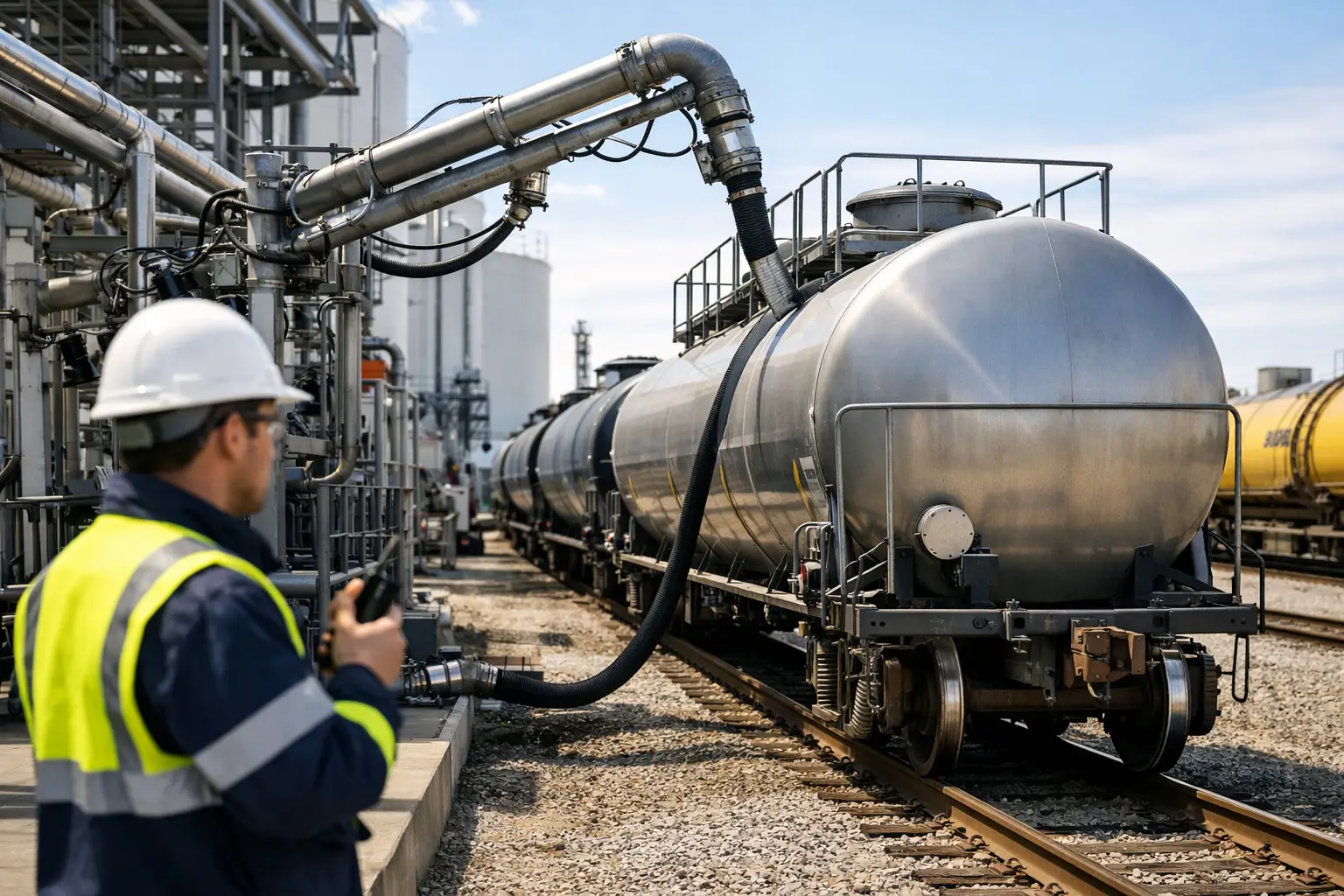
A transloading operation halted by a leak, misaligned hoses or an uncoordinated switching move can affect much more than a production shift. It can immobilize railcars, endanger people’s safety, cause compliance failures and disrupt the entire logistics chain. That is why rail transloading best practices must be designed as an operational control system, not as a series of isolated tasks.
At an industrial terminal, transloading connects the track infrastructure, switching equipment, safety procedures, product quality and shipment planning. Proper operation depends as much on a well-executed facility as on the discipline with which each move is inspected, authorized and supervised.
Transloading Begins Before the Railcar Is Spotted
Most operational incidents are prevented before a valve is ever opened. The first check is to confirm that the railcar received matches the product, the unloading or loading point and the planned operating window. This involves verifying shipping documents, railcar identification, seals where applicable, available capacity at the destination and compatibility between the product, connections and transfer materials.
The railcar’s physical condition must also be validated. Visual inspections should cover ladders, platforms, valves, hatches, connections, gauges, the underframe and any signs of damage or leakage. With liquids, gases, chemicals or hydrocarbons, a seemingly minor anomaly can turn a routine operation into a high-risk situation.
Planning must also incorporate the arrival and departure order of equipment. When the terminal receives multiple railcars or handles different products, a poorly defined sequence increases unnecessary switching, creates idle time and raises the likelihood of loading or unloading at the wrong position. The goal is not to move more railcars, but to move the necessary ones with control, traceability and the fewest possible interventions.
Securing Railcars and Protecting the Track: Non-Negotiable Conditions
A railcar being transloaded cannot be exposed to accidental movement. Effective protection combines applied brakes, properly placed wheel chocks, visible signage and clear coordination with switching personnel. If the facility has turnouts, crossings or tracks on a grade, the analysis must be even more rigorous.
Track lockout must be understandable to anyone involved in the operation. It is not enough to assume that the railcar mover operator or the outside crew knows the situation. There must be defined rules to block access, communicate the start and end of transloading, and prevent a railcar from being coupled or moved while it remains connected.
Infrastructure also affects safety. A track with insufficient clearance, rail wear, poor drainage or leveling problems makes it harder to access domes, valves and walkways. In high-volume operations, track rehabilitation, geometry correction and turnout maintenance can have a direct impact on the availability of the transloading area.
Switching Must Follow a Plan, Not Urgency
Switching equipment must be suited to the type of terminal, track length, tonnage, frequency of moves and site constraints. A well-chosen railcar mover provides control in indoor or last-mile operations, but its value depends on operator training, maintenance and communication with the person in charge of transloading.
Forcing a switching move to make up for a delay usually pushes the problem to the next phase. Sustainable productivity is achieved by reducing repositioning, waiting for track authorization and keeping equipment available, not by speeding up moves under uncertain conditions.
Rail Transloading Best Practices for Risk Control
Each product requires a specific procedure, but there are common controls that should be present at any industrial terminal. The area must have an up-to-date risk assessment, written procedures and clearly assigned responsibilities. Generic instructions are no substitute for preparing for the real conditions of each facility.
Before starting, the operating team should conduct a joint job review. This brief conversation confirms the product, the transloading method, connections, personal protective equipment, isolation points, communications and the response to any deviation. It is especially important when contractors, plant personnel and different rail operators are involved.
When transferring flammable liquids or products at risk of generating static, grounding and bonding must be verified before connecting. For corrosive, toxic or pressurized products, the integrity of gaskets, hoses, loading arms, relief valves and containment systems must also be checked. The right criterion is not that the equipment appears functional, but that it has been inspected and maintained according to its criticality.
During transloading, supervision must be active. Attending to an operation only intermittently reduces the ability to detect a leak, overpressure, overfilling or a flow anomaly. Automation can provide valuable alarms, measurement and records, but it does not eliminate the need for a trained operator who knows how to interpret an abnormal condition and stop the process.
Designing the Terminal to Operate with a Safety Margin
Safety does not depend solely on personnel behavior. A properly designed terminal reduces exposure from the outset. Access routes must allow people to move, inspect and evacuate without interference; platforms and walkways must enable safe connection; and drainage and containment systems must be suited to the product handled and to foreseeable spill scenarios.
The design of the transloading area should consider track spacing, usable length, clearance envelope, valve locations, lighting, ventilation and access for emergency equipment. It is also advisable to provide enough space for inspection and maintenance without blocking the main rail operation.
Not all terminals need the same solution. A facility dedicated to dry bulk cargo will prioritize dust control, efficient unloading and equipment cleaning. A fuel, gas or chemical operation will require more extensive isolation, detection, containment and emergency protocols. Copying a design without evaluating the cargo, volume and frequency of operation usually leads to later retrofit costs.
Maintenance: Continuity Is Protected Between Operations
Failures of hoses, valves, connections, pumps, metering equipment or rail infrastructure rarely occur without prior warning signs. A well-structured preventive program identifies wear, corrosion, fatigue, looseness and component failures before they turn into an unplanned shutdown.
Assets should be classified by criticality. A component whose failure could cause a product release, immobilize a railcar or halt the receipt of raw materials should have more demanding inspection frequencies, replacement criteria and spare parts availability. The decision cannot be based solely on the age of the equipment: the number of cycles, the type of product and environmental conditions also matter.
Records are part of maintenance, not additional bureaucracy. Documenting inspections, repairs, leak tests, incidents and downtime makes it possible to detect patterns. If a connection fails repeatedly, if a point on the track requires frequent adjustments or if an operation takes longer than expected, the data helps correct the root cause instead of repeating the repair.
Training, Communication and Stop-Work Authority
Procedures only work if personnel understand them and can apply them under pressure. Training should include normal operation, hazard identification, use of protective equipment, rail communication, emergency response and criteria for stopping transloading. Hands-on field training is as important as knowledge from documentation.
A mature operating culture does not penalize a worker who stops an operation in the face of an unsafe condition. On the contrary, it establishes a chain of notification, evaluation and restart that prevents improvised decisions. This authority must extend to operators, supervisors, maintenance personnel and contractors.
Coordination with third parties deserves specific attention. At terminals connected to mainline rail networks, schedules, access restrictions and railcar interchange rules must be aligned with internal operations. A clear protocol keeps a shipment from becoming a source of interference in the loading or unloading area.
Measuring to Improve Without Compromising Control
Transloading efficiency is not measured only in tons per hour. Indicators such as spotting time, connection duration, incidents per railcar, equipment availability, additional moves, leaks, near misses and inspection compliance provide a more complete picture.
The analysis must distinguish between useful speed and apparent speed. Cutting minutes from an operation can be positive if it eliminates waiting, travel or duplication. It is not if it requires skipping checks, reducing supervision or increasing wear on assets. Long-term rail productivity is built on repeatable processes and the ability to recover from deviations.
Track Speq addresses these needs from a comprehensive perspective: track infrastructure, terminals, maintenance, materials and switching equipment must work as a single operating system. That coordination reduces friction between specialties and helps ensure that investment decisions reflect the reality of the operation.
The best time to strengthen a rail transloading operation is not after a disruption. It is while the terminal can still review its critical points, test its procedures and turn every railcar move into a predictable, safe operation that is ready to grow.
