
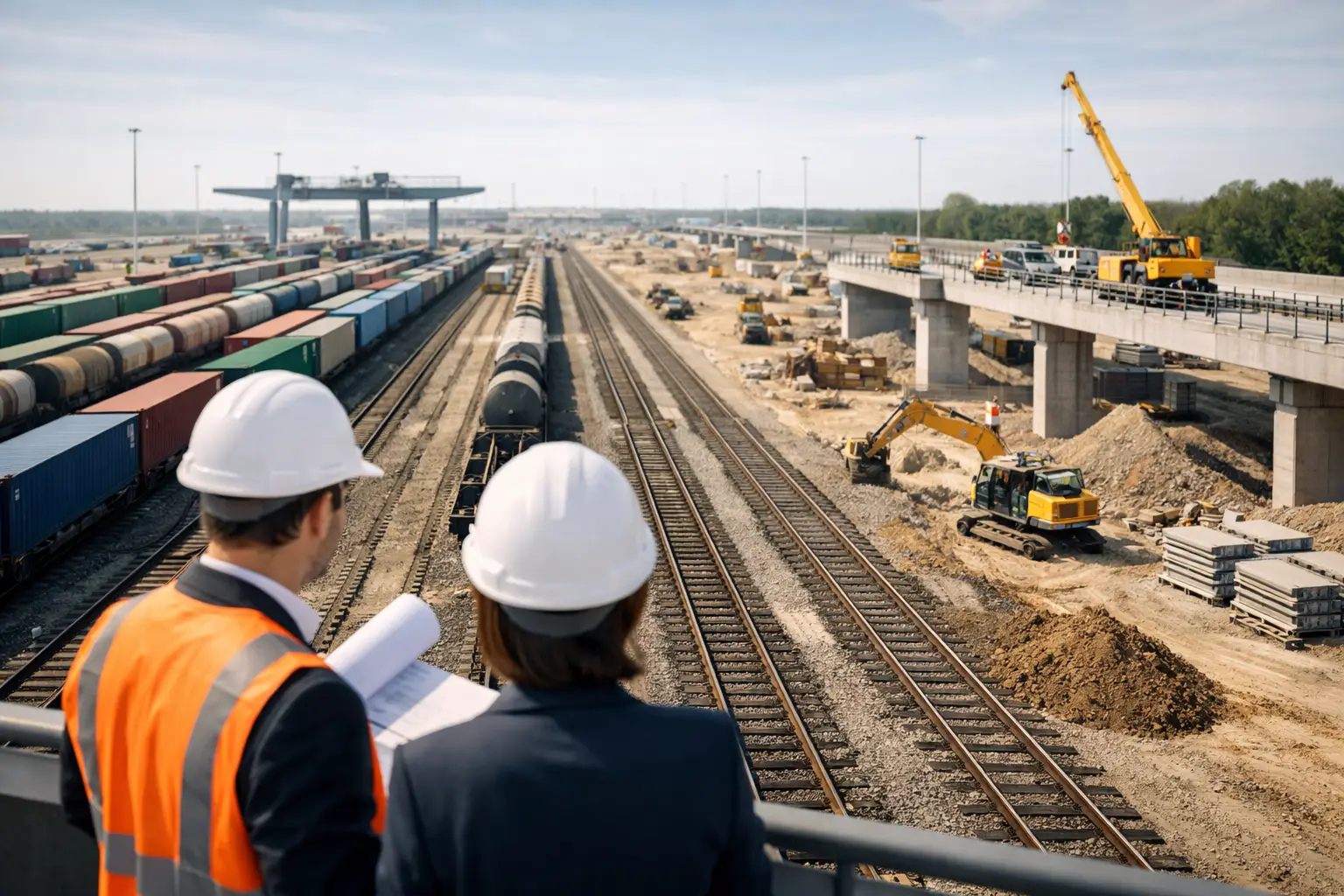
When a terminal starts operating at its limit, the problem usually doesn’t show up first on the track. It appears as dead time, longer switching moves, railcars held outside their windows and a plant losing operating margin due to a lack of rail capacity. At that point, rail terminal expansion stops being a desirable improvement and becomes a strategic decision.
For an industrial or logistics operation, expanding doesn’t just mean adding feet of track. It means redesigning how each train or each cut of cars enters, is positioned, loaded, unloaded and dispatched. If the project is approached only from a civil works standpoint, it is usually limited from the outset. If it’s approached from the real operation, it can translate into more capacity, less internal interference and better control of logistics costs.
What a rail terminal expansion solves
The most common reason to expand a terminal is simple: the current infrastructure no longer keeps pace with the business. This may be due to increased volume, a different product mix, new end-customer requirements or a change in the switching configuration. It’s also common in plants that grew in phases and ended up with a terminal that is functional but not optimized.
A well-planned expansion fixes specific bottlenecks. Sometimes the problem is the usable length for receiving and departure. Other times it’s a lack of auxiliary tracks, a poorly designed crossover, a yard that forces unnecessary switching moves or an alignment that limits the use of pulling and spotting equipment. In sectors such as automotive, steel, agribusiness, dry bulk or hydrocarbons, these differences have a direct impact on productivity, safety and meeting railroad service windows.
There’s also a financial component that shouldn’t be underestimated. When a terminal becomes too small, the company doesn’t just lose internal efficiency. It usually takes on extra costs from delays, inefficient use of personnel and equipment, dependence on outside switching or even diversion of freight to less competitive modes. Expanding in time costs less than operating for years with a constrained terminal.
The most expensive mistake: expanding just to gain space
In many projects, the conversation starts with a seemingly logical idea: add another track, extend an existing one or create a new loading area. The problem is that this decision, made without a complete operational analysis, can shift the bottleneck to another point in the system.
A rail terminal doesn’t work as isolated pieces. Track geometry, radii, turnouts, grades, drainage capacity, coexistence with internal roads, safety systems, crossings, loading and unloading points and the type of switching form a whole. A poorly integrated partial modification can generate more moves, longer occupancy times or greater safety restrictions.
That’s why, before defining the construction work, it’s worth answering very specific operational questions. How many railcars must be received per cycle? How long can a consist remain idle? What usable length does each track require? What type of equipment will perform the switching? What growth is expected over three to five years? And how much leeway does the terminal have to operate during construction? The answer is rarely universal. It depends on the product, the yard, the railroad concessionaire, seasonality and each plant’s logistics model.
Engineering, permits and operations: three inseparable fronts
Rail terminal expansion requires coordinating disciplines that many companies still contract separately. That is usually where delays, rework and budget overruns begin. The engineering may be well resolved on paper and still not be viable due to operational or regulatory constraints.
Engineering focused on real capacity
Design must start from the planned operation, not from a standard solution. That means reviewing the alignment, static and dynamic capacity, interaction between main and auxiliary tracks, turnouts, access points, drainage, subgrade, pavements in adjacent areas and compatibility with switching equipment. In some cases, expanding means building more. In others, it means reconfiguring better.
A yard with a poor operating sequence can improve more through smart redistribution than through additional feet of track. Similarly, a usable length that seems sufficient can fall short if it forces switching moves to be split or limits the type of consist the plant needs to receive.
Permitting and regulatory compliance
Industrial railway infrastructure can’t be treated as conventional construction. There are permits, technical validations, regulatory criteria, coordination with railway stakeholders and safety requirements that must be incorporated from an early stage. When this front is left for later, construction moves faster than the project’s viability, and that usually comes at a high price.
In addition, for expansions within operating terminals, compliance isn’t just about documentation. It also affects how construction is carried out, how work areas are signed and isolated, and how safe conditions are maintained for personnel, equipment and traffic.
Operational continuity during construction
This is one of the most sensitive points for any operations director. Expanding a terminal without shutting down the plant requires realistic construction phases, well-coordinated work windows and a precise understanding of how freight moves every day. It isn’t always possible to build everything at once, and it isn’t always advisable.
In some projects, the priority is to protect the current operation while bringing future capacity online in stages. In others, it makes sense to concentrate a critical intervention to reduce the total duration of the impact. Neither approach is better by definition. The right one is the one that reflects the real cost of interrupting the terminal and the flexibility of the supply chain.
Signs that the terminal already needs to grow
Not all saturation is evident in traditional indicators. Sometimes the terminal still meets its targets, but does so at the cost of extra switching moves, more labor hours or greater dependence on very tight windows. That kind of operation looks stable until a demand peak or a minor incident upsets the balance.
There are usually five clear signs. The first is that switching moves recurrently take longer than planned. The second is that receiving or departure capacity forces trains to be split too often. The third is that the yard can’t absorb volume variations without affecting production or shipping. The fourth is an increase in incidents due to forced coexistence of rail traffic, internal vehicles and personnel. The fifth is that maintenance and operations start competing for the same windows, something common in terminals operating with no slack.
When these signs appear at the same time, the decision should no longer focus on whether to expand, but on how to do so without compromising business continuity.
What a technical buyer or expansion manager should ask for
In this type of project, the purchasing criterion shouldn’t be limited to the cost per foot of track or the construction scope. What matters is the supplier’s ability to cover the full cycle: diagnosis, design, permits, construction, equipment, integration with the operation and ongoing support. If each phase is in different hands, the client company takes on the coordination and the risk.
It’s worth demanding a comprehensive view of the rail asset. That includes knowledge of track materials, turnouts, hardware, signage, switching equipment, maintenance and regulatory constraints. Experience in real industrial terminals also matters, where the priority isn’t just finishing construction, but leaving behind a more efficient and more controllable operation.
For many companies, working with a partner that centralizes infrastructure, technical supply, maintenance and operational support reduces friction and speeds up decisions. In that approach, firms like Track Speq add value because they connect engineering with execution and with the day-to-day reality of industrial rail switching.
Expanding for current volume or for the next leap
One of the most delicate decisions is defining the project’s horizon. Designing only for immediate demand lowers the initial investment, but can leave the terminal short within a short time. Designing for an overly ambitious scenario, on the other hand, ties up capital and complicates implementation.
There are no universal recipes here. The sensible approach is to identify which part of the expansion should be built now and which part is best left ready for a future phase. Sometimes it’s enough to reserve alignments, properly size a track bed or plan for the integration of new switching equipment. That foresight costs much less when it’s built into the design than when someone tries to add it later.
A well-executed rail terminal expansion isn’t measured only by the finished construction. It’s measured by the capacity the operation gains, the reduction of unproductive switching moves, yard safety and the flexibility to grow without starting over. When the project is defined with that logic, the terminal stops being a point of congestion and becomes a real competitive advantage.
