
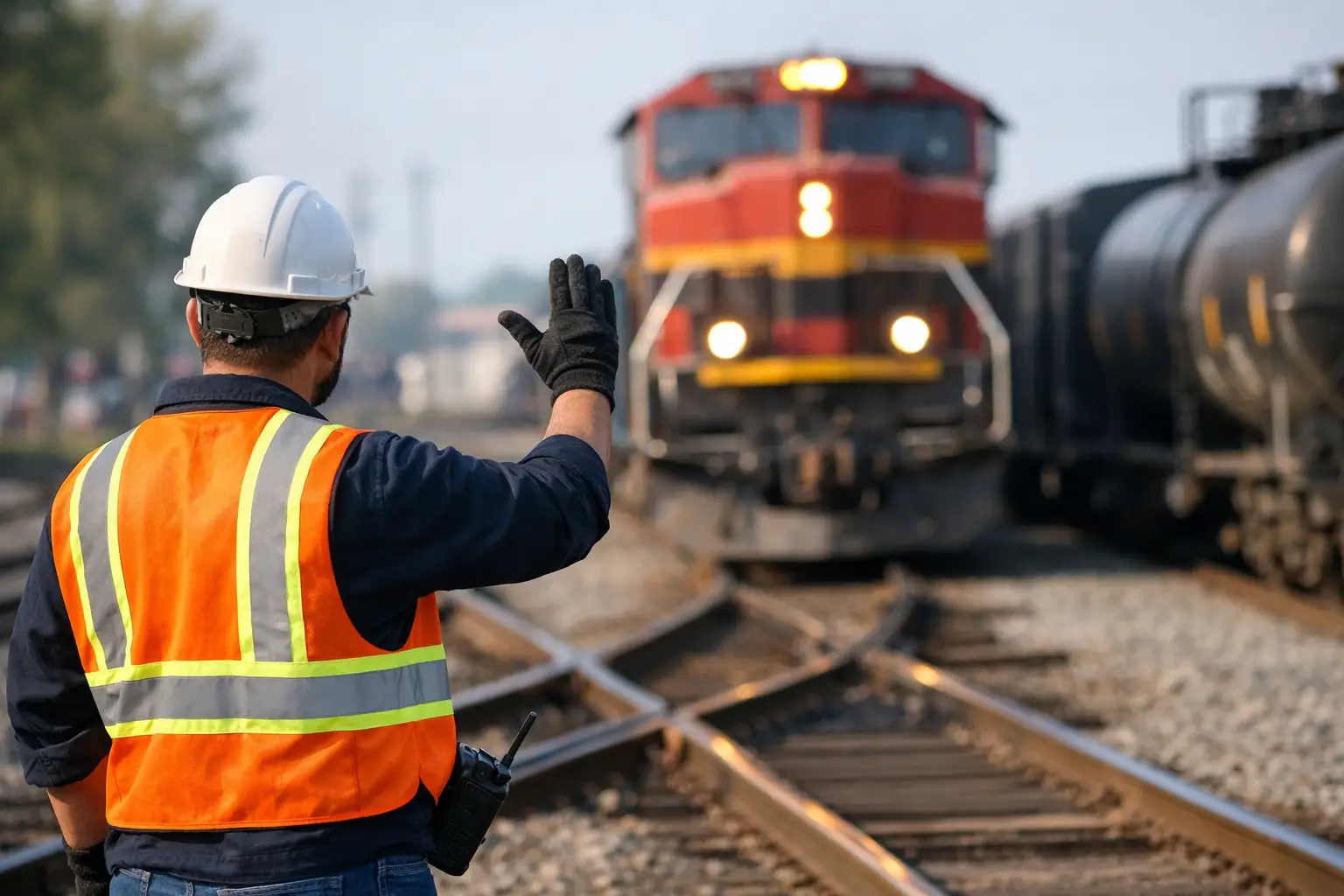
A poorly coordinated switching move can stop an industrial terminal for hours, compromise the integrity of equipment, and expose the workforce to avoidable risks. Rail switching best practices are not just about moving railcars precisely: they turn safety, infrastructure condition, and operational discipline into continuity for the plant.
For operations leadership, switching is a critical control point between the arrival of raw materials, the shipment of product, and the real ability to meet the logistics plan. That is why it must be managed as a technical function with procedures, qualified personnel, appropriate equipment, and verifiable indicators, not as a reactive yard activity.
Planning starts before the first railcar moves
Efficient switching starts with a clear work order. The responsible team must know which railcars will be moved, their position, destination, approximate weight, goods carried, operating priority, and any special handling conditions. This information prevents improvisation, reduces unnecessary movements, and limits the time critical tracks are occupied.
The sequence must be designed taking into account the usable capacity of each track, runaround points, crossings, grades, and coexistence with loading, unloading, or maintenance operations. In a terminal with heavy traffic, moving a seemingly accessible cut of railcars first can later block the departure track or prevent access to an unloading facility. The right order is defined by the complete flow, not by how close the railcar is.
It is also advisable to establish switching windows coordinated with production, industrial safety, and trucking. If loading doors are occupied, if personnel are working next to the track, or if a forklift is moving through a rail crossing, the switching move must be adjusted. Productivity does not improve by forcing unsafe coexistence, but by eliminating interference before it turns into waiting time or incidents.
Operational communication: one instruction, one authority
Most switching errors do not start with a mechanical failure. They start with an ambiguous instruction, an uncommunicated change, or an assumed order. For this reason, each movement must have an identifiable operational lead and a defined communication channel among the operator, the switching foreman, ground personnel, and the terminal’s control center.
Instructions must be brief, standardized, and confirmed. Before starting a movement, the person in charge must verify that the route is set, that turnouts are in the required position, that no personnel are inside the danger zone, and that everyone involved understands the planned move. When communication is lost, the rule must be unequivocal: stop the movement until contact is restored and conditions are confirmed.
Radio communication adds speed, but it does not replace direct observation. In sharp curves, areas with limited visibility, nighttime operations, or near industrial installations, ground personnel remain essential for checking clearances, obstacles, doors, hoses, bumping posts, and loading points.
Standardizing does not mean ignoring context
Procedures must be consistent, but not so rigid that they overlook the environment. A switching move with loaded railcars, a consist carrying hazardous materials, or a movement on a track with a grade requires additional measures compared with a simple transfer on a level area. The base procedure must define when to raise the level of control, who authorizes the exception, and what additional checks are mandatory.
Infrastructure and equipment: switching depends on both
There is no safe operation on a track whose condition is unknown. Before scheduling frequent movements, especially with heavy loads or high-capacity traction equipment, it is necessary to verify the condition of rails, ties, fasteners, ballast, joints, switches, drainage, and internal grade crossings. Poor geometry or a poorly maintained switch can turn a routine switching move into a high-cost disruption.
Inspection should prioritize the elements that concentrate the most risk: switch points, turnouts, crossovers, bumping posts, loading and unloading areas, tight-radius curves, and spots fouled by mud, debris, or spills. Preventive maintenance is usually less visible than an urgent repair, but it protects terminal availability and prevents a minor defect from escalating during a critical operation.
The switching equipment must also match the facility’s profile. The choice among a conventional locomotive, a railcar mover, or another solution depends on the number of daily movements, track length, available space, cut weight, the need for traction on grades, and the level of flexibility required. The highest-capacity equipment is not always the most efficient alternative: in terminals with short, frequent switching moves, agility, visibility, and response time can be worth more than nominal power.
Track Speq approaches this decision based on the relationship among infrastructure, operations, and technical support. Equipment performance is not evaluated in isolation, but in terms of the track, yard conditions, planned maintenance, and the ability to keep operations available.
Coupling, uncoupling, and securing without shortcuts
Coupling operations account for a significant share of physical risk. Personnel must not position themselves between vehicles until immobilization has been confirmed and the established protection procedures have been applied. Visual inspection of couplers, hoses, valves, chains, and safety components is essential before starting the movement.
Once the cut has been made up, it must be verified that couplers are properly closed and that the brake system responds according to the type of operation. In low-speed internal movements, some terminals tend to relax because distances are short. That is precisely where impact damage, incomplete couplings, or railcars left unsecured on a track with a slight grade occur.
Securing parked equipment deserves the same rigor. Hand brakes, wheel chocks, protection against unauthorized movement, and signage of the occupied track must follow a documented method. The exact combination depends on the grade, number of railcars, their load, brake condition, and the rules that apply to the facility. What must not depend on individual experience is the decision as to when a cut is truly immobilized.
Controlled speed and constant reading of the environment
In switching, speed is a safety and quality tool. Hard couplings, cargo damage, premature component wear, and low-speed derailments are usually linked to insufficient control of the movement’s energy. Setting limits by zone and type of switching move gives the operator a clear framework, especially in areas with personnel, curves, scales, pits, or loading equipment.
The authorized speed should not be fixed out of habit. It must be reviewed when adhesion, visibility, hauled weight, grade, or track condition change. Rain, contamination on the rail, and low lighting change the distance needed to stop a consist. The right response is not to maintain the planned pace, but to adapt the plan before starting the movement.
Indicators that turn switching into management
A terminal does not improve by piling up incident reports. It improves when it turns each shift’s information into maintenance, training, and investment decisions. Operations managers should review at least four groups of data:
- movements performed versus planned, and average time per operation;
- waiting time due to track occupancy, breakdowns, lack of equipment, or coordination with the plant;
- safety incidents and damage to railcars, cargo, and infrastructure;
- switching equipment availability and compliance with preventive maintenance.
These indicators must be interpreted with judgment. An increase in movements does not always mean greater productivity if it is achieved at the cost of empty runs, idle time, or repeated switching moves to correct poor planning. Likewise, high equipment availability loses value if switches or track geometry continue to cause restrictions.
Hands-on training and field supervision
Personnel competence is demonstrated under real conditions: a longer-than-usual consist, a track with limited visibility, a last-minute production change, or an anomaly detected during inspection. Training must include procedures, communication, hazard identification, incident response, and specific familiarization with the terminal where the work takes place.
Field supervision makes it possible to verify whether the procedure is workable and whether it is followed without shortcuts. When a rule is repeatedly broken, the solution is not simply to keep insisting on it. It may point to insufficient signage, a poorly designed work sequence, a lack of resources, or infrastructure that no longer matches current operating volume.
Reliable rail switching is built shift by shift: with maintained track, available equipment, clear instructions, and the ability to stop when conditions are not safe. That discipline protects people, keeps the industrial flow moving, and gives the terminal the ability to respond when operations cannot afford delays.
