
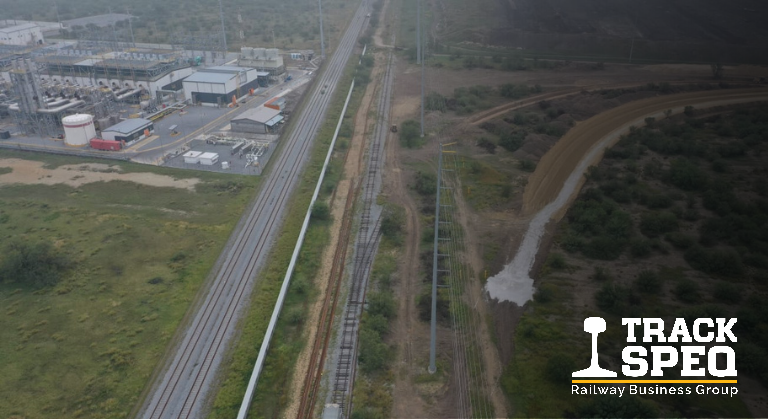
Mexico’s railway network is operated by private concessionaires under federal concessions, plus a state-run line on the Isthmus of Tehuantepec. Three of them (Ferromex, CPKC de México and Ferrosur) moved about 97% of the 132.69 million tons hauled in 2024. Knowing which one serves a plant defines its routes, its border crossing and its negotiating leverage.
That short answer matters more to someone deciding where to produce or whom to supply than to someone studying it out of curiosity. A site that touches a single network depends on a single concessionaire to bring and take railcars. A site that touches two or more can compare service conditions. And a site with no connection handles everything by truck or through intermodal terminals, with different costs and lead times.
This article describes how the network is divided, which freight dominates each operator, where the networks meet and what changed in 2026. It closes with the decisions a plant executive faces when rail stops being someone else’s topic and becomes part of the supply chain.
Three Concessionaires Move Almost All the Freight: How the Corridors Are Divided
Mexico’s freight rail system was privatized through concessions granted in 1997, as the Mexican Railroad Association (AMF) recalls. Since then, each concessionaire operates its own network on federal infrastructure and provides freight haulage service. The AMF reports 23,389 kilometers of operated track in the country, a figure that includes main lines, branch lines, auxiliary tracks and private tracks.
In volume, the weight is concentrated in a few hands. According to the 2024 Railway Statistical Yearbook from the former Railway Transport Regulatory Agency, the system moved 132.69 million tons that year, an all-time high and 0.92% more than in 2023. The table summarizes how that volume was split among the main operators.
| Operator | Freight moved in 2024 | What it connects according to the sources consulted |
|---|---|---|
| Ferromex | 62.55 million tons | More than 7,100 km of main lines and more than 1,000 km of branch lines. Links Mexico City, Guadalajara and Monterrey with Pacific ports (Guaymas, Topolobampo, Mazatlán and Manzanillo) and with five border crossings, including Nogales, Ciudad Juárez and Piedras Negras. |
| CPKC de México (formerly KCSM) | 51.56 million tons | A 3,638 km network linking the Gulf with the Pacific (Tampico and Lázaro Cárdenas) and offering services toward Laredo and the interior of the country. It belongs to the Canadian Pacific Kansas City group. |
| Ferrosur | 14.57 million tons | A network of more than 2,600 km according to industry reports. It belongs to the same group as Ferromex. |
| Ferrocarril del Istmo de Tehuantepec | 111.6 thousand tons | A line of about 1,550 km operated by a state entity, part of the Interoceanic Corridor. |
Two useful readings come out of that table. First: the difference between the first and second operators is less than eleven million tons, so there is no single dominant network that explains everything, but rather two large ones with different corridors. Second: Ferromex and Ferrosur share an owner, so two of the three largest networks answer to the same corporate group. That structure is what the antitrust authority analyzed in 2026, as discussed below.
There are also short lines and regional operators, such as Ferrovalle. Their volume is small compared with the big three, but for a plant located in their area they may be the only access to rail.
Which Freight Dominates Each Network and Why It Changes the Conversation With the Operator
The network does not move the same thing everywhere. In the first half of 2025, the system moved 64.12 million tons, 6.71% less than in the same period of 2024. The mix was 46.8% industrial products, 28.8% agricultural products and 14.2% petroleum and derivatives, according to the semiannual rail system report covered by the trade press.
Ferromex’s 2024 annual report shows how an operator’s business is composed. By share of revenue, agricultural products lead (34.4%), followed by intermodal (13.1%), automotive (11.9%), industrial products (8.9%), chemicals and fertilizers (7.2%), minerals (6.9%), energy (5.7%), metals (5.6%) and cement (4.9%).
For an executive, that mix has practical consequences:
- Seasonality of railcar availability. An operator whose largest segment is agricultural handles harvest demand peaks with specialized equipment. A plant in another sector should ask how equipment is allocated during those months and what supply commitment can be agreed in writing.
- Operating priority. Intermodal and automotive services may run on stricter time windows than bulk freight. A bulk plant sharing a corridor with them should know in which windows it receives and delivers.
- Type of railcar and switching. Receiving cement, steel or chemicals does not demand the same things. The operator’s mix shows what equipment and experience it has in each freight family.
An industry with high-value product and a steady pace, such as an automotive plant, and a bulk terminal with seasonal peaks do not negotiate the same service with the same concessionaire, even if both use the same network.
Where the Networks Meet: Interchange, Trackage Rights and the Border
No operator reaches every destination on its own. Railcars move from one network to another at interchange points (interchange: the place where one railroad hands cars over to another), and a large part of a shipment’s total transit time is decided at those points.
Two mechanisms reduce those handoffs. The first is trackage rights (trackage rights), which allow one railroad to run on another’s track. Ferromex’s 2024 annual report states that it holds rights over more than 600 km of KCSM’s north-south route, between Encantada and Viborillas, and that KCSM holds rights from Mariscala to Guadalajara and toward Altamira. The second is interconnection with U.S. operators: Ferromex operates under AAR standards (the U.S. association that sets the rules for railcar interchange) and hands cars over to Union Pacific and BNSF.
For exporters, the border is the point that weighs most. Ferromex lists five crossings: Calexico-Mexicali, Nogales, El Paso-Ciudad Juárez, Presidio-Ojinaga and Eagle Pass-Piedras Negras. CPKC, for its part, promotes end-to-end services toward Laredo and the U.S. and Canadian markets, according to its own communications. The AMF adds that about 60% of the products moved by rail in North America cross a border at least once, so the crossing is not the exception but a normal part of operations.
The consequence for a plant is concrete: a railcar leaving a site served by Ferrosur bound for a customer on CPKC’s network passes through an interchange that a railcar traveling within a single network does not. Each handoff is a point where the car can sit and wait. That is why it pays to ask the operator which interchange points it usually uses for the route of interest and how long, on average, the passage through each one takes.
What Changed in 2026: Antitrust Opinion, New Authority and Proposed Right-of-Way Fee
Three developments in 2026 shift the context of any rail decision, and they are best followed as changes in progress, not as settled facts.
Preliminary competition opinion. On February 5, 2026, a preliminary opinion from the antitrust authority was released concluding that freight rail transportation operates without effective competition. According to press coverage, of 1,772 markets analyzed, 1,768 showed monopoly or very high concentration. Among the proposed measures is that Ferromex sell the Nogales-Guaymas segment within six months of a final ruling, and that a regulator more closely oversee the trackage rights rules. This is a preliminary opinion: the companies can present arguments before the final ruling.
New regulatory authority. According to the trade press, on January 13, 2026, the Agency for Trains and Integrated Public Transportation (ATTRAPI) took over the functions of the former Railway Transport Regulatory Agency. For a project’s permitting, this means confirming which office each document is filed with.
Proposed increase in the right-of-way fee. The 2027 Economic Package proposes raising the fee paid by concessionaires from 1.25% to 3% of their annual gross revenue. CPKC executives warned publicly that, if approved, it would mean more payments and less investment. It is a proposal, not a rule in force, and its effect on rates or track investment is uncertain.
None of the three changes the track map overnight, but all three can shift service conditions, trackage rights and the decision on where to invest in a connection. An executive budgeting rail infrastructure five or ten years ahead would do well to review these points every quarter.
The Network Ends at the Delivery Point: What the Plant Decides When Connecting
The concessionaires’ network reaches the delivery or interchange track. From there inward, the infrastructure and switching are the plant’s responsibility. The decisions that fall to the executive fall into three groups.
Who Serves the Site and What Alternatives Exist
Before buying land or expanding a plant, it is worth confirming which concessionaire runs past the site, whether another network is within reasonable distance and how many interchanges the route to customers crosses. A plant with access to only one network loses room for comparison. One with access to two keeps it, even if the additional connection requires more track investment.
Connection, Engineering and Concessionaire Approval
Connecting a spur to the general network requires a project that the concessionaire reviews and approves before construction, plus permits and filings with the authority. Timelines depend on each case. An early feasibility letter avoids designing a track that later cannot be connected where it was planned. Track Speq handles this process through its railway procedures and permits area and holds CPKC and Ferromex certification to work on their networks.
It is also worth keeping the regulatory scope in mind: NOM-003-ARTF-2023 governs general communication routes. Industrial yards and tracks are not obligated parties under that standard, although they do use it as a technical reference for good practice. Whoever designs an industrial track should separate what the concessionaire requires in order to connect from what the plant decides as its own operating standard.
Switching Inside the Plant Remains the Plant’s Own
When the concessionaire delivers railcars at the agreed point, the plant must move them to the loading or unloading position and get them out on time. An undersized yard or slow switching turns the concessionaire’s punctual service into plant delays. Yard locomotives and railcar movers exist for that switching; the Rail Movers guide to railcar movers compares three railcar mover brands offered in Mexico.
To complete the picture of operators, including passenger ones, the article on the main railway companies in Mexico brings together those currently running trains in the country.
Frequently Asked Questions About Mexico’s Railway Network
How many kilometers does Mexico’s railway network have?
The Mexican Railroad Association reports 23,389 km of operated track. The figure includes concession, auxiliary and private tracks, and does not by itself show how many kilometers are main lines. Updated official data is published by the rail authority.
Which companies operate freight trains in Mexico?
Three concessionaires concentrate the freight: Ferromex, CPKC de México and Ferrosur, which together moved about 97% of the 2024 volume. There are also short lines such as Ferrovalle and the Ferrocarril del Istmo de Tehuantepec, operated by the state.
How do I know which concessionaire serves the area where I want to build a plant?
The site’s location is compared with each concessionaire’s maps and with information from the rail authority, and a field check confirms whether the track runs through the site or how far away it is. The result defines whether a connection is viable and with which operator.
Are the tracks inside a plant part of the network?
Industrial tracks connect to the general network, but they are not general communication routes. That is why their design and maintenance parameters are defined by the plant owner, with the concessionaire as the counterpart at the connection point.
Anyone evaluating a connection, an expansion or a change of operator today can review their case with a team that knows the network from the field. At Track Speq, through Rail Infra, we help review connection feasibility and the freight route for a specific operation: en.trackspeq.com · ventas@trackspeq.com · +52 81 1600 5603.
