
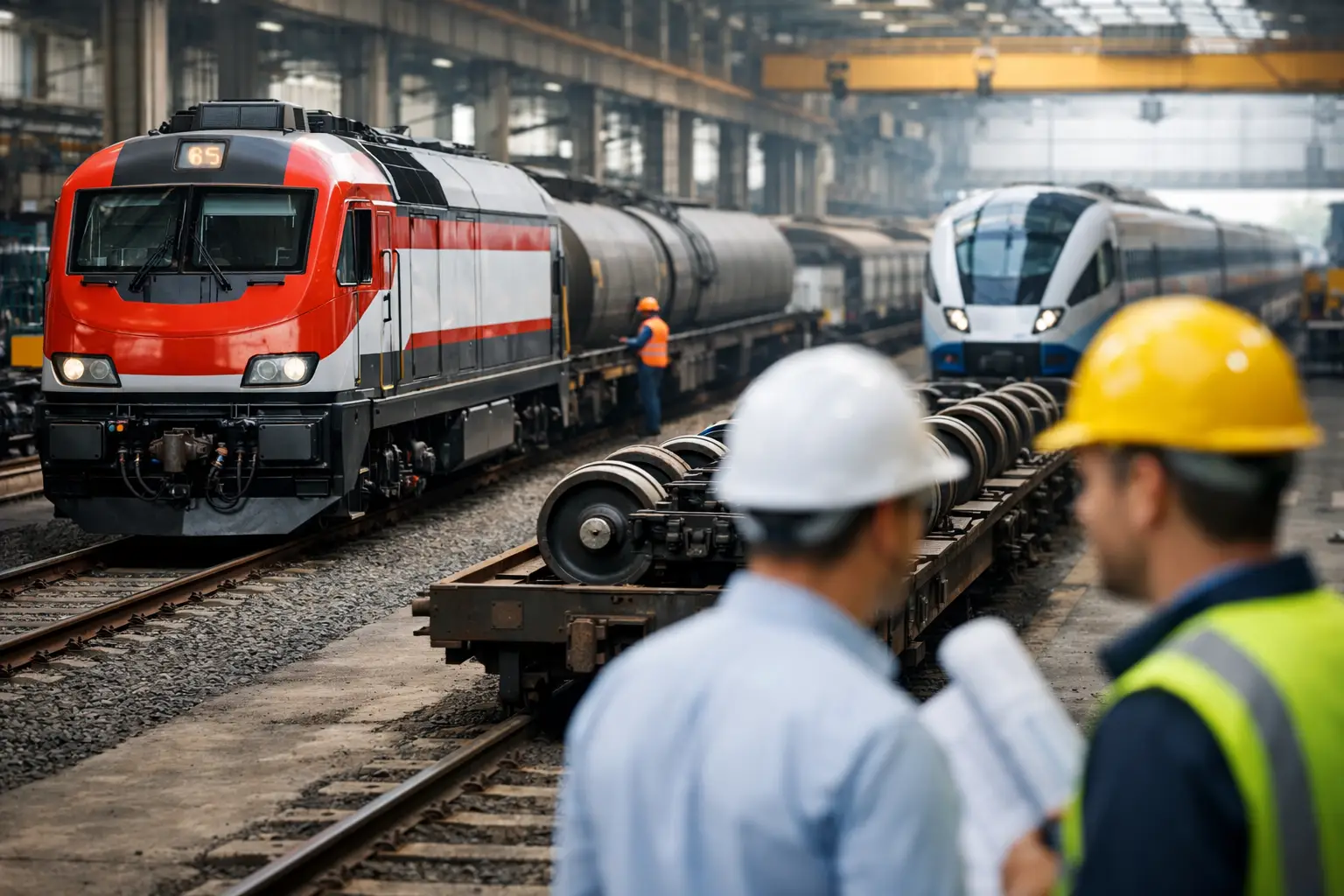
A terminal can have freight, customers and production capacity, yet lose performance because of a degraded track, a slow switching move or a poorly managed permit. That is where a full-service railway supplier stops being a commercial label and becomes an operational decision: it concentrates critical capabilities so that infrastructure, equipment and operations all serve the same continuity objective.
For an industrial company, rail is not just a means of transportation. It is an active part of its shipping capacity, raw material receiving, plant safety and logistics cost. Splitting its management among builders, material suppliers, maintenance companies and equipment distributors may seem price-competitive, but it usually increases friction, lengthens timelines and dilutes accountability when an issue arises.
What a Full-Service Railway Supplier Should Solve
A full-service model must cover the real life cycle of a rail operation, not just carry out a construction project or deliver a component. The starting point is engineering: needs analysis, track design, capacity definition, curve radii, drainage, connections, internal circulation and compatibility with the freight operation.
From there, management must move forward with technical and documentary coordination. Procedures, permits and regulatory criteria determine both the feasibility of a new terminal and the expansion of an existing one. A technically correct specification that does not account for the applicable authorizations can tie up investment, delay startup or require costly modifications later on.
Construction is the next test. Building, rehabilitating or expanding a track requires control over the roadbed, ballast, rail, ties, turnouts, drainage and signage. However, quality is not measured only when installation is finished. It is measured in the geometric stability of the track, its behavior under load and how easily the asset can be maintained over years of intensive operation.
A supplier with a complete view must also cover the supply of materials, hardware, signage, tools and light equipment. This capability reduces procurement times and avoids incompatibilities between what was designed, what was installed and what is later needed to maintain the infrastructure.
Infrastructure and Switching Must Be Planned Together
One of the most common mistakes in industrial railway projects is designing the infrastructure without defining precisely how the cars will be moved. Usable track length, sidings, loading and unloading points, grade and safety zones all depend on the planned switching. An operation with occasional traffic is not the same as a terminal with daily turnover, several car types or limited service windows.
Switching equipment deserves a specific evaluation. A railcar mover can provide control, availability and flexibility compared with other alternatives, especially when the facility needs recurring moves within the plant or when dependence on outside locomotives causes waiting time. The choice, however, depends on tonnage, track conditions, grade, switching volume, available space and the operating profile.
Purchasing the equipment does not end the decision. Commissioning, operator training, maintenance, spare parts availability and technical support must also be evaluated. A critical asset without local support or without an adequate preventive program can shift operational risk from the rail yard to the maintenance shop.
Track Speq integrates this perspective through infrastructure, supply and switching equipment support capabilities, including its exclusive representation of Shuttlewagon in Mexico. For the industrial customer, the value lies in aligning the terminal’s configuration with the traction solution, spare parts availability and subsequent technical support.
Maintenance Should Not Start When the Track Fails
Reactive rehabilitation usually comes at the worst moment: when a speed restriction, a geometric deviation or the deterioration of a component is already affecting service. In addition to direct costs, emergency work can disrupt loading schedules, require additional switching moves and increase exposure to incidents.
Preventive maintenance changes the conversation. It is based on planned inspections and reviews of geometry, ballast condition, fasteners, ties, joints, drainage, switches and internal grade crossings. Its purpose is to identify degradation before the infrastructure loses capacity or safety.
Corrective maintenance will still be necessary in certain circumstances. A storm, an unexpected increase in load, accelerated wear on a curve or localized damage may require an immediate response. The difference is that a prepared company knows the condition of its assets, has priority criteria and has a partner capable of mobilizing materials and personnel with knowledge of the facility.
Not all assets require the same frequency of intervention. A low-traffic track and a terminal subject to intensive loading cycles carry different risks. That is why effective maintenance plans are based on actual use, the criticality of each section and the consequences of a shutdown, not on a generic frequency applied equally across the entire internal network.
How to Evaluate a Full-Service Railway Supplier
The evaluation must go beyond a catalog of services. The first criterion is the ability to take on technical responsibility from project definition through operation. This means the supplier can engage with engineering, maintenance, purchasing, safety and logistics without turning every decision into a chain of intermediaries.
The second criterion is demonstrable experience in industrial environments. A terminal serving automotive, steel, food, dry bulk or hydrocarbons has different requirements for alignment, safety, cadence and equipment. Understanding those differences makes it possible to propose proportionate solutions, without oversizing a facility or compromising its future growth.
It is also worth reviewing the strength of after-sales support. The availability of specialized materials, spare parts, qualified technicians and diagnostic capability is decisive when rail is part of daily production. The initial price of a supply may be attractive, but a slow response to a breakdown can end up costing far more than the price difference.
Finally, the supplier must work with a compliance mindset. Regulatory advisory is not a paperwork add-on. It is part of reducing project risk and must be connected to the terminal’s design, construction and operating procedures.
Centralizing Capabilities Reduces Friction, Not Control
Some purchasing managers view full-service contracting as a loss of competition among suppliers. In reality, the right approach makes it possible to maintain control over specifications, budgets and milestones while reducing the number of interfaces the customer has to coordinate.
Centralization offers a clear advantage when changes arise. If an expansion requires modifying the alignment, adding a new unloading point or increasing switching capacity, a partner with an overall view can assess the effects on civil works, track, materials, equipment and maintenance. In a fragmented model, each supplier optimizes its own part and the customer takes on the integration.
This does not mean every project must be contracted under the same scope. A plant may only need to rehabilitate one section, purchase track materials or add a railcar mover. The difference lies in having a specialist who understands the impact of that decision on the rest of the operation and can scale its involvement when the project requires it.
The useful question is not whether a company needs a construction project, a piece of equipment or a specific repair. It is what the consequences would be for its operation if that need were addressed in isolation. When rail determines the flow of goods and plant capacity, choosing a partner capable of responding throughout the terminal’s service life is a direct way to protect operational continuity.
