
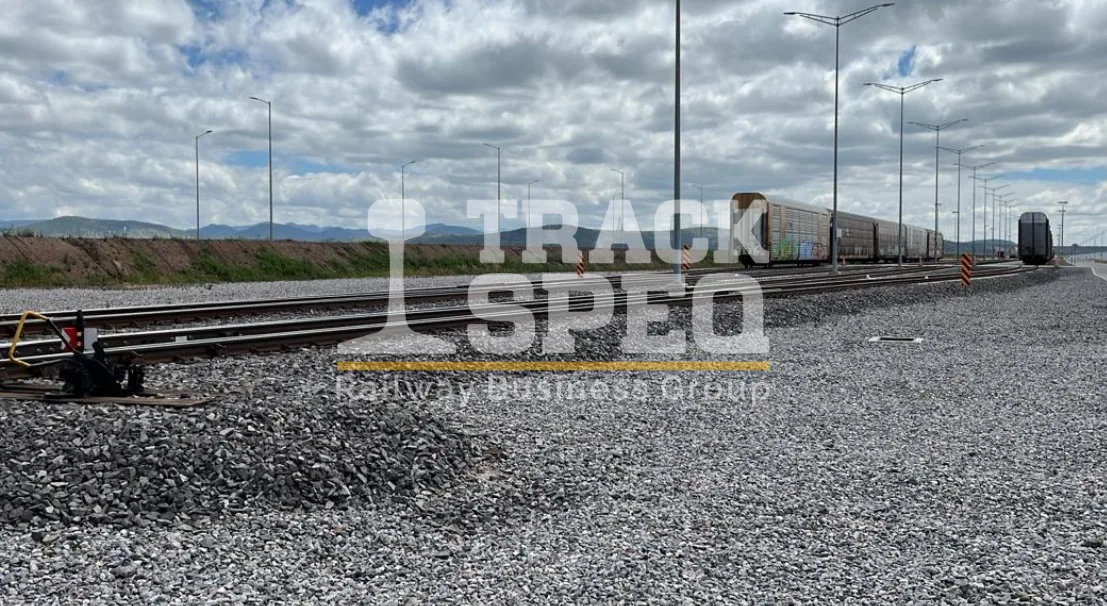
Ballast isn’t just any stone: it’s a structural component of the track
Railway ballast is often described as the stone placed beneath and around the ties, but that definition falls short for any industrial project that depends on logistics continuity. In a railway track, ballast works as a structural layer that drains, deforms in a controlled way and is able to redistribute repetitive loads. Its function is neither decorative nor secondary: it holds the track geometry, contributes to the lateral stability of the tie, allows water to drain away and reduces the direct transmission of stresses to the subgrade.
That’s why, when a plant, terminal or rail yard asks what material is used for ballast, the answer shouldn’t be limited to a list of rocks. The right question is what type of material can withstand that operation’s loading regime, with what acceptable level of degradation, under what moisture conditions, with what switching frequency and with what logistical supply capacity. A rock may look suitable in the stockpile but fail through abrasion, fracture under load cycles or generate fines that clog drainage.
In practical terms, railway ballast is produced by crushing and screening rock. The particle must be angular, clean, durable and hard enough to retain its geometry over years of operation. A rounded, flaky, friable or fines-contaminated material should not be used as ballast, even if it’s inexpensive and available near the project. Initial savings can turn into level corrections, premature cleaning, material replacement or operating restrictions.
This difference is especially relevant in industrial yards. Unlike a main line, where trains tend to travel along more uniform paths, a yard concentrates starts, stops, couplings, uncouplings, short moves, turnout movements and loaded railcars standing for long periods. That pattern requires the ballast to maintain interlocking between particles and not degrade quickly. In a heavy-haul terminal, the material can be as decisive as the geometric design or the type of tie.
From a total-cost perspective, choosing ballast isn’t about buying the cheapest aggregate per cubic meter. It’s about selecting a rock source and a production process that reduce maintenance costs over the track’s life cycle. The delivered price matters, but so do Los Angeles abrasion, absorption, the content of flat and elongated particles, material cleanliness, chemical stability and quarry traceability. In industrial projects, these variables end up affecting availability, operational safety and return on investment.
Technical properties that make a material suitable for ballast
A material’s suitability for ballast is measured by its mechanical behavior, not its trade name. Two quarries can sell “basalt” and deliver very different results if the rock shows alteration, natural fractures, poor crushing or excess fines. Likewise, a high-hardness limestone can perform reasonably well in a low-speed yard, while a soft limestone can pulverize quickly. The geological name provides guidance, but it doesn’t replace testing.
The first critical property is wear resistance. In rail operations, particles don’t just bear vertical load; they also rub against each other, rearrange and receive dynamic stresses. The Los Angeles abrasion test is used as a reference to estimate the aggregate’s mass loss from impact and wear. Generally speaking, the lower the abrasion loss, the higher the expected durability. For an industrial operation with heavy traffic or frequent switching, a material with high wear can generate fines and lose drainage sooner than expected.
The second property is shape. Ballast needs fractured faces and angular geometry to generate interlocking. That interlocking is what helps resist lateral and longitudinal displacement of the tie. Rounded particles settle with less friction and tend to migrate. Excessively flat or elongated particles can break, sit in unstable positions or reduce bearing capacity. That’s why crushing and shape control are as important as the source rock.
The third property is gradation. Ballast must have a size distribution that allows contact between particles, sufficient voids for drainage and overall stability. If there are too many small particles, water doesn’t drain well and the material becomes contaminated easily. If overly large or poorly graded sizes predominate, seating stability may be lower and achieving uniform tie support may be difficult. In Mexico, projects typically take as a reference the specifications of railroad concessionaires, AREMA criteria and the design’s particular requirements.
Water absorption also matters. A highly porous rock can weaken, be prone to weathering or retain moisture under unfavorable conditions. In yards with spills, industrial fines, constant moisture or drainage deficiencies, absorption and cleanliness become more sensitive factors. Ballast must remain an open, free-draining layer; when it becomes fouled, it stops fulfilling one of its main functions.
Finally, petrographic stability must be reviewed. Some rocks contain minerals susceptible to alteration or fracturing. Others may have microcracks that aren’t visually evident but show up during crushing or under repeated loading. That’s why a serious supply program shouldn’t accept material based solely on visual inspection. It should include laboratory testing, production control, periodic sampling and clear rejection criteria.
Main materials used in railway ballast
Basalt: high durability for demanding operations
Basalt is one of the most widely used rocks for railway ballast thanks to its igneous origin, high density and good wear resistance. When properly crushed, it produces angular particles with fractured faces capable of providing good interlocking. This combination makes it attractive for tracks with significant loads, high-turnover industrial yards and terminals where geometric stability is a priority.
Its main advantage is durability. Under proper production conditions, basalt tends to resist abrasion better than many sedimentary rocks. This reduces fines generation and preserves the ballast’s drainage capacity longer. For an operation where a track outage carries high logistics costs, that durability can justify a higher initial price. The decision should be evaluated as an investment in availability, not just a material purchase.
In terms of reference costs, basalt for railway use can fall within very variable ranges depending on region, volume, quarry and distance to the project. As an order of magnitude for preliminary analysis in Mexico, a range of approximately 250 to 550 MXN per metric ton at the quarry or plant can be considered for crushed aggregate of controlled quality; delivered to site, including transportation and handling, the range can easily rise to 500-1,200 MXN per ton or more for projects far from the quarry. These values don’t replace a quote, but they help size the importance of logistics.
Logistics is precisely one of basalt’s limitations. If the quarry is far from the job site, hauling costs can exceed the technical difference compared with another acceptable local material. In railway projects, transportation cost can change with distance, volume, truck availability, access, unloading times and site restrictions. That’s why excellent basalt 350 kilometers away won’t always be the best decision compared with a nearby granite or hard limestone that meets the specification.
Basalt also requires production control. Good-quality rock can perform poorly if it’s processed with an excess of elongated particles, contaminated with fines during stockpiling or mixed with off-spec material. In an industrial project, supply must be accompanied by periodic gradation tests, abrasion control, visual inspection and lot traceability. Simply writing “basalt ballast” on a purchase order isn’t enough.
Its use is usually recommended when the project has high axle loads, frequent traffic, repetitive switching or low tolerance for maintenance windows. It can also be a solid option in areas where the subgrade requires a reliable drainage system and where future replacement would be costly. In these cases, the CAPEX difference can be offset by lower OPEX in leveling, cleaning and replenishment.
Granite, quartzite and high-strength igneous or metamorphic rocks
Granite is another common option for railway ballast, especially when it comes from quarries with good structural quality. It’s an igneous rock composed mainly of quartz, feldspars and micas, and it can offer good mechanical strength. Its performance, however, depends on the degree of alteration, texture, presence of weak minerals and the crushing process. Not all granite is automatically suitable for ballast.
When properly produced, granite can generate strong, angular particles. It usually performs well in industrial tracks, terminals and sections where a balance between regional availability and durability is sought. In some cases, its wear can be competitive with basalt; in others, it can degrade faster if the quarry has weathered rock or rock with planes of weakness. The only way to confirm its suitability is through testing.
Quartzite, a quartz-rich metamorphic rock, can be very strong and durable. Its high hardness makes it attractive in applications requiring low degradation. However, it can also present challenges in crushing, particle shape and availability. Some quartzites produce very hard fragments but with geometries that must be controlled to avoid an excess of flat or elongated particles. As with granite, the industrial process is as important as the geology.
In terms of cost, granite and quartzite can fall within ranges similar to or slightly below/above basalt, depending on the region. For an initial estimate, crushed aggregate suitable for railway evaluation can be analyzed in ranges of 220 to 520 MXN per ton at the plant, and 480 to 1,150 MXN per ton delivered to site once hauling, handling, losses and quality control are included. The wide range is intentional: with aggregates, distance weighs as much as the rock.
The choice between basalt, granite and quartzite should consider the type of operation. A heavy-traffic bulk terminal may favor materials with lower wear, while a low-speed, lower-frequency yard could accept a local alternative as long as it meets the specification. In both cases, the evaluation should include expected service life and not just unit price. A saving of 80 MXN per ton can lose its meaning if the material requires maintenance work sooner than expected.
Granite can also be suitable for projects requiring dimensional stability and good drainage, but material cleanliness must be ensured. Contamination during stockpiling and transportation is one of the most frequent causes of performance loss. If ballast arrives with clay, crusher dust or fine material, the problem isn’t just cosmetic: those fines reduce permeability and accelerate the formation of saturated zones.
For industrial procurement, the recommendation is to ask the supplier for results by lot or by production campaign, not just a general quarry data sheet. In natural rock, properties can vary within the same quarry. One area of the quarry may yield sound material while another shows alteration. Traceability reduces uncertainty and allows decisions to be made before the material is incorporated into the track.
Hard limestone and dolomite: viable alternatives with clear limits
Limestone is used in some infrastructure projects because of its availability and competitive cost, but its use as railway ballast requires greater caution. Limestone is a sedimentary rock composed mainly of calcium carbonate, and it can behave very differently depending on its origin. There are dense, hard limestones that can meet certain requirements; there are also porous or soft limestones that should not be used in demanding railway applications.
Its main appeal is economic and logistical. In several regions of Mexico, limestone is abundant and may be close to industrial areas. That proximity can reduce hauling costs, which often account for a significant share of the delivered cost. For a low-speed, low-tonnage yard with accessible maintenance, a high-quality limestone could be evaluated. For heavy traffic or intensive switching, the demands increase and the margin for error decreases.
The most common risk with unsuitable limestones is fines generation. Under repeated loading, some limestones wear or fracture more quickly, reducing ballast permeability. A fouled layer loses drainage, retains moisture and transmits stresses less efficiently. From there, settlement, pumping of fines from the subgrade and the need for more frequent corrective maintenance can appear.
Dolomite, related to carbonate rocks, can perform better than some limestones if it has greater hardness and lower porosity. Even so, it must be tested. In railway applications, it’s best not to generalize: a sound dolomite can work better than an altered granite, but a weak dolomite can fail before a dense limestone. The material’s name should never replace laboratory evidence.
For preliminary cost analysis, crushed limestone or dolomite of controlled quality can range from 180 to 430 MXN per ton at the quarry or plant, and from 420 to 1,000 MXN per ton delivered to site, depending on distance and volume. In metropolitan markets or low-volume deliveries, prices per cubic meter can be much higher and aren’t comparable with bulk industrial railway purchases. The buyer must distinguish between retail price, quarry price and project logistics price.
When evaluating limestone for ballast, it’s advisable to require stricter testing for abrasion, absorption, soundness and weathering. It’s also recommended to review the quarry’s track record in similar applications. If the material has only been used on roads or as fill, that doesn’t prove railway performance. Ballast works under a different regime of load, vibration, drainage and geometry.
Hard limestone can be an alternative when the budget is tight and the operation doesn’t demand maximum performance, but it must be used within clear technical limits. On a critical track, where a failure stops production or creates safety risks, the lowest initial cost can turn into an expensive decision. The question isn’t whether limestone is good or bad; the question is whether that specific limestone, from that quarry, processed that way, is suitable for that operation.
Alternative materials and unconventional solutions
In some markets, alternative materials such as steel slag, recycled aggregates or special blends for support layers have been evaluated. These materials can offer advantages in availability, cost or sustainability, but their use as railway ballast requires rigorous validation. They shouldn’t be incorporated on intuition or by assuming equivalence with conventional aggregates.
Steel slag can have high hardness and good angularity, but it may also show chemical, volumetric or density variations that must be analyzed. Some slags can expand or behave undesirably if they haven’t been properly stabilized. In railway infrastructure, any expansion, degradation or chemical reaction can affect geometry and drainage.
Recycled aggregates, for example from crushed concrete, are usually more problematic for primary ballast. They can absorb more water, degrade more quickly or contain contaminants. In certain cases they could be evaluated for auxiliary layers, internal roads or temporary solutions, but they shouldn’t be considered equivalent to high-quality crushed rock without specific testing.
Interest in alternative materials will grow due to cost and sustainability pressures. However, in industrial projects, sustainability shouldn’t be confused with lowering the specification. A sustainable solution must maintain operational safety, service life and traceability. If an alternative material generates more maintenance, more replacement and more corrective transportation, its environmental and economic benefit can disappear.
When analyzing an unconventional material, the protocol should include petrographic or chemical characterization, abrasion, absorption, gradation, soundness, particle shape, compaction, drainage and a pilot test under controlled conditions. It must also be defined where it will be used: ballast under active track is not the same as sub-ballast, a yard layer, a service road or structural fill.
In Mexico, the use of unconventional materials in industrial railway track should still be handled case by case, considering the railroad concessionaire’s acceptance, the project specifications and the operational risk. For most critical applications, basalt, granite, quartzite or validated hard limestone will remain the most reasonable options.
Costs and logistics before purchasing
How to compare materials with hard data
The technical comparison of materials must be based on data, not perceptions. A supplier’s data sheet can be useful as a starting point, but the buyer and the technical team should request verifiable results. In railway projects, material must be evaluated before committing large volumes, because correcting a poor selection after placing ballast means removing, transporting, replacing, re-leveling and disrupting the operation.
A practical approach is to build a decision matrix that combines performance, cost and risk. The matrix should assign weight to variables such as abrasion, gradation, shape, absorption, distance to the project, supply capacity, quarry track record, documentation compliance and delivered cost. This allows alternatives to be compared objectively. The hardest material doesn’t always win; the winner is the material that offers the best technical and economic balance for the operating context.
Reference ranges for preliminary analysis can be organized as follows:
| Material | Typical performance | Technical risk | Plant range MXN/t* | Delivered-to-site range MXN/t* | Most suitable use |
|---|---|---|---|---|---|
| Basalt | High to very high | Low if sound and well crushed | 250-550 | 500-1,200+ | Demanding yards, high loads, critical terminals |
| Granite | Medium-high to high | Variable due to mineral alteration | 220-520 | 480-1,150 | Industrial tracks and terminals with good quality control |
| Quartzite | High | Shape control and availability | 260-600 | 520-1,250+ | Applications where low degradation is the priority |
| Hard limestone | Medium to high if it passes testing | Fines generation if soft | 180-430 | 420-1,000 | Less demanding yards or projects with a validated nearby quarry |
| Dolomite | Medium to high | Absorption and soundness must be validated | 190-450 | 430-1,050 | Regional alternative with favorable test results |
| Slag/recycled | Case by case | High without specific validation | Variable | Variable | Auxiliary layers or pilots, not an automatic substitute |
*Reference ranges for preliminary planning. They do not replace a formal quote, testing, detailed logistics or project specifications.

Logistics can weigh as much as the rock
One of the most frequent mistakes is comparing materials by quarry price without calculating the real delivered cost. With aggregates, transportation can represent a dominant share of the total cost, especially when the project is far from the quarry or when site access limits unloading productivity. For railway ballast, moreover, delivering material isn’t enough: it must be delivered with consistent gradation, cleanliness and volume.
Logistics cost includes loading, hauling, waiting, unloading, internal movements, losses, dust control, segregation in stockpiles and sometimes double handling. If the material is transported by truck, distance and cycle times determine how many trips are needed to meet the schedule. If rail supply is possible, it can improve economics for large volumes, but it requires coordination of windows, unloading equipment and stockpile locations.
For a conceptual estimate, an industrial yard may require thousands of tons of ballast depending on track length, layer thickness, shoulders, rehabilitation work and losses. A seemingly small increase of 100 MXN per ton can represent hundreds of thousands of pesos in medium-sized projects. But the reverse saving must also be tested: if a cheaper material shortens the life of the layer, the maintenance cost can exceed the purchase savings.
In addition, logistics affects quality. Excellent material can degrade or become contaminated if handled poorly. Stockpiles on fine soils, mixing with earthworks material, machinery driving over the material or segregation during unloading can alter the actual gradation. Stockpile management must be part of the quality plan. Ballast shouldn’t be stored or handled like ordinary fill.
In Mexico, regional variation is very wide. Areas with volcanic rock available may have advantages for basalt; other regions depend on nearby limestone or granite. Therefore, the best solution isn’t always national, but locally optimized. Engineering must define the standard, procurement must evaluate supply and operations must validate that the material matches the track’s actual use.
Drainage, maintenance and switching in industrial operations
The relationship between material, drainage and track maintenance
Drainage is one of the reasons railway ballast can’t be replaced by just any aggregate. The layer must allow water to drain quickly to prevent saturation and loss of support. When the material degrades and generates fines, those voids become clogged. The problem doesn’t appear overnight; it builds up until the track starts requiring more frequent leveling or develops soft spots.
Ballast degradation has several sources. One is particle-on-particle wear. Another is external contamination from subgrade fines, industrial dust, spills or material carried by runoff. Pumping of fines from lower layers also plays a role when there is poor separation, insufficient drainage or a weak subgrade. The type of material determines how quickly the ballast loses its initial condition, but drainage design and maintenance determine how long it retains its performance.
In railway maintenance, a clean ballast layer allows more efficient interventions. Tamping, alignment and leveling depend on the material being able to rearrange without behaving like a saturated mass. If the ballast is fouled, maintenance becomes corrective, more expensive and less durable. Equipment can correct geometry temporarily, but if the cause is loss of drainage, the failure will reappear.
This is where material cost connects with OPEX. A more resistant ballast can reduce the frequency of cleaning and replenishment. A weaker material may require additional maintenance windows, labor, equipment, supervision, switching interruptions and the risk of affecting production. In industrial plants, those windows aren’t always easy to get; sometimes the highest cost isn’t the maintenance itself, but the stopped operation.
Condition-based maintenance (CBM) makes it possible to anticipate problems through inspection, measurement and trend analysis. For ballast, this can include visual checks for fouling, track geometry measurement, behavior at turnouts, settlement history and drainage analysis. The initial material selection must align with this strategy: you’re not just buying stone, you’re defining the foundation of future maintenance.
Ballast materials and switching in industrial yards
Industrial rail switching creates particular conditions for ballast. Moves are usually low speed, but with frequent starts and stops. Railcars may stand loaded for long periods. At turnouts, tight curves and coupling zones, lateral and point loads can be more severe than on tangent track. The material must withstand that load pattern without losing stability.
In yards with railcar movers, yard locomotives or road-rail equipment, ballast quality affects track regularity and operational safety. A track with settlement or fouled zones can increase vibration, hinder precise switching and accelerate component wear. Although ballast isn’t visible to most users, its performance is felt in daily operations.
Critical zones are usually turnouts, track ends, loading and unloading areas, industrial curves, internal crossings and points with poor drainage. In these zones it’s advisable to use material with better resistance, pay attention to depths, shoulders and confinement, and reinforce the inspection plan. Not every foot of track has the same level of demand; engineering can specify differentiated solutions to optimize cost without sacrificing safety.
A common mistake is designing the track only for static vertical load. In real operation, switching generates dynamic effects, coupling impacts, longitudinal forces and vibration. If the ballast doesn’t retain its interlocking, the tie can lose uniform support. This translates into low spots, indirect gauge variation due to structural movement, fastening degradation and greater maintenance demand.
For high-utilization industrial yards, basalt, sound granite or quartzite usually offer a better technical margin. For secondary yards or low-turnover storage tracks, a validated hard limestone could work if drainage is adequate and maintenance is accessible. The key is connecting material to operation: the same ballast isn’t necessarily optimal for a main line, an industrial spur, an automotive terminal and a bulk loading track.
CAPEX vs. OPEX: why cheap material can end up costing more
The discussion of ballast materials usually starts in procurement, but it should be resolved with input from engineering, maintenance, operations and finance. Price per ton is a CAPEX variable; intervention frequency, loss of availability and replenishment are OPEX variables. When they’re separated, the project can choose a cheap material and shift the cost to the maintenance department for years.
A conceptual example helps put it in perspective. Suppose an industrial track requires 3,000 tons of ballast. If a local alternative costs 120 MXN less per ton delivered to site, the initial saving would be 360,000 MXN. If that alternative triggers an additional round of cleaning, leveling and partial replenishment two years earlier than planned, the combined cost of equipment, labor, material, supervision and the operating window can exceed the saving. If the intervention also affects shipments or railcar receipt, the real cost can multiply.
The financial evaluation should include at least four layers: delivered material cost, placement and control cost, expected maintenance cost and the cost of unavailability. In industrial operations, unavailability can be the dominant factor. A terminal that stops spotting railcars or a plant that delays loading because of an out-of-tolerance track can face costs greater than the ballast purchase differential.
The asset’s service life must also be considered. If a better-quality material extends the ballast cleaning cycle from 5 to 8 years, or reduces recurring leveling, its economic value can be significant. The comparison should be made using cost flows over time. Lower CAPEX doesn’t always mean lower total cost; in railway infrastructure, the opposite is often true.
The goal isn’t always to choose the most expensive material. The goal is to choose the technically sufficient material with the lowest total cost for the required level of service. In some cases it will be basalt; in others, regional granite; in others, validated hard limestone. The right decision depends on data, not general preferences.

Specification, validation and technical decision
Two lists worth using before approving a material
Before buying, the technical and procurement teams should agree on a minimum validation package. This list avoids ambiguity and reduces the risk of receiving material that doesn’t match design expectations:
- Minimum tests: gradation, Los Angeles abrasion, absorption, soundness/weathering, particle shape, fines content and petrographic review when the project warrants it.
- Operational validation: distance to the quarry, monthly capacity, lot traceability, stockpile control, sampling plan, track record in railway projects and delivered cost with full logistics.
The second list is useful for differentiating materials by application. Not every project requires the same level of demand, but all require consistency between use and specification:
- High demand: critical industrial lines, high-turnover yards, turnouts, coupling zones and heavy-haul terminals; it’s usually best to prioritize basalt, sound granite or validated quartzite.
- Moderate demand: storage tracks, low-frequency spurs or yards with accessible maintenance; local alternatives such as hard limestone or dolomite can be evaluated, always with testing and acceptance limits.
How to specify the material without closing the door to a better local solution
A well-written specification shouldn’t just name a rock. If it says “basalt ballast” without performance criteria, the project may exclude suitable local alternatives or accept low-quality basalt. If it says only “crushed ballast,” it opens the door to inadequate materials. The balance lies in specifying measurable properties and, where necessary, restricting rock types by risk level.
A mature specification defines gradation, wear limits, absorption, fines content, flat and elongated particles, cleanliness, sampling procedure, testing frequency, rejection criteria and logistics responsibilities. It can also define differentiated requirements for critical zones. For example, using a higher-performance material at turnouts and switching zones, and another validated material on secondary sections.
The specification must also consider how compliance will be measured. Requesting an initial test isn’t enough. There must be control during production and receipt. A quarry can deliver an approved sample and then vary in quality if it changes its working face or adjusts its crusher. The quality plan must cover the entire supply, especially when volumes are high.
In projects involving railroad concessionaires, the specification must align with their requirements. In-plant industrial tracks, spurs and connections may be subject to particular acceptance criteria. Ignoring these requirements can delay permits, construction acceptance or operational connection. Ballast selection should be integrated from conceptual engineering, not settled at the end due to construction urgency.
It’s also advisable to document the equivalence criterion. If the contractor proposes a material different from the one planned, it must demonstrate compliance through testing and logistics analysis. This protects the asset owner without closing off supply competition. Flexibility is positive when it’s based on performance; it’s risky when it’s based only on price.
Criteria by type of railway project
Material selection also changes depending on the type of project. On a new industrial spur, the designer has the opportunity to coordinate subgrade, sub-ballast, drainage, tie type and ballast from the start. In a rehabilitation, by contrast, many decisions are constrained by existing geometry, available space, active operations and the condition of the installed material. That difference changes how the material is evaluated: in new construction, the whole system is optimized; in rehabilitation, the goal is to correct the causes of failure without stopping the operation longer than necessary.
On plant access lines, where traffic may be less frequent but with heavy railcars, it’s best to prioritize long-term stability and drainage. If the track crosses areas with fine soils or problematic water tables, the best ballast material won’t make up for a deficient sub-ballast. In these cases, rock selection must be accompanied by geotextiles, separation layers or drainage solutions. Ballast shouldn’t be used to hide earthworks problems.
In intermodal, automotive or bulk terminals, demands may be concentrated at specific points: loading areas, receiving tracks, classification areas and turnouts. There, wear doesn’t always come from high speeds, but from repetition. The track can receive thousands of load cycles with short moves, and that repetition causes settlement if the ballast doesn’t retain its structure. A material with good abrasion performance can reduce frequent adjustments and maintain yard productivity.
On tracks with concrete ties, ballast support must be particularly uniform. Concrete ties distribute loads differently from wood ties and can be less tolerant of point supports or voids. That’s why gradation, depth and placement quality become more important. On tracks with wood ties, the system can tolerate certain variations, but that doesn’t justify using low-quality material; it simply changes how degradation shows up.
Selection must also consider future availability. A project can be built with excellent material from a temporary quarry, but if that quarry stops operating, future replenishment may be done with different rock. This can create zones with uneven behavior. For long-term assets, it’s worth evaluating whether the supplier can sustain supply or whether previously validated equivalent alternatives exist. Material continuity is part of the maintenance strategy.
A mature approach is to define a base specification and a reinforced specification for critical points. The base covers less demanding sections; the reinforced one applies to turnouts, tight curves, coupling zones, heavy-load tracks and points with a history of settlement. This segmentation can optimize the budget without sacrificing performance where it matters most. Railway engineering doesn’t always require spending more on everything; it requires investing better in the points that control reliability.
In procurement, this segmentation must translate into clear line items. If everything is purchased as “ballast” without differentiating zones, the supplier has neither the incentive nor the obligation to deliver different qualities. If zones and tests are specified, the project gains control. In addition, maintenance can record which material was placed on each section, facilitating subsequent performance analysis. That traceability turns the project into a source of data for future expansions.
Operational learning is key. If a plant has already had problems with settlement, mud, loss of level or ballast fouling, the selection of the new material must start from that history. Changing the rock without correcting drainage or subgrade can repeat the failure. Conversely, correcting the cause and selecting a suitable material can significantly extend the track’s service life. In railway infrastructure, the best decision is usually systemic, not isolated.
An additional practice is to keep reference samples of the approved material and compare them with subsequent deliveries. This simple measure helps detect visual changes in color, shape, size or contamination before the material is placed. In projects with multiple work fronts, it also helps align supervision, the site manager and the supplier under the same criteria. Preventive control is much cheaper than removing rejected ballast after it has been unloaded on the track.
That discipline prevents reactive purchases and costly failures.
A technical decision that connects engineering, procurement and operations
Ballast material selection sums up a common reality in industrial railway infrastructure: seemingly simple decisions have profound operational consequences. Basalt, granite, quartzite, hard limestone, dolomite or alternative materials are not universal answers. They are options that must be evaluated against load, switching frequency, drainage, availability, logistics cost and maintenance strategy.
For an industrial company, the best decision isn’t to buy “the best material” in the abstract, but the material that guarantees sufficient performance at the lowest total cost of ownership. That requires integrating hard data, testing, supply costs, quarry experience and actual operating conditions. The right rock on the wrong project may be oversized; cheap rock on a critical track can be a financial and operational risk.
Track Speq approaches these kinds of decisions from a comprehensive railway infrastructure perspective: design, construction, materials, maintenance and operation. That approach ensures ballast isn’t evaluated as an isolated input, but as part of a system that must sustain safe switching, logistics continuity and long-term efficiency. When selection is made at early stages, it’s possible to reduce last-minute changes, better control CAPEX and anticipate OPEX.
If your plant, yard or terminal is evaluating materials for railway track ballast, the technical recommendation is to start with a review of operations, loads, geometry, drainage, available quarries and logistics costs. On that basis, a realistic specification can be defined, materials compared and decisions based solely on price avoided. For a technical evaluation, you can contact Track Speq at ventas@trackspeq.com, call +52 81 1600 5603 or visit en.trackspeq.com. This strengthens verifiable technical decisions.
