
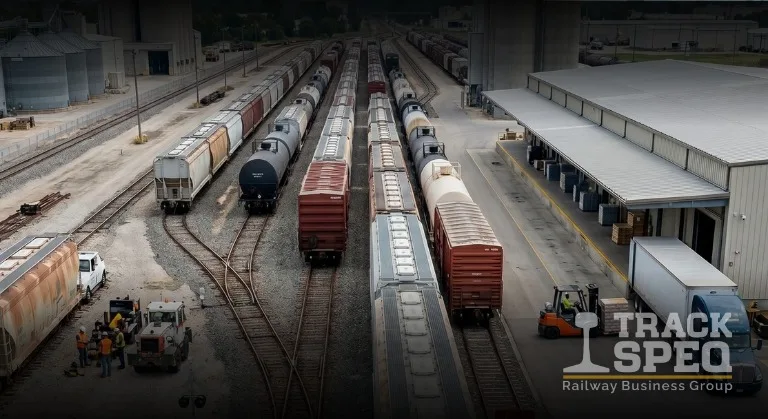
In an industrial plant with rail operations, the yard is not a support area. It is critical infrastructure. Every car that moves within it, every switching move performed, every section of track that deteriorates, and every turnout that fails has a direct impact on production times, operational safety, and logistics costs.
However, in many industrial facilities the rail yard is managed in a fragmented way: one supplier looks after the track, another team runs the switching, materials are purchased without technical criteria, and the switching equipment operates without regard to the actual condition of the infrastructure. The result is predictable: long cycle times, recurring failures, slow switching, and costly corrective work that interrupts operations.
This technical guide explains what defines a well-designed industrial rail yard, what conditions must be met to operate safely and efficiently, which maintenance factors are critical, and how the integration of infrastructure, switching equipment, and materials determines the operation’s real performance.
Why does the industrial rail yard matter in today’s context?
Nearshoring is putting direct pressure on logistics infrastructure in Mexico. New plants, terminal expansions, and industrial parks with rail connections require yards that are well designed from the outset. A yard that is poorly conceived at the project stage becomes an operational bottleneck that has no easy fix once it is built. The cost of designing poorly is always greater than the cost of designing well.
What is an industrial rail yard and how does it differ from a concessionaire yard?
An industrial rail yard is the set of infrastructure and equipment used to receive, switch, classify, and dispatch railcars within a private facility — a manufacturing plant, freight terminal, logistics park, raw materials warehouse, or port facility.
Unlike the concessionaire yards operated by CPKC or Ferromex, where volumes, speeds, and equipment follow the logic of long-haul transportation, an industrial rail yard operates under a completely different logic: short, frequent movements in tight spaces, with cars that arrive loaded and must be spotted precisely at loading, unloading, or storage areas.
That difference in scale and function has direct implications for how the track is designed, what equipment is used for switching, which materials are specified, and how maintenance is managed. What works in a concessionaire yard does not always apply in an industrial yard, and conceptual errors in this distinction are a frequent source of operational problems.
Main components of an industrial rail yard
Receiving and departure tracks: sections where cars coming from the concessionaire network enter the yard or wait to be delivered to the concessionaire. Their length, radius, and grade must be coordinated with receiving volumes and the required switching times.
Classification tracks: sections where cars are separated by destination, type of cargo, or operating priority. In yards with multiple products or loading points, these tracks define the efficiency of the internal flow.
Loading and unloading tracks: sections positioned at docks, ramps, scales, hoppers, pipelines, or transloading equipment. Their design must be integrated with the plant’s production process — the car doesn’t just have to arrive; it has to arrive with millimeter precision.
Storage tracks: sections where cars wait their turn for processing or hold finished cargo. Rail storage capacity is a critical factor in plants with high demand or irregular processing windows.
Turnouts: switches, frogs, switch points, and crossings that allow cars to move from one track to another. They are the components with the greatest wear and the greatest criticality in the operation. A turnout in poor condition is not just a derailment risk — it is a bottleneck that can paralyze the entire yard.
Switching equipment: industrial locomotives or railcar movers that carry out car movements within the yard. Choosing the right equipment — type, capacity, and operating characteristics — affects cycle times, fuel consumption, safety, and availability.
▸ Key fact
In most industrial plants with rail operations, internal switching times account for 20% to 40% of the total receiving or dispatch cycle time. Optimizing rail yard operations has a direct and measurable impact on logistics productivity.
Designing an industrial rail yard: technical factors that define future operations
The most common mistake in designing industrial rail yards is thinking about the design from the drawing rather than from the operation. A layout that looks orderly on paper can create serious conflicts when compared against actual car flows, the capabilities of the switching equipment, and the physical constraints of the site.
Good industrial rail yard design starts with a rigorous operational analysis: how many cars are received per shift, what the process sequence is, how long each switching move takes, what type of cargo is handled, what loading and unloading equipment exists, and what physical constraints are imposed by the terrain, access points, and existing facilities.
Curve radii
The yard’s minimum curve radius directly determines the type of equipment that can operate in it and the speed of switching moves. Very tight radii limit the length of cars that can pass through, increase rail and wheel wear, and require greater pulling force during switching. AREMA standards establish minimum radii according to the type of service, but in industrial yards the constraint is often imposed by the size of the property or the position of existing facilities.
When the minimum available radius does not meet the requirements of the equipment or the cars to be handled, the options are to redesign the layout, adjust the maximum length of the consist (the set of railcars) entering the yard, or select switching equipment with greater ability to handle tight curves. None of these decisions should be made without a technical analysis that considers the impact on operations, maintenance, and safety.
Grades
The grade of the tracks in an industrial rail yard directly affects the pulling effort required to move cars, braking capacity, and the risk of uncontrolled movement. Excessive grade in storage areas requires the use of wheel chocks on all stopped cars and increases operational risk. In loading and unloading areas, steep grades can create problems with precisely spotting the car at the process equipment.
In new projects, grade control begins with the design of the subgrade and earthworks. In existing yards with grade problems, the solution may range from local leveling adjustments to deeper reconfigurations of the layout.
Track length
The usable length of each yard track must be calculated based on the maximum number of cars it needs to hold simultaneously, plus an operating margin that allows cars to be moved within the track without having to clear others. An undersized track constantly generates additional movements that add up in time and wear. An oversized track takes up space that could be used for another function.
Drainage and interferences
Drainage is one of the most underestimated aspects of industrial rail yard design and one of the biggest sources of long-term problems. Water accumulated under the track fouls the ballast, weakens the subgrade, accelerates tie deterioration, and causes settlement that affects geometry. A well-executed drainage design from the start protects the infrastructure and significantly reduces maintenance costs over the yard’s entire service life.
Underground interferences — pipes, ducts, cables, structures — must be identified before the final design. In existing industrial facilities where tracks are to be added or expanded, interferences are common and can affect both track alignment and excavation depths and construction methods.
▸ Common mistake in rail yard design
Defining the yard layout after the plant has already been built and process equipment is in place. When the yard is designed as a leftover element — using whatever space remains after everything else has been placed — the result is almost always a yard with severe operating constraints that have no easy fix. The rail yard must be integrated from the preliminary design, not added at the end.
Operating an industrial rail yard: switching, equipment, and safety
Design defines the possibilities. Operations define the results. A well-designed yard can perform poorly if procedures are deficient, personnel are not trained, or the switching equipment is not suited to the yard’s actual conditions.
In industrial rail yards, operations revolve around three elements that must work in coordination: the switching equipment, the operating personnel, and the switching procedures. When any of these three elements fails or works in isolation, cycle times increase, operational risks grow, and the cost of the operation rises.
Choosing switching equipment: railcar mover vs. industrial locomotive
In industrial rail yards, the most frequent question is not whether switching equipment is needed, but which type of equipment best fits the yard’s specific conditions.
The industrial locomotive was designed to move large volumes of freight over runs of some length, with highly trained operators and an operating logic that requires space, time, and personnel. In an industrial yard where switching moves are repetitive, in tight spaces, with cars that must be spotted precisely and where equipment availability is critical, a locomotive may be oversized for the yard’s actual function.
The railcar mover — specifically the Shuttlewagon line, represented exclusively by Track Speq in Mexico and Latin America — was designed precisely for industrial yard operations: repetitive movements in tight spaces, direct coupling to the car without weight transfer, bimodal on/off-rail operation (on and off the track), greater operator visibility, and lower fuel consumption in short switching cycles.
The choice between a railcar mover and a locomotive should not be made on price or nominal horsepower. It should be based on an analysis of the yard’s actual conditions: maximum consist weight, curve radii, grades, switching distances, frequency of movements, required availability, and track condition.
▸ Technical criteria for selecting switching equipment in an industrial rail yard
Required tractive effort (not HP) · Maximum consist weight under heaviest-load conditions · Maximum grade in switching areas · Minimum curve radius · Frequency of movements per shift · Track condition · Available switching space · Required equipment availability · Maintenance and spare parts response capability
Switching procedures and operational safety
Safety in an industrial rail yard does not depend solely on the equipment — it depends on procedures. A Shuttlewagon with an untrained operator is as dangerous as any other poorly operated equipment. And a locomotive with solid procedures can operate safely within its limitations.
Switching procedures in industrial rail yards must cover: radio communication with clear protocols and defined stop-work authority, maximum speeds by yard zone, mandatory use of wheel chocks on stopped cars, verification of switch point position before each movement, pre-operational inspection of the equipment at the start of each shift, and response protocols for incidents and failures.
Documenting these procedures is also a regulatory requirement at facilities connected to certified railroad concessionaires such as CPKC or Ferromex. Yard operations must be auditable, and records of switching moves, incidents, and maintenance are part of operational compliance.
Telemetry and remote monitoring in yard operations
Adding telemetry to switching equipment enables a level of operational control that transforms the management of an industrial rail yard. Systems such as ShuttleTrak — available on Shuttlewagon railcar movers through Track Speq — make it possible to monitor fuel consumption, operating hours, preventive maintenance alerts, and fleet performance in real time.
For a Director of Operations, telemetry turns yard operations into data: how many switching moves were performed, how long each cycle took, when the equipment needs service, and where the bottlenecks are. That visibility is the foundation for making continuous improvement decisions based on evidence, not intuition.
Maintaining an industrial rail yard: the system that protects the investment
Maintenance of an industrial rail yard does not start when something fails. It starts when the infrastructure is designed, materials are specified, and the inspection program is established. A well-maintained yard has a significantly longer service life, more predictable operating costs, and better-controlled operational risks than a yard that is attended to only when a problem appears.
In industrial environments, the real cost of corrective work on railway track is not just the repair. It is the halt in switching during the intervention, delays in production or shipping, the risk of incidents created by the degraded track condition while waiting for the intervention, and potential damage to switching equipment working on deteriorated infrastructure.
Preventive inspection: what to check and how often
Periodic inspection of an industrial rail yard must systematically cover the elements with the highest operational criticality and the fastest rate of deterioration:
Track geometry: gauge (distance between rails), cross level, horizontal alignment, and longitudinal profile. Out-of-tolerance deviations are the earliest sign of structural deterioration and the most frequent cause of speed restrictions or unsafe movements.
Rail condition: head wear, cracks, impact damage, condition of joints and joint bars, and proper fastening. In high-frequency switching areas — at loading areas, in curves, at turnouts — rail deteriorates faster and must be inspected more frequently.
Turnouts: condition of switch points, frog, guard rails, and connecting rods; operation of the switch mechanism; play and wear at contact areas. Turnouts concentrate the highest level of stress in the yard and are the components with the highest failure rate.
Fasteners and ties: proper securing of spikes, clips, and screw spikes; tie condition (no cracks, no rot if wood, no corrosion if steel); proper seating of plates. A loose fastener doesn’t just compromise geometry — it compromises safety.
Ballast: sufficient depth, cleanliness (ballast free of fines), and proper distribution under the tie and on the shoulders. Fouled ballast loses its drainage and support capacity, accelerating geometry deterioration.
Drainage: operation of ditches, culverts, and downspouts; no water accumulation under the track or on slopes; condition of the subballast in critical areas. Poorly controlled water is the most frequent cause of premature deterioration in industrial rail yards.
▸ Warning sign — Indicators of accelerated deterioration in an industrial rail yard
Increase in switching times with no change in operating volume · Frequent minor derailments in specific areas · Abnormal vibrations or noises as cars pass · Speed restrictions imposed by the concessionaire during inspections · Rising maintenance costs for switching equipment · Operator reports of difficulties in specific areas of the yard
Preventive vs. corrective maintenance: the financial argument
The comparison between preventive and corrective maintenance in industrial rail yards is not a technical debate — it is a financial debate with a clear answer. Well-scheduled preventive maintenance consistently costs less than urgent corrective work, and its impact on operations is predictable and controllable.
Urgent corrective work on a turnout can involve: a halt in switching of 4 to 72 hours depending on severity, unscheduled mobilization of crews and machinery, material cost overruns from urgent procurement without optimized specifications, potential damage to switching equipment that operated over the deteriorated area, and, in extreme cases, requirements from the railroad concessionaire that may involve broader restrictions on access to the spur.
Against that scenario, the cost of a well-structured preventive maintenance contract — including periodic inspections, scheduled interventions, planned replacement of materials, and guaranteed technical response — is quickly justified in the CAPEX vs. OPEX analysis that any director of operations understands: fewer emergency investments, more control over spending, and better availability of the rail asset.
Track materials: technical specification as the foundation of maintenance
Maintenance of an industrial rail yard depends heavily on replacement materials being technically correct for the application. Buying rail, ties, fasteners, or ballast without technical criteria is not saving money — it is shifting the cost to future maintenance.
Correct material specification involves considering: the rail section and weight based on axle load and traffic frequency; the right type of tie for the environment (steel ties in high-demand areas, concrete ties where dimensional stability is the priority); fasteners compatible with the yard’s specific rail-tie system; and ballast gradation in accordance with AREMA for the site’s load and operating conditions.
Rail Depot, Track Speq’s specialized supply line, offers railway materials backed by technical support on specification, documented traceability, and compatibility support. The difference between buying from a generic catalog and buying with technical criteria is measured in service life, maintenance frequency, and the yard’s operating performance.
▸ CAPEX / OPEX impact — Steel ties in industrial yards
In high-demand operating areas — turnouts, curves, at loading and unloading areas — steel ties can help reduce intervention frequency, stabilize gauge under repetitive loads, and extend the period between replacements. Their use should be evaluated based on the yard design, axle load, fastener type, and expected maintenance. They are not a universal solution, but under specific conditions they offer a solid technical and economic case.
Integrating the industrial rail yard’s systems: infrastructure, equipment, and materials as a single system
The most costly conceptual mistake in managing industrial rail yards is treating their components as independent systems. One supplier handles the track. Another manages the switching equipment. Materials are bought wherever they are cheapest. And maintenance is handled by whoever is available when a problem appears.
This fragmentation creates inefficiencies on multiple fronts: a railcar mover with sufficient capacity working on deteriorated track will never perform to its potential — equipment wear increases, switching times are longer, and operational risk is higher. Materials specified without considering the complete system create incompatibilities that translate into premature failures. Maintenance interventions that do not consider the condition of the switching equipment arrive late or are done in the wrong order.
The efficiency of an industrial rail yard depends on how three systems that must be designed and managed together are integrated:
The infrastructure: layout design, track geometry, turnouts, drainage, and storage capacity. It defines what is possible to operate.
The switching equipment: type, capacity, and condition of the switching equipment; telemetry; operator training. It defines how operations are carried out within what the infrastructure allows.
Materials and maintenance: correct specification, availability of spare parts and consumables, and the inspection and replacement program. It defines how long what is built will last and what it costs to sustain.
Track Speq is the only supplier in Mexico with the technical capability to serve all three systems in an integrated way: Rail Infra for railway infrastructure design and construction, Rail Movers for Shuttlewagon switching equipment with local technical support, and Rail Depot for the supply of railway materials with specification and traceability.
Industrial rail yards in Mexico: context, sectors, and reference projects
Demand for industrial railway infrastructure in Mexico is growing at a sustained pace, driven by three converging factors: nearshoring, which is bringing new manufacturing plants that require a rail connection from the design stage; the expansion of existing operations in sectors such as steel, automotive, and food that need to increase their switching capacity; and pressure from the railroad concessionaires, which demand higher technical standards for the private spurs that connect to their network.
The sectors with the most activity in the development and rehabilitation of industrial rail yards in Mexico are:
Automotive: finished-vehicle receiving terminals, storage and distribution yards, and manufacturing plants that receive raw materials by rail. Spotting precision and operational continuity are critical.
Steel: yards for receiving scrap and shipping finished product, with high demands on axle-load capacity and frequency of movements. Track materials must be specified to withstand heavy loads and intensive operating cycles.
Food and agribusiness: transloading terminals for grain and bulk products, with yards designed to minimize unloading times and maximize car turnover.
Energy and hydrocarbons: yards for receiving inputs and shipping product, with additional regulatory requirements for operational safety and containment.
Intermodal logistics: terminals that integrate rail, trucking, and in some cases maritime transport, where the rail yard design must respond to complex flows and variable volumes.
Track Speq has carried out railway infrastructure construction, rehabilitation, and maintenance projects at facilities for BMW, Mazda, Nissan, Metalsa, DeAcero, Vallon Logistics, Toyota, FRISA, and other leading companies in the automotive, steel, food, and logistics sectors.
▸ Track Speq recommendation
Before starting an industrial rail yard design, expansion, or rehabilitation project, it is advisable to carry out a comprehensive technical assessment that includes a survey of existing conditions, an analysis of current and projected operating flows, and an evaluation of the condition of the infrastructure, equipment, and materials. A well-executed assessment keeps investment decisions from being made with incomplete information and significantly reduces the risk of rework or costly corrections during execution.
Frequently asked questions about industrial rail yards
How long does it take to design and build an industrial rail yard from scratch?
It depends on the complexity of the project, the availability of technical information about the site, and the procedures required with the railroad concessionaires. A project of medium complexity — including field survey, detailed engineering, feasibility procedures, and construction — can take between 6 and 18 months from the first technical meeting to operational release.
Is it possible to expand an existing industrial rail yard without stopping operations?
In most cases, yes — with proper planning. The key is to define work phases that respect the plant’s operating windows, ensure safety in work zones adjacent to active tracks, and secure materials in advance so as not to extend intervention times.
What regulations apply to an industrial rail yard in Mexico?
Industrial rail yards connected to the concessionaire network are subject to the technical specifications of CPKC or Ferromex, depending on the concessionaire in the area, AREMA standards for track design and construction, and the regulations of Mexico’s Ministry of Communications and Transportation (SCT) for permits and feasibility approvals. In addition, the facility’s own industrial safety standards apply and, in some sectors, specific standards such as Mexican NOM standards at hydrocarbon or food facilities.
When does it make sense to rent a railcar mover instead of buying one?
Renting is especially advantageous for temporary projects, capacity expansions with uncertain demand, situations where available CAPEX must be prioritized for other fronts, or when the organization is building the operational capability to manage the equipment on its own. Track Speq offers Shuttlewagon railcar mover rental arrangements with technical support included, allowing the operation to access specialized equipment without taking on the total cost of ownership from the start.
Conclusion: the industrial rail yard as a strategic asset
A well-designed industrial rail yard, properly equipped and maintained with technical criteria, is not an infrastructure cost — it is a strategic asset that directly affects the facility’s logistics capacity, operational safety, and competitiveness.
Companies that treat their rail yard as a secondary element — designed without rigor, operated without procedures, and maintained only when it fails — end up paying the price in costly corrective work, long switching times, and operational risks that accumulate until they cause a major incident.
Companies that understand their rail yard as an integral part of their production system — and that invest in design, equipment, and maintenance with technical criteria — have yards that perform better, last longer, and cost less over their service life.
The difference between these two scenarios is not always in the budget. It lies in the technical criteria behind the decisions and in the ability of the infrastructure, equipment, and materials supplier to connect every front under a single operational vision.
To assess the current condition of your industrial rail yard and define an improvement plan aligned with your operation, reach out to Track Speq’s technical team.
en.trackspeq.com | ventas@trackspeq.com | +52 81 1600 5603
