
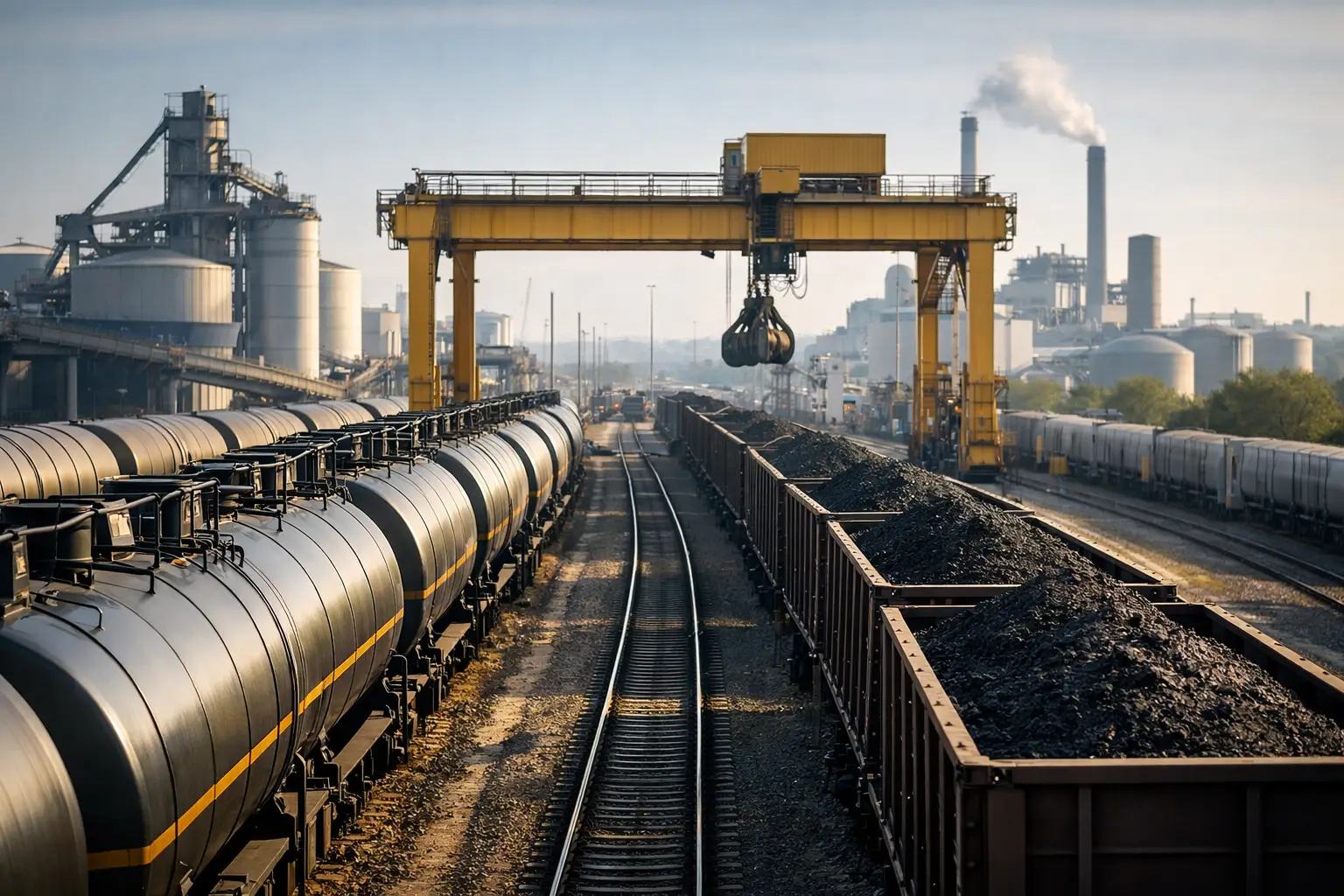
A poorly sized terminal doesn’t usually fail on day one. It fails when volume increases, when the yard becomes congested, when a railcar is stuck where it shouldn’t be or when switching consumes hours the operation hadn’t planned for. That’s why industrial rail terminal design isn’t an exercise in drawing lines on a plan. It’s a strategic decision that determines real capacity, safety, regulatory compliance and operating cost for years.
In industrial environments, the rail terminal doesn’t function as an isolated element. It’s connected to production rhythms, loading and unloading times, availability of pulling equipment, road access, inventories and logistics planning. If the design doesn’t start from that operational reality, the infrastructure ends up imposing restrictions on the plant instead of supporting its growth.
What defines good industrial rail terminal design
Good design isn’t necessarily the largest or the most expensive. It’s the one that precisely addresses the type of operation the facility will sustain. That means understanding how many railcars will be received per day or per week, how long they’ll stay in the yard, what type of goods will be moved, what safety restrictions apply and what switching moves must be carried out without affecting other critical areas.
The difference between an efficient terminal and a problematic one usually lies in decisions that seem minor at first. The usable length of a track, the location of a crossover, the sequence of crossings, the grade in a loading area or the curve radius can directly alter daily productivity. They can also accelerate premature track wear or limit the use of certain switching equipment.
At this point there’s a criterion worth making clear: designing for current demand is rarely enough. In industrial railway infrastructure, the cost of expanding after poor planning is usually much higher than the cost of providing a reasonable operating reserve from the outset.
The starting point: the operation, not the plan
Before defining alignments, turnouts or classification yards, the operation must be modeled. The central question isn’t how many tracks fit on the site, but what logistics sequence must happen every day without bottlenecks. That includes receiving, inspection, sorting, loading, unloading, temporary storage, building internal trains and dispatch.
A terminal for bulk products doesn’t behave the same as one for steel, automotive or hydrocarbons. Requirements for safety, containment, accessibility, dwell times and coordination with other assets change significantly. So does tolerance for downtime. At some plants, missing a switching window is an inconvenience; at others, it can stop entire production lines.
That’s why design must start from scenarios: a base scenario, a peak scenario and an expansion scenario. If only the average is considered, the terminal will look efficient on paper but will struggle on the days when real demand puts the infrastructure to the test.
Capacity, switching and internal flow
Capacity doesn’t depend only on the number of tracks. It depends on how much movement the terminal can sustain without recurring interference. A configuration with fewer but better-designed tracks can outperform a large yard with crossing paths and unnecessary switching moves.
Critical variables come into play here, such as receiving and departure track lengths, storage tracks, runaround tracks for a locomotive or railcar mover, loading and unloading points and the relationship between rail and road areas. When internal flow is well designed, moves are predictable, repeatable and safe. When it’s poorly planned, the operation depends on improvised solutions.
It’s also worth assessing at the design stage what type of equipment will perform the switching. Designing a terminal for a conventional locomotive is not the same as designing one for specialized in-plant rail switching equipment. Traction conditions, operable radii, visibility, grades and coupling zones may require different criteria. That detail has direct effects on productivity and availability.
Track geometry and long-term performance
In an industrial terminal, geometry isn’t a technical formality. It’s one of the factors with the greatest influence on safety, maintenance and operational continuity. Tight curves, poor transitions, poorly selected turnouts or inadequate grades increase mechanical stress, reduce component service life and raise operational risk.
Design must balance the site’s physical constraints with the real demands of the rolling stock and switching. Sometimes space forces compact solutions, but over-compacting is costly in maintenance, lost time and future limitations. This is one of the points where the difference between a design meant to build quickly and one meant to operate well is most noticeable.
The superstructure also matters from the start. Rail, ties, fastenings, ballast, sub-ballast and subgrade must match the type of load, frequency of use and industrial environment. Not every terminal needs the same specification, but reducing the specification to save on upfront costs usually shifts the cost to corrective maintenance and early rehabilitation.
Safety and compliance: two fronts that allow no shortcuts
An industrial rail terminal must be designed to move freight, but also to control risks. That includes personnel protection, flow separation, signaling, access points, crossing points, exclusion zones, lighting, drainage and compatibility with the plant’s internal protocols.
Regulatory compliance deserves a comprehensive view. It’s not just about the track meeting certain parameters. Permits, interconnections, industrial safety criteria, environmental constraints and specific requirements depending on product, sector and location must also be considered. If these variables are left for later phases, the project becomes more complicated, delayed and expensive.
In Mexico, moreover, coordination among engineering, permitting and construction shouldn’t be fragmented. When each front advances separately, incompatibilities arise that later affect construction and commissioning. A comprehensive approach reduces rework and gives the investor greater certainty.
Integration with the plant and the supply chain
One of the costliest mistakes in industrial rail terminal design is treating the terminal as a peripheral project. In reality, it’s a physical extension of the supply chain. If the railroad arrives smoothly but the product can’t flow efficiently to warehouses, silos, racks or process areas, the infrastructure is underused.
Integration with truck yards, scales, conveyors, pits, loading equipment, spill containment and control systems must be resolved from the conceptual engineering stage. It’s also necessary to coordinate operating windows with the line-haul railroad, crew availability and interchange rules. A technically correct terminal can still be inefficient if it isn’t aligned with the commercial logic of inbound and outbound materials.
This is a point where it’s worth thinking in complete cycles. How long does it take for a railcar to enter, be spotted, be serviced and leave? How many unproductive moves are generated? Which areas are blocked during a switching move? How much idle capacity is there during off-peak hours and how much pressure appears at peak times? That’s where the design reveals whether it was truly conceived for the operation.
Designing for maintenance and growth
Every terminal ages according to how it’s used and how it was designed. If inspection, access to components, drainage, material replacement and maintenance work are made easy from the start, the operation gains stability. If not, any adjustment becomes invasive and expensive.
It’s also reasonable to prepare the infrastructure for modular growth. It isn’t always advisable to build the entire expansion from day one, but it is wise to have corridors, reserves, connections and structural criteria in place that allow expansion without completely reconfiguring the terminal. That foresight provides financial and operational flexibility.
In demanding industrial projects, the advantage isn’t just in executing construction. It’s in connecting design, construction, equipment, maintenance and technical support under the same performance logic. That comprehensive vision is what allows a terminal to function as a strategic asset rather than a constant source of adjustments.
Track Speq works precisely at that intersection of engineering, execution and rail operations, where every design decision has a direct impact on business continuity.
The best terminal isn’t the one that impresses on the plan, but the one that keeps responding when the operation grows, changes or becomes more complex. Designing with that criterion from the outset usually makes the difference between an investment that supports the business and infrastructure that has to be corrected far too soon.
