
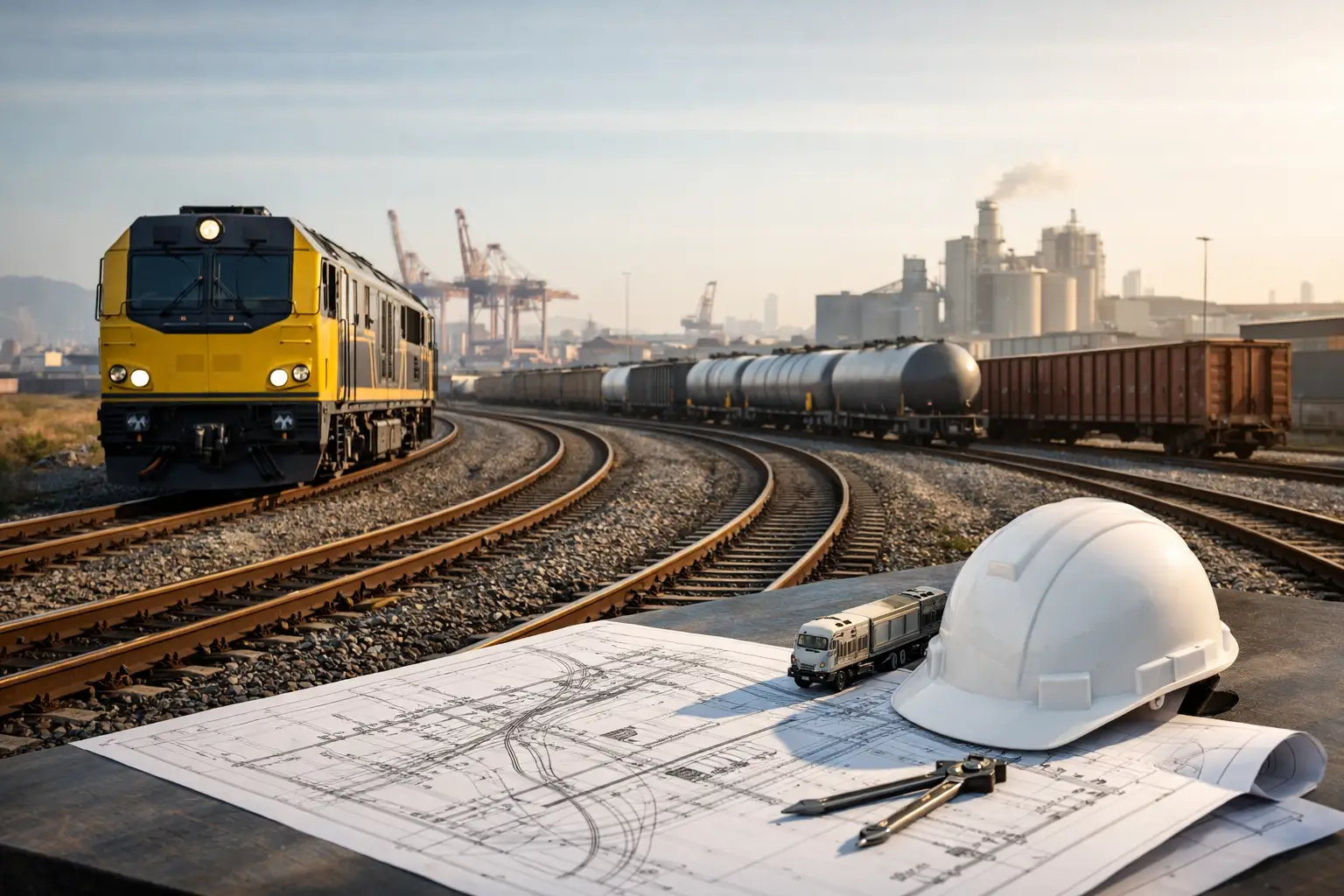
When a plant starts missing loading windows, congesting yards, or relying on improvised switching moves, expansion stops being a desirable improvement and becomes an operational decision. This industrial railway expansion guide is intended for managers who need to increase capacity without compromising safety, compliance, or production continuity.
Expanding railway infrastructure is not just about adding meters of track. The decision affects yard design, switching speed, coexistence with internal processes, equipment availability, future maintenance, and the regulatory framework. A well-conceived project reduces bottlenecks for years. A poorly defined one can create more restrictions than it solves.
What an industrial railway expansion guide should address
The first question is not how much to build, but what problem needs to be eliminated. In industrial environments, expansion usually responds to four scenarios: sustained volume growth, the addition of new products or flows, the need to improve loading and unloading times, or safety and compliance requirements that the current infrastructure can no longer support.
Each scenario requires a different approach. If the problem is capacity, a new receiving track or a runaround extension may be needed. If the bottleneck is switching, the real adjustment may lie in curve radii, turnouts, or rail-moving equipment. If the limitation comes from internal operations, expanding without redesigning access routes, crossings, loading areas, or holding yards is usually a costly mistake.
That is why a serious industrial railway expansion starts with a functional diagnosis. Actual track occupancy, dead time, switching frequency, interference with internal traffic, asset condition, and projected growth must be measured. The infrastructure should not be designed for today’s snapshot, but for a demanding and sustainable operation.
Planning: capacity, layout, and operational continuity
Planning determines the project’s profitability long before construction begins. At this stage, it is advisable to align operations, engineering, maintenance, safety, purchasing, and management. When expansion is defined solely from a technical desk, late adjustments tend to appear that drive up schedules and execution costs.
Designing for the actual flow, not the ideal drawing
An efficient industrial rail layout must respond to the type of train, the required usable length, inbound and outbound frequency, loading order, material segregation, and compatibility with the rest of the site. Serving an automotive flow with high operational discipline is not the same as serving a bulk terminal with variable windows and greater track wear.
You also have to decide whether the expansion should absorb peak demand or average demand. Designing only for the average reduces initial investment, but can leave the plant exposed during production campaigns, seasonal peaks, or changes in product mix. Designing for the absolute maximum, on the other hand, can oversize assets that never generate revenue. There is no universal answer here. It depends on the opportunity cost per unserved train and the criticality of rail within the logistics chain.
Keeping operations running during construction
In many industrial complexes, the biggest challenge is not technical but operational: how to carry out the work without halting shipments or compromising safety. This requires sequencing work fronts, establishing work windows, protecting interfaces with personnel, and coordinating material deliveries precisely.
A good practice is to divide the project into functional phases. That way, each completed section delivers partial value and reduces exposure. It is not always possible, but when the client needs continuity, constructability matters as much as engineering.
Permits, regulations, and site constraints
An industrial railway expansion in Mexico is rarely limited to calculations and civil works. There are regulatory constraints, connection criteria, documentation requirements, and approvals that must be resolved from the outset. If these fronts are addressed late, the project stalls when investment has already been committed.
The regulatory review should include rights-of-way, interfaces with railroad concessionaires or connected networks, operational safety, crossings, drainage, compatibility with existing facilities, and the industrial user’s own internal requirements. In addition, certain industries add restrictions due to the handling of hazardous substances, coexistence with high-risk processes, or international corporate requirements.
A comprehensive view is advisable here. The typical mistake is to split engineering, permitting, and execution among several suppliers without real coordination. When each party optimizes its own piece and no one manages the whole, design incompatibilities, rework, and cost overruns appear.
Railway construction: where success is usually decided
An expansion is not won in the project presentation, but in the quality of execution. Deficient earthwork, underestimated drainage, non-uniform materials, or poorly specified turnouts end up affecting geometry, availability, and maintenance costs.
Substructure and drainage
In industrial environments, drainage is often underestimated. However, track that sits on a saturated subgrade or has poor drainage loses stability, accelerates geometric defects, and multiplies corrective interventions. The problem does not always appear in the first month. Sometimes it emerges after the first rainy season, when correcting it costs more and affects operations.
Materials and components
Not all projects require the same standard of rail, fastening, tie, or hardware. The selection depends on axle load, intensity of use, corrosive environment, switching speed, and maintenance strategy. Buying on unit price without considering life cycle is a bad decision at almost any industrial terminal.
Supply traceability also matters. In an expansion, delays do not just make the work more expensive. They can throw off operating windows, contracted equipment, and the client’s logistics commitments. That is why working with an ecosystem that combines execution and supply reduces friction and improves control.
Rail switching and equipment: capacity does not depend on track alone
Many expansions fail because they add infrastructure but do not solve switching. A longer track is of little use if the yard still has slow movements, interference, or dependence on resources that are insufficient to handle the new capacity.
The review should include switching equipment, operating radii, visibility, coupling points, positioning sequence, and preparation times. In some cases, adding or upgrading railcar movers changes yard productivity more than a marginal track extension.
This point is especially relevant when the expansion seeks to reduce dependence on third parties, gain autonomy within the plant, or improve response times. Infrastructure and equipment must be thought of as a system. Separating them leads to partial investments.
Maintenance from the design stage
A useful industrial railway expansion guide does not end at startup. If the solution does not incorporate maintenance criteria, future availability will be compromised. The real cost of track lies not only in building it, but in keeping it in safe and predictable condition.
Designing with maintenance in mind means making inspection easier, providing access to critical points, specifying materials suited to the environment, and establishing a preventive program from the start. It also requires identifying which assets will need the most attention: turnouts, transition zones, internal crossings, areas contaminated by product, or segments exposed to mixed traffic.
A mature approach combines preventive maintenance with corrective response capability and a reasonable stock of critical components. This prevents a relatively minor incident from turning into a major impact on production or shipping.
How to evaluate whether the project is well conceived
Before approving an expansion, it is worth checking whether the project clearly answers five questions. Does it increase usable capacity and not just meters built? Can it be executed without compromising operational continuity? Does it comply with the applicable regulatory framework? Is it aligned with the site’s actual switching operation? And can it be maintained at reasonable cost over its service life?
When a proposal does not address these points, the risk is not always visible in the initial budget. It usually appears later, in the form of delays, operating restrictions, premature maintenance, or underused assets.
For companies with complex operations, the value does not lie in contracting separate pieces, but in working with a partner capable of integrating engineering, permitting, construction, materials, equipment, and technical support under a single operating logic. That approach reduces blind spots and speeds up decision-making. That is where a firm like Track Speq provides a clear advantage.
A well-executed industrial railway expansion is not meant to impress with more infrastructure. It pursues something more demanding: that every meter added truly improves the operation, supports growth, and keeps the business moving when demand intensifies.
