
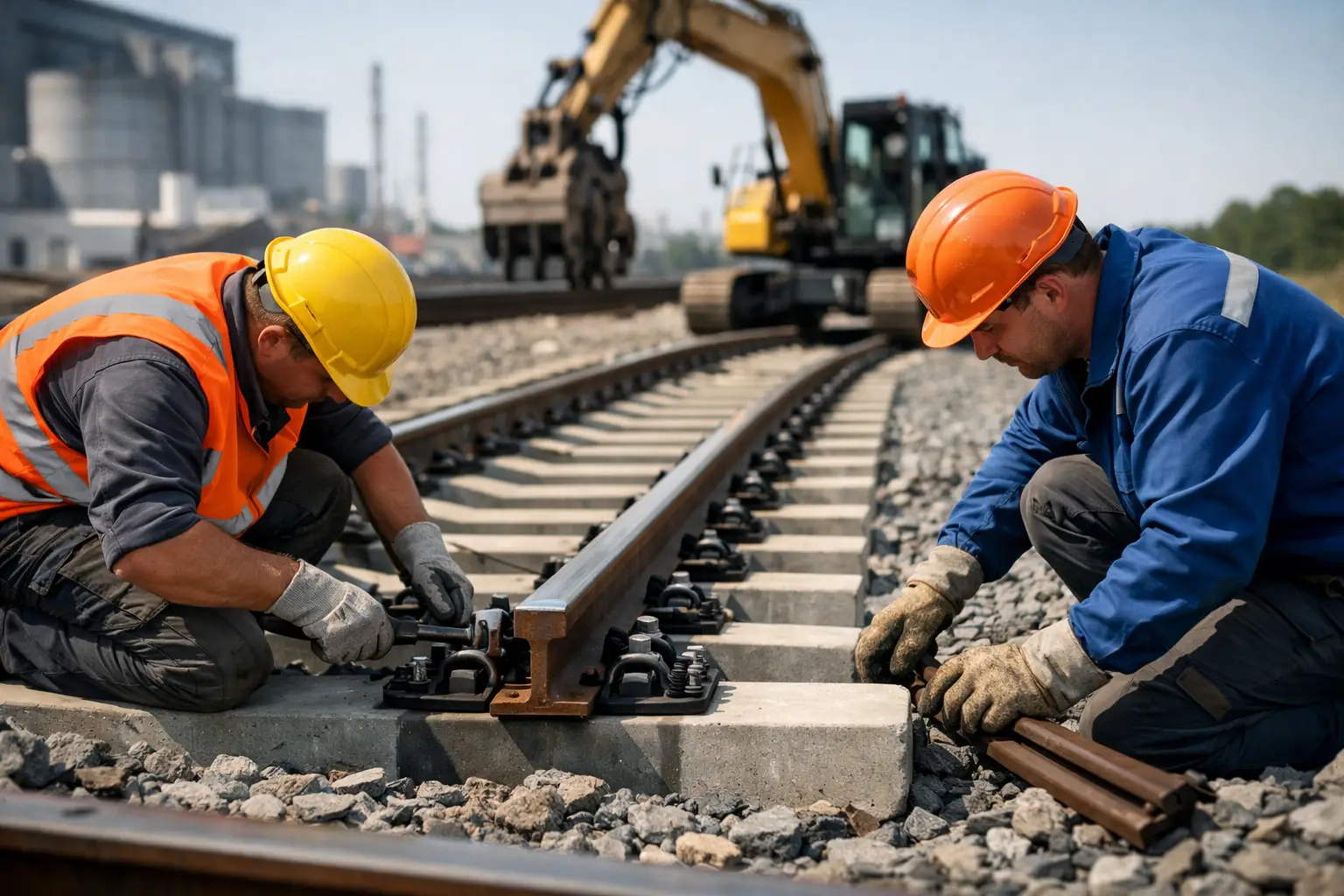
Industrial Railway Track Installation Without Errors
A rail yard doesn’t fail all at once. It starts with small misalignments, poorly controlled settlement, fastenings that loosen too soon and switching moves that stop flowing smoothly. That’s why industrial railway track installation shouldn’t be seen as an isolated construction phase, but as an operational decision that affects productivity, safety, maintenance and total cost of ownership from day one.
In industrial and logistics environments, the track doesn’t just connect loading and unloading points. It also determines switching speed, equipment stability, rolling stock service life and the ability to grow without rebuilding the infrastructure. When installation is handled with real railway expertise, the operation gains continuity. When it’s improvised, the problem soon shows up as restrictions, rework and downtime.
What defines a good industrial railway track installation
The difference between a track that simply meets requirements and one that sustains a demanding operation lies in integrating the variables. It isn’t enough to lay rail, ties and hardware according to the drawings. You have to read the full context: type of load, switching frequency, axle load, available radii, interaction with yards, crossings, drainage, subgrade and regulatory requirements.
In an industrial facility, the track also usually coexists with internal traffic, loading equipment, platforms, buildings, pipelines and space constraints. That requires installation with geometric precision and a clear view of future maintenance. A seemingly economical solution can turn out to be expensive if it complicates component replacement, accelerates wear or limits the customer’s operation during demand peaks.
It’s also important to distinguish between track for occasional light service and infrastructure designed for a heavily used terminal. The same installation method doesn’t work for every case. The right standard depends on expected performance, not just the initial budget.
Up-front engineering: where the project is won or lost
Before starting any work front, engineering must clearly define the track’s function. An intermittently served spur is not the same as a classification yard or a loading area with recurring switching moves. That definition changes the rail type, tie spacing, fastening system, turnout configuration and the treatment of the track bed.
Installation quality depends much more on site preparation than is usually acknowledged. If the subgrade lacks adequate bearing capacity or drainage is underestimated, geometry begins to degrade even if the surface installation was done correctly. In industrial areas, this point is critical because the ground may have been previously disturbed, contain heterogeneous fill or coexist with underground installations that constrain compaction.
This stage also defines operational compatibility with the rest of the facility. Usable lengths, connection points, clearances, maintenance access and coexistence with switching equipment are not secondary details. They are part of the real return on the investment.
Materials and specification: not every rail is fit for the same purpose
In industrial railway track installation, material selection must follow a service logic. Rail, ties, plates, fastenings, bolts and turnouts must be specified according to loads, switching cycles, operating environment and maintenance strategy.
Choosing materials based only on immediate availability often creates incompatibilities or unnecessary technical compromises. For example, a poorly matched combination of rail and fastening system can accelerate hardware loosening. Likewise, a turnout poorly selected for the intensity of use can become the first point of failure in the yard.
There’s another factor technical buyers know well: traceability. In serious industrial projects, having material delivered on site isn’t enough. You need certainty about specification, condition, compatibility and expected life. That discipline reduces risks during installation and avoids costly corrections when the operation is already committed.
Field execution: precision, sequence and control
The construction phase requires more than building capacity. It requires railway judgment in the installation sequence. Leveling the track bed, placing ballast or an equivalent structure per the design, distributing and squaring ties, laying rail, fastening, alignment, leveling and final adjustment must all be carried out with clear controls.
A common mistake is to speed up linear progress at the expense of intermediate checks. That may give a feeling of productivity on site, but later forces corrections to geometry, re-tamping of critical areas or rework of joints. In industrial yards, where margins are tight and switching requires precision, those deviations quickly translate into operating restrictions.
Turnout installation deserves specific attention. Turnouts are highly sensitive components, both mechanically and geometrically. If their installation doesn’t respect tolerances, supports, fastenings and a proper transition to the adjacent track, wear concentrates there. And when a switch fails, the impact on the operation is usually disproportionate.
That’s why survey control, technical supervision and tolerance validation are not a formality. They are the filter that separates a finished track from a track that is truly ready to operate.
Safety and compliance: an operational requirement, not a paperwork one
In industrial railway projects, regulatory compliance shouldn’t be seen as a parallel formality. It affects decisions on design, construction, signaling, crossings, safety distances, accessibility and operation. A correct installation incorporates that dimension from the start to avoid late adjustments that increase cost and delay commissioning.
The same applies to job-site safety. Working in active plants, expanding terminals or areas with personnel and heavy equipment traffic requires detailed planning, realistic work windows and coordination with the customer’s operation. Railway construction can’t be carried out as if the site were isolated from the rest of the business.
When the supplier understands both the infrastructure and the customer’s operational logic, execution becomes more orderly. Interference is reduced, risks are better controlled and the transition from construction to operation is much more stable.
Rehabilitate or build from scratch: it depends on the existing asset
Not every project requires new track. In many cases, the right decision is to rehabilitate. But that route only works if the technical assessment of the asset is honest. There are sections where the rail can be kept and the problem lies in the support structure. In others, the degradation of fastenings, turnouts or accumulated geometry makes a comprehensive intervention more cost-effective.
The answer depends on the level of service required. If the plant is going to increase frequencies, move heavier loads or integrate new logistics areas, a superficial rehabilitation may fall short. On the other hand, for certain moderately used operations, a well-executed selective strategy can extend service life without oversizing the investment.
The key is to avoid a fragmented approach. Replacing only what’s visible rarely solves the underlying problem. Track works as a system, and installation or rehabilitation must treat it as such.
The real impact on costs and operational continuity
Operations managers usually measure the project’s CAPEX first. That’s normal. But in industrial railway track, the decisive cost appears over time: recurring corrective maintenance, slower switching, load restrictions, premature component wear and disruptions to shipping windows.
A well-executed installation reduces that friction from the start. It makes inspection easier, holds geometry longer and allows preventive maintenance to be planned instead of reacting to failures. That improves infrastructure availability and gives the supply chain more certainty.
For companies with continuous operations or cross-border supply commitments, that reliability is worth more than any miscalculated upfront savings. The track stops being a construction expense and becomes a performance asset.
What a technical buyer or operations director should demand
When evaluating a supplier for industrial railway track installation, it’s worth looking beyond unit price or construction scope. The central question is whether that supplier can take responsibility for the complete system: engineering, materials, execution, safety, operational compatibility and subsequent maintenance.
When those capabilities are fragmented, responsibility gaps appear. The designer blames the installer, the installer blames the supplier and the customer ends up absorbing the cost of coordination and errors. By contrast, working with a partner that understands the infrastructure, the equipment and the operational logic enables faster, better technically supported decisions. That approach is especially valuable in projects where the start-up schedule allows no deviations.
Track Speq works at exactly that level of integration, combining railway construction, specialized supply, technical support and operational assistance for projects that can’t afford partial solutions.
The best decision for an industrial track isn’t the one that looks fastest on paper, but the one that keeps working when demand grows, switching intensifies and the operation no longer has any margin for failure. That’s where a well-planned installation proves its true value.
A well-installed industrial railway track doesn’t just carry loads: it sustains the continuity, safety and efficiency of the entire operation. Evaluating the project from the standpoint of engineering, maintenance and switching makes it possible to reduce risks, anticipate costs and build infrastructure ready to grow.
At Track Speq, we bring together technical expertise in railway design, construction, rehabilitation and maintenance to develop solutions aligned with each industry’s real operation.
Learn more at en.trackspeq.com or email us at ventas@trackspeq.com to review your railway project with a technical, safe and efficient approach.
