
A turnout that loses geometry, a fastening that loosens too soon or an incorrectly specified rail are not minor incidents. In an industrial operation, railway track material determines terminal availability, switching safety and the real cost of maintenance for years. That’s why buying on unit price usually ends up being expensive.
In logistics and industrial environments, the track doesn’t behave as an isolated element. It responds to axle loads, switching frequency, type of rolling stock, soil conditions, drainage, fines contamination, operational crossings and regulatory requirements. Material selection must start from that context. When it doesn’t, the same symptoms appear: accelerated wear, repeated corrective interventions, operating restrictions and a service life shorter than expected.
What railway track material means
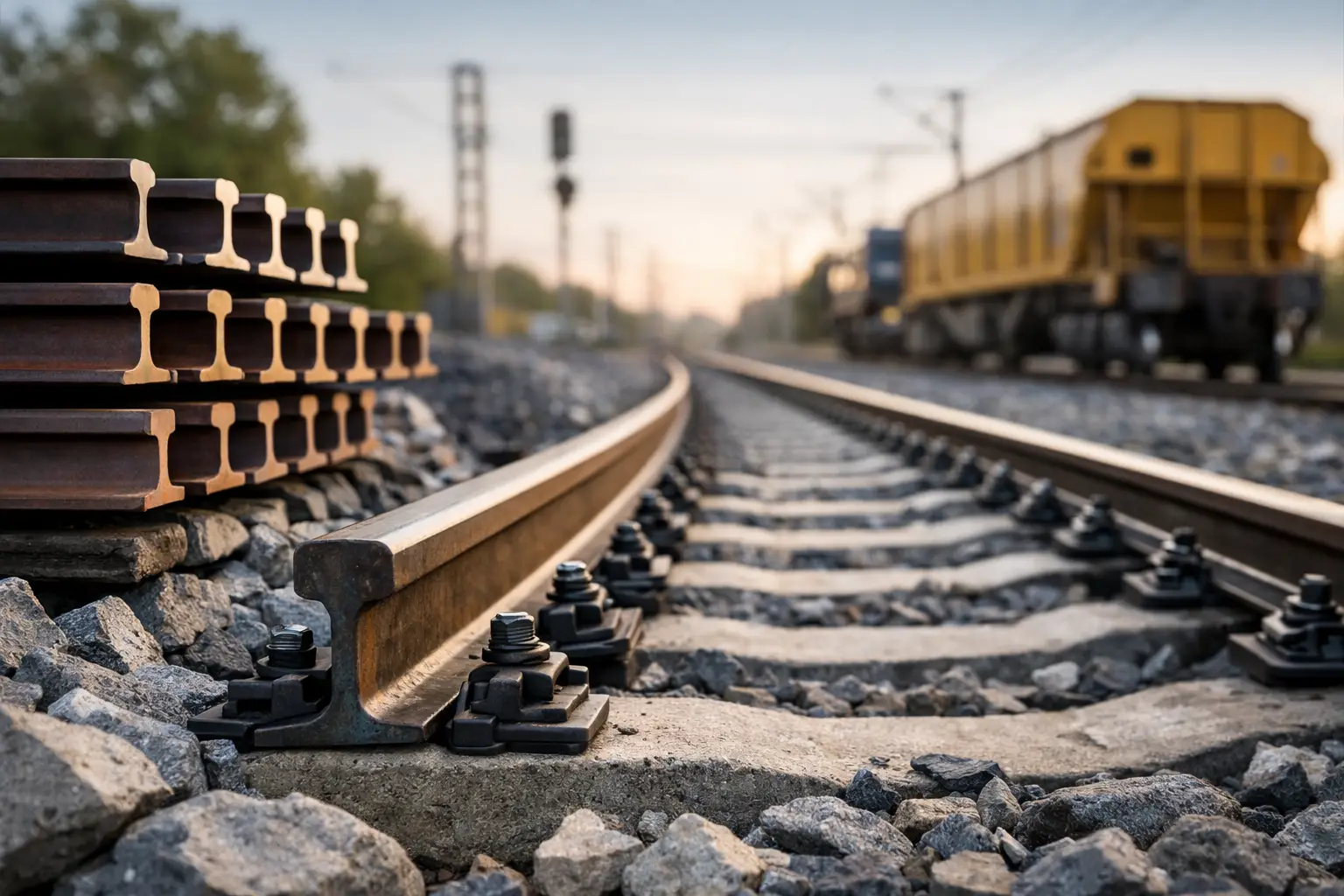
Talking about railway track material isn’t just talking about rail. The system includes rails, ties, tie plates, fastenings, joint bars, screw spikes, clips, insulated joints, switches, frogs, hardware, ballast and auxiliary safety and signaling elements associated with the infrastructure. Each component works together to maintain geometry, distribute loads and absorb dynamic forces.
The practical implication is clear: a correct specification can’t be made item by item. A high-quality rail installed on an unsuitable tie or combined with a poorly selected fastening won’t deliver the expected performance. Track always responds as a system.
The purchasing criterion that really matters
In industrial purchasing, the usual temptation is to compare seemingly equivalent part numbers and close the decision based on availability or immediate price. That approach may work for consumables, but not for railway infrastructure. Here, what’s decisive is the total cost of ownership.
That cost depends on several factors: expected service life, behavior under load, ease of maintenance, compatibility between components, replacement lead times and the operational risk associated with a failure. A cheaper material may require more maintenance windows, keep equipment idle longer or shorten the life of other track components. By contrast, a specification well aligned with the operation reduces incidents and stabilizes spending over the medium term.
There’s also a point that is often overlooked: technical traceability. In demanding operations, simply receiving material isn’t enough. You need to know which standard it meets, what tolerances it holds, what certificates back it and whether its integration with the rest of the infrastructure has been validated. That documentation isn’t red tape. It’s risk control.
Railway track material by type of operation
Not all terminals need the same thing. A plant with slow, highly repetitive switching has a different wear pattern than a facility with heavier trains, mixed traffic or expansion planned in the short term. Choosing well requires reading both the current and the future operation.
Rail and rail section
The rail section must match the tonnage, the type of traffic and the maintenance strategy. Oversizing can raise investment without real benefit if the operation is light. Undersizing, on the other hand, accelerates wear and compromises geometric stability. In industrial sidings and private terminals, the most common mistake is copying specifications without checking whether they match the site’s actual traffic.
Ties and support system
The choice between different types of ties and support configurations depends on the environment, the availability of maintenance and ground conditions. Some solutions offer good initial performance but require an inspection discipline that not every operation can sustain. Others have a higher upfront cost but are more stable where the priority is to minimize interventions.
Fastenings, hardware and joints
This is where much of day-to-day reliability is decided. Incorrect fastenings lead to unwanted movement, loss of clamping force, fatigue and recurring geometry defects. The same happens with hardware and joints when they aren’t properly specified for the actual stresses on the track. They are less visible components than the rail, but decisive in preventing recurring failures.
Turnouts
Switches and frogs deserve separate attention. They are points of high mechanical demand and, at the same time, sensitive areas for operational continuity. In terminals with frequent switching, a poorly selected or poorly maintained turnout quickly becomes a bottleneck. Here it’s wise to prioritize design, installation precision and spare-parts availability, not just purchase price.
Regulations are not a formality
In the railway field, regulatory compliance affects design, construction, operation and maintenance. That’s why material selection can’t be separated from the permits, applicable specifications and safety criteria required in each project.
For an operations or engineering manager, this has a direct consequence: working with the right materials outside the regulatory context can delay commissioning, trigger technical observations or complicate audits and inspections. Regulatory compatibility must be validated during the specification phase, not when construction is already well underway.
In addition, when the infrastructure serves supply chains connected to international customers, documentation requirements increase. In those cases, supply quality isn’t measured only by the product delivered, but by the supplier’s ability to back it technically and from a regulatory standpoint.
Common mistakes when selecting railway track material
The first is splitting the purchase among multiple suppliers without a systems view. It may seem like a way to optimize cost, but it often complicates compatibility, warranties, traceability and response times. When an incident occurs, no one takes ownership of the whole problem.
The second is specifying with outdated information. Many terminals today operate with loads, frequencies or equipment different from those envisioned in the original design. If material is replaced with the logic of ten years ago, the track starts working outside its real conditions.
The third is failing to link supply and maintenance. Some technically correct materials fail prematurely because they weren’t installed with the proper torque, alignment or inspection. The best purchase loses value if it isn’t integrated into a coherent upkeep plan.
How to evaluate a supplier beyond the catalog
In this market, the right supplier isn’t the one that only delivers material. It’s the one that understands the application, validates compatibility, anticipates risks and responds when the operation can’t stop. For an industrial terminal, that difference matters more than a marginal price variation.
It’s worth checking whether the supplier can support engineering, supply, installation, maintenance and technical support. Also whether it has the capacity to handle rehabilitations, expansions or urgent replacements without breaking project continuity. When these functions are concentrated in a single point of contact, operational friction is reduced and decision-making speeds up.
That is one of the advantages of a full-service model like Track Speq’s: track material specification isn’t treated as an isolated sale, but as part of the overall performance of the infrastructure and its long-term operation.
The right conversation doesn’t start with price
It starts with tougher questions. What actual loads does the track carry? Which switching moves generate the most wear? Which failures recur today? What is the cost of an unscheduled maintenance window? Will there be traffic growth, new customers or changes in rolling stock? Without those answers, any commercial comparison is incomplete.
A technically mature purchase considers availability, service life, maintainability, safety and compliance. It also accepts that there isn’t always a single solution. In some cases it’s best to prioritize extreme durability, and in others what matters more is replacement speed or ease of intervention. It depends on the operating profile, the criticality of the track and the customer’s industrial strategy.
Well-engineered railway infrastructure rarely draws attention. It works, sustains the operation and allows the plant to keep its pace without surprises. That is the true standard when it comes to railway track material: not buying parts, but ensuring operational continuity with technical judgment from day one.
If a terminal depends on rail to move business, every decision about the track should be made with the same rigor as for any critical production asset.
