
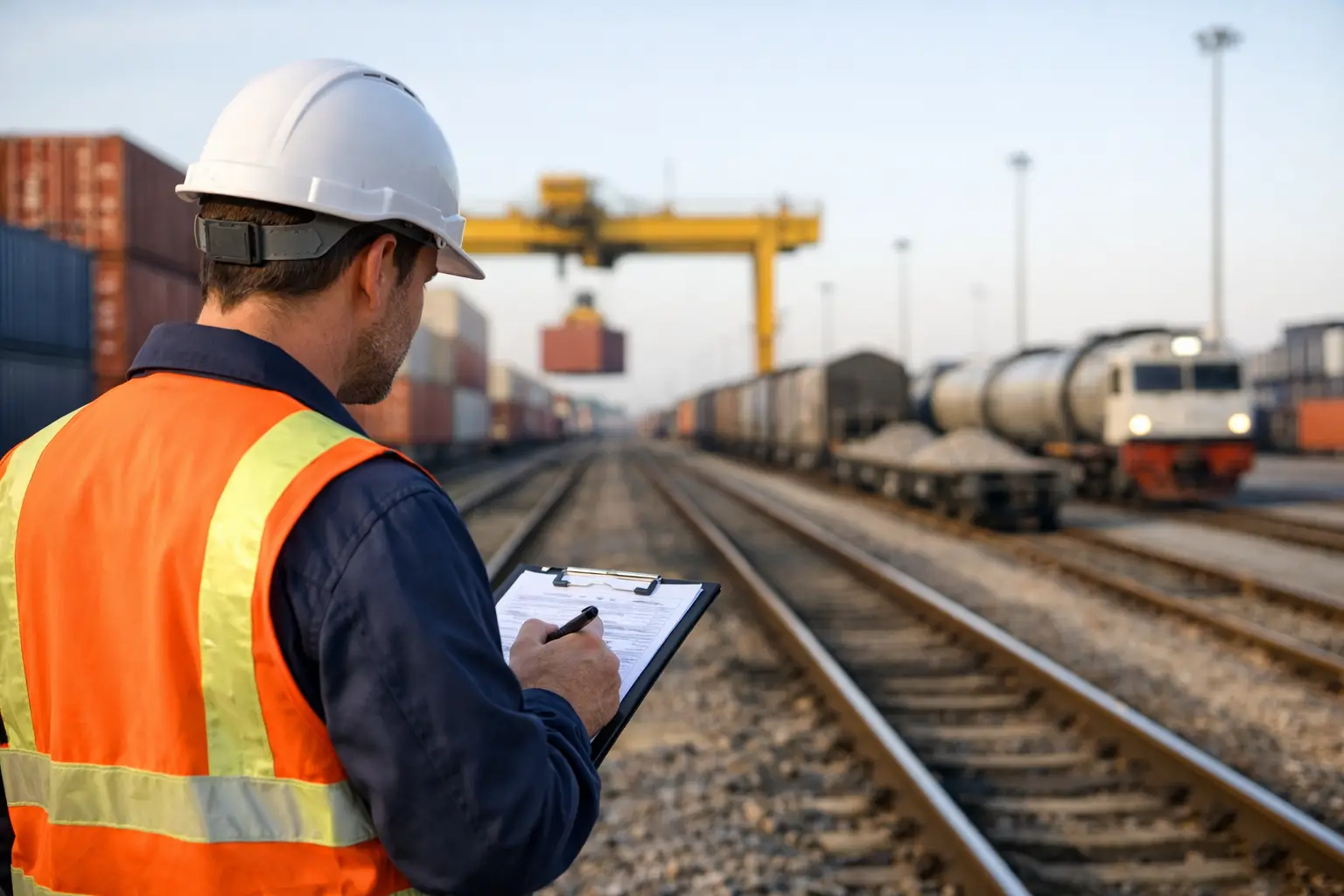
A terminal can keep its tracks apparently operational and still accumulate conditions that end in speed restrictions, equipment damage, slow switching or downtime. A rail terminal inspection guide should turn that uncertainty into verifiable findings, technical priorities and work orders that protect plant continuity.
For an industrial operation, inspection is not walking the infrastructure with a generic checklist. It is verifying whether the track, turnouts, crossings, drainage, signage and switching equipment are suited to the terminal’s actual loads, frequencies and conditions. The criterion is not just to detect an anomaly, but to determine its impact on safety, capacity and operating cost.
What a Rail Terminal Inspection Should Cover
The scope should start with the facility’s operating map: access points, receiving and departure tracks, loading or unloading spurs, crossovers, scales, internal crossings, storage areas and switching areas. Each zone has a different criticality. A minor defect on a secondary track can be scheduled; the same condition on the main access can compromise the entry of full trains.
Effective inspection combines visual review, measurements, functional tests and analysis of records. It must also consider the surroundings: truck traffic, product contamination, standing water, vibration from heavy equipment, vegetation and third-party work. These factors often accelerate track deterioration more than the passage of railcars itself.
It is advisable to define the inspection frequency from the outset based on level of use and risk. Areas of intense switching require more frequent operational walk-throughs than storage tracks. There is no single interval valid for all terminals: it depends on tonnage, authorized speed, type of commodity, network geometry and the requirements applicable to each facility.
Track Inspection: Where Operational Risks Begin
The superstructure review should follow the direction of traffic and leave evidence of each finding. The rail is examined for wear, visible cracks, impact damage, corrugation, burrs, deteriorated joints and abnormal conditions at welds. In braking zones, tight curves and areas frequently traveled by locomotives or railcar movers, wear can concentrate and require a specific assessment.
Ties deserve direct attention. Their structural condition, holding capacity, seating, the presence of breaks, rot in the case of wood ties, and damage from impact or contamination should be verified. A deteriorated tie is not an isolated problem if it allows rail movement or loss of track gauge.
The ballast and roadbed also determine stability. Fouling by fines, insufficient section, pumping, settlement, vegetation, spilled material and areas with retained water must be identified. Adding ballast without correcting poor drainage may improve the track’s appearance for a short time, but it does not solve the cause of the settlement.
Track Geometry and Continuity
Measuring gauge, cross level, alignment, superelevation and twist makes it possible to move from a visual impression to a technical diagnosis. Acceptable tolerances should be tied to the speeds, loads and operating standards defined for the terminal. A deviation that does not justify immediate intervention may require closer monitoring and a temporary operating restriction.
Joints, tie plates, lag screws, clips, anchors and other hardware must also be checked. Missing or loose components encourage rail movement and worsen the dynamic effects of each pass. Documenting the exact location is essential: a note such as “track with defective hardware” does not allow materials to be planned or the subsequent repair to be verified.
Turnouts, Crossings and Transition Zones
Turnouts concentrate much of a terminal’s technical risk. Loads change there, moving parts multiply, and dirt tends to build up that prevents proper closure. The inspection must confirm the condition of switch points, stock rails, frogs, guard rails, switch rods, fastenings, switch machines or throw mechanisms, as well as the cleanliness of the area.
It is necessary to verify that the switch points seat correctly and that the throw is complete. If the switch is manually operated, personnel must be able to throw it without abnormal effort and apply the corresponding locking system. If it is powered, the functional test must verify indication, interlocking and failure response, in accordance with the facility’s design.
Road, yard or internal roadway crossings require an additional criterion. The pavement must provide a stable crossing without encroaching on the rail flangeway, and signage must be visible to drivers, pedestrians and plant personnel. A deteriorated crossing produces impacts that damage both the pavement and the track geometry, as well as increasing the risk to vehicles outside the rail operation.
Drainage, Clearances and Site Conditions
Water is one of the most revealing indicators of a poorly maintained terminal. During inspection, clogged ditches, insufficient slopes, discharges that erode the roadbed and spots where mud forms must be located. After heavy rains, a special inspection can detect failures that a dry-weather walk-through may conceal.
The clearance envelope must be kept free along the entire operating route. Branches, temporary structures, stacked goods, pipes, mobile equipment and anything that could encroach on the rolling stock’s safety envelope are checked. This verification is especially important at terminals that grow in phases, where new industrial facilities are built close to existing tracks.
The inspection should also include cleanup of spills, waste and loose materials. In sectors such as food, steel, dry bulk or hydrocarbons, the nature of the product can completely change the cleaning method, the slip risk and the level of protection required for personnel.
Signage, Switching and Operational Coordination
Track in good condition does not make up for an operation with insufficient signage or ambiguous procedures. Clearance point markers, switch indicators, crossing protection, bumpers, track identification and operational markings must be verified. Signage must be legible, in position and reflect the terminal’s current configuration.
It is also advisable to observe an actual switching move. This validation reveals problems that do not appear in a static review: poor radio communication, limited visibility, mismatches between procedure and track design, unsafe coupling areas or excessive time spent on changes of direction.
When the terminal uses railcar movers, the infrastructure inspection should be coordinated with the equipment inspection. Tractive capacity and the condition of brakes, lights, safety systems, couplers and tires influence how switching behaves on grades, curves and pavement next to the track. Separating the two reviews can leave a shared operational risk unanalyzed.
How to Classify Findings and Turn Them into Action
An inspection only adds value when it sets clear priorities. Each finding should include location, description, photographic evidence where applicable, observed condition, risk, temporary measure and recommended action. Classification can be organized into four levels:
- Critical: requires stopping traffic, isolating the section or imposing an immediate protective measure.
- High: affects safety or availability and must be corrected as a priority, with restrictions while work is performed if necessary.
- Medium: does not prevent current operations, but may worsen and should be included in the next maintenance window.
- Low: corresponds to early-stage deterioration, housekeeping or improvements that can be planned with no immediate impact.
Priority should not depend solely on visual severity. A moderate anomaly on an access turnout, on a daily loading track or next to a personnel area may be more urgent than a major defect on an unused track. The analysis should weigh probability of failure, consequence, exposure and ease of intervention.
Records, Traceability and Preventive Maintenance
The report should support decision-making, not just archive issues. That is why each finding should be linked to a work order, responsible party, target date, required materials and closure criteria. After the work, a reinspection verifies that the cause was corrected and not just the symptom.
Historical records reveal patterns: the same spot that keeps losing surface, a turnout that requires recurring adjustment or a crossing that deteriorates after every rainy season. This information makes it possible to justify a thorough rehabilitation instead of repetitive repairs that consume budget and operating windows.
Track Speq applies this approach from infrastructure to switching: inspect, diagnose, intervene and sustain the asset throughout its operating life. For the plant manager, the goal is specific: every available track must maintain the capacity, safety and predictability that the cargo flow demands.
A reliable rail terminal is not defined on the day it is commissioned. It is built through every well-executed inspection, every properly prioritized finding and every repair that eliminates the cause of a problem before it reaches the operation.
