
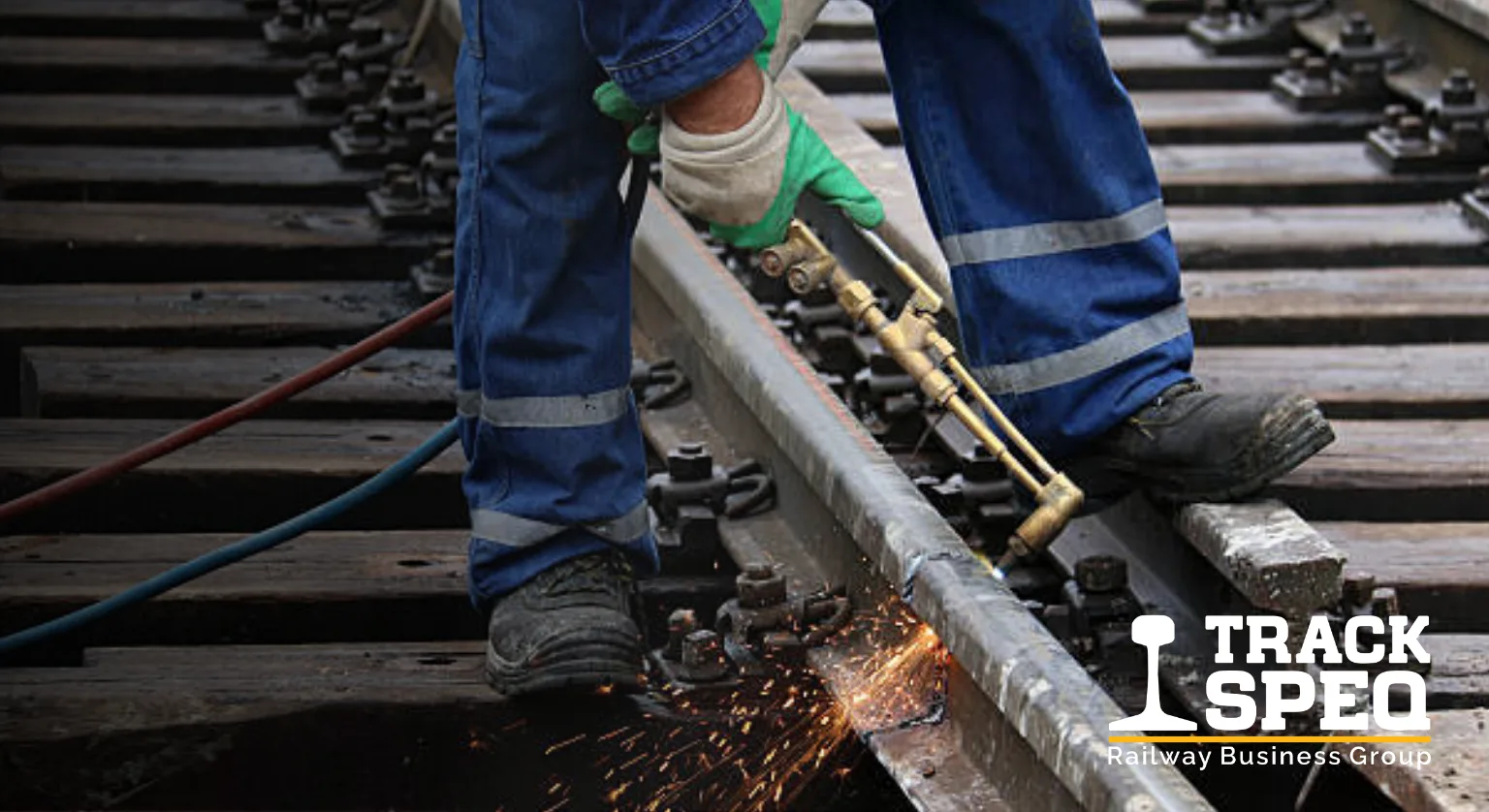
The day a plant misses its shipping window because of a track condition, the conversation stops being technical. A car that cannot enter the loading area stops a production line, moves a shipping date and, when the spur connects to a main line, exposes the plant to the railroad concessionaire restricting movement until the condition is corrected. The cost of that day rarely shows up in the maintenance budget: it shows up in the operations budget, in the logistics budget and, if the event repeats, in the conversation with the end customer.
Industrial track degrades silently. Unlike a plant machine, it does not sound an alarm or increase its consumption: it accumulates millimetric settlement, fasteners that loosen, drainage that clogs and ties that lose their holding capacity, until one day a car derails at five kilometers per hour inside the yard. That low-speed derailment, which almost never causes injuries, does cause hours of interruption, a crane, rerailing, a follow-up inspection and a repair quoted as an emergency.
The way to anticipate that scenario is a contract, not a phone call. And that is where the hard part begins. Most operations managers know they need track maintenance, but they come to the negotiating table without their own criteria for what that contract should include, how often it should be performed, which parameters are measured, what documentation should be delivered at closeout and how to compare two proposals that arrive with very different numbers. These are five decisions made by whoever authorizes the spending, and none of them is resolved by reading a quote.
What Comprehensive Maintenance Means in an Industrial Yard and How It Differs from the Main Line
Comprehensive maintenance means that a single party covers the full cycle: scheduled inspection, diagnosis, defect correction, supply of the material the correction requires, the track machinery to perform it and the car movements needed to clear the section. When those pieces are contracted separately (one contractor for the work, one supplier for the material, a rental for the machinery and the plant itself for switching), the client ends up managing coordination among four third parties during a window that is almost always short.
The difference from the main line is one of nature, not size. A main line is maintained to sustain speed and tonnage: the dominant criterion is geometry under dynamic loading at 60, 80 or 100 kilometers per hour. An industrial yard is maintained to sustain availability and safety during switching. There, speed rarely exceeds 10 kilometers per hour, but the frequency of starts, stops and changes of direction is extremely high, turnouts are thrown dozens of times a day and the track coexists with forklift traffic, product spills, crossings with internal roads and, in many cases, track embedded in concrete that makes it impossible to inspect the ties.
That difference changes where wear shows up. On the main line, the critical point is usually rail on curves and geometry on long tangents. In an industrial yard, the critical points are turnouts, joints, drainage and loading and unloading areas, where the car stands under load for hours and transmits a static load that the main line never sees. A maintenance program copied from the main line ignores those three points and spends the budget on the wrong section.
Preventive, Corrective and Predictive: What Each Yard Needs
All three types of maintenance coexist in any yard; what changes is the proportion and the criteria for allocating budget among them.
| Type | What it is | When it is performed | Which yard it suits as the dominant strategy | Consequence of skipping it |
|---|---|---|---|---|
| Preventive | Inspection and correction scheduled by calendar or by accumulated tonnage, before the defect reaches the tolerance limit | On fixed dates, with an agreed window and scope defined in the contract | Every yard with regular operations. It is the foundation on which the other two are built | The defect is discovered when it already forces movement to be restricted or suspended |
| Corrective | Repair of a defect that is already present: rail replacement, tie replacement, surfacing, turnout repair | When detected during inspection, or as an emergency after an event | Yards with aging infrastructure in the process of recovery, while the overall condition is stabilized | Defects accumulate and the repair goes from spot work to rehabilitation of an entire section |
| Predictive | Instrumented measurement that anticipates failure: ultrasonic testing for internal rail defects, geometry measurement, trend analysis between inspections | At a defined frequency on critical assets, or when history shows accelerated degradation in a section | High-density yards, hazardous cargo or operations where an interruption has a high hourly cost | It is replaced by visual judgment, which does not detect internal rail defects until they show up as a fracture |
The practical rule for operations management is simple: preventive is contracted, corrective is budgeted and predictive is justified. Preventive maintenance must be in the service agreement with frequency and scope in writing. Corrective maintenance must have an allocated reserve, because assuming there will be no corrective work in a given year is what later forces emergency purchases. And predictive maintenance is justified when the cost of an hour of interruption clearly exceeds the cost of measurement: in an automotive terminal or a chemical plant, that calculation usually favors predictive maintenance much sooner than people think.
Maintenance Agreement vs. On-Call Intervention
A maintenance agreement is a contract with a term, scope, frequency and price defined in advance. An on-call intervention is a quote requested once the problem already exists. The commercial difference is obvious; the operational difference is even more so.
Under an agreement, the supplier knows the yard, has the history of every section, knows which materials turn over and schedules its crew in advance. Under on-call work, each intervention starts from scratch: diagnosis, quote, internal approval, purchase order, crew availability and material sourcing. That administrative path, not the repair, is what consumes most of the time in a track emergency. A plant that operates on an on-call basis often discovers that weeks passed between detection of the defect and the start of the repair, not because no one wanted to solve it, but because each step required a signature that had not been planned for.
The agreement also changes the client’s position with the concessionaire. When the spur connects to a main line and the concessionaire requests evidence that the track is being maintained, a current contract with documented reports answers that request on the spot. Without it, the answer has to be put together in a rush from whatever can be found in the files.
What Activities a Comprehensive Maintenance Contract Should Cover
This is the point most underestimated during negotiation and most missed when something fails. The inspection scope that Mexican standard NOM-003-ARTF-2023 requires to be documented in its conformity assessment procedure serves as a solid reference, adapted to the reality of an industrial yard. Each activity is listed with the consequence of leaving it out, because a proposal that omits a line item is not cheaper: it is shifting that line item to the client.
- Routine track inspection. Walking or vehicle inspection at a speed that allows real observation; the standard limits passage through crossings and switches to 8 km/h (5 mph). Without a frequency written into the contract, inspection becomes a sales visit in disguise.
- Visual rail inspection and internal defect detection. What is visible is wear, flattening and surface cracking; what breaks a rail is usually an internal defect that only shows up with ultrasonic testing. Omitting nondestructive testing leaves out precisely the failure that causes derailments.
- Inspection of switches, turnouts and special trackwork. This is the component with the most moving parts and the one operated most often in a yard. A switch with play in the switch stand or an obstructed flangeway causes derailments at switching speed.
- Inspection of bolted, welded and insulated joints. The joint is the structural weak point of conventional track; its deterioration spreads to the tie that supports it and from there to the ballast.
- Recording of gauge, alignment, surface and superelevation. These are the four measurable parameters that turn an opinion into data. Without a numerical record, there is no way to demonstrate a trend or justify a budget.
- Tie inspection and count. The standard does not require all ties to be in good condition: it requires a minimum per section. That count is what determines whether a section needs partial replacement or reconstruction.
- Inspection of fastening and rail anchors. A loose fastener allows the rail to gain lateral play, the gauge widens progressively and wear accelerates before the defect is visible from the surface.
- Ballast inspection, control and ballast cycles. Ballast contaminated with fines loses drainage and load distribution capacity. It is the underlying cause of most of the settlement that is later corrected with repeated surfacing.
- Inspection of the roadbed and drainage. Standing water along the track is, in the words of the standard, an indication of blocked culverts. In an industrial yard, drainage is the line item most frequently omitted and the one that destroys geometry the fastest.
- Rail lubrication. On tight yard curves, the absence of lubrication accelerates lateral wear of the railhead and measurably shortens rail life.
- Vegetation control. Beyond appearance, vegetation obstructs the visibility of signals, interferes with personnel in the field and retains moisture in the ballast.
- Inspection of grade crossings and rail crossings. This is where the track coexists with internal roads and forklifts, and where an elevation difference damages plant equipment in addition to creating risk.
- Inspection of permanent signage and safety devices. Derails, bumping posts and fixed signage are part of the yard’s protection system and degrade like any other component.
- Correction of findings. It must be written down which corrections are included in the agreement, which are quoted separately and under what threshold. An agreement that only inspects delivers diagnoses, not availability.
- Supply of replacement material. Rail, ties, fasteners, switch hardware and ballast, with batch traceability. If the client sources the material, repair time depends on its purchasing process.
- Track machinery for execution. Tamper, ballast regulator, crane and hauling equipment. This line item determines whether surfacing is done with equipment or by hand, and therefore how long the correction takes.
- Car movement during the intervention. Clearing the section to be worked on requires moving equipment. When the contract does not cover it, the plant handles it with its own people, on its own time and at its own risk.
- Documentation and reporting of each intervention. This is the deliverable that supports the evidence before the concessionaire, the insurer and an internal audit.
A contract that covers the first thirteen items and leaves out the last five is an inspection contract, not a comprehensive maintenance contract. The distinction matters when comparing proposals: two very different numbers are almost always describing very different scopes, and the difference rarely explains itself on the cover page of the quote.
Inspection Frequency and Track Parameters: What NOM-003-ARTF-2023 Establishes
NOM-003-ARTF-2023, Railway System – Safety – Track Classification and Specifications, is the current technical reference in Mexico for classifying track and establishing minimum maintenance requirements. It was published in the Official Gazette of the Federation (Diario Oficial de la Federación) on May 24, 2024 by Mexico’s Rail Transport Regulatory Agency (ARTF), and before using its figures there is a question that is frequently answered incorrectly.
Whether or Not the NOM Applies to an Industrial Yard
The standard applies to general railway communication routes, and the parties bound by it are concessionaires and assignees. An industrial yard, by itself, is not a bound party. Claiming otherwise in a proposal is a mistake that any informed engineer will spot immediately, and it undermines the credibility of everything else the proposal says.
That said, it is the best technical framework available in Spanish for an industrial yard, and for three practical reasons it is worth adopting as an internal reference. The first is that it defines measurable parameters and tolerances by track class, which makes it possible to turn “the track is bad” into a number that can be compared between inspections. The second is that, at the point where the spur connects to the main line, the concessionaire is a bound party and will evaluate that connection using these criteria. The third is risk management: after an incident, being able to show that the facility is maintained against a recognized national standard completely changes the operator’s position with its insurer and in an investigation.
The correct wording in a contract is “technical safety reference,” not “mandatory regulatory compliance.” It is more honest and, for practical purposes, just as demanding.
How Often the Track Should Be Inspected
Table 9 of the standard sets the minimum frequency according to track class and function. For the classes that describe most industrial tracks:
| Track class | Type of track | Minimum inspection frequency |
|---|---|---|
| Excepted track and Class 1, 2 and 3 track | Main track and sidings | At least once a week, with a minimum interval of 3 days between inspections; or before use, if the track is used less than once a week |
| Excepted track and Class 1, 2 and 3 track | Tracks that are neither main track nor sidings | At least once a month, with a minimum interval of 20 days between inspections |
| Class 4 and 5 track | All | Twice a week, with a minimum interval of 1 day between inspections |
The standard adds a condition on how to inspect: each inspection is performed on foot or by vehicle, at a speed that allows the track structure to be observed, and without exceeding 8 km/h (5 mph) when passing through crossings and switches. It also requires that the inspection be supported by a document with the inspector’s name and signature, identification of the section or component, location, date and time, and the work performed to correct it. That documentation requirement is exactly the deliverable worth requiring in the contract, whether or not the yard is obligated to comply.
For an industrial yard, the regulatory frequency is a floor, not a complete program. A reasonable program combines six levels of frequency, each with a defined owner and evidence: a daily or per-shift operational visual check, handled by operations, with a shift log; a weekly visual inspection of critical sections, handled by the yard supervisor, with a checklist; a monthly documented inspection with photographs, handled by maintenance, with a report; a quarterly criticality assessment and closeout of findings, with an updated matrix; a semiannual technical review of switches, drainage, grade crossings and loading areas, handled by a railway specialist, with a technical report; and an annual comprehensive assessment with a CAPEX and OPEX budget, between management and the specialized contractor, with an annual plan.
The value of that structure lies in the evidence column. An inspection without a document is not an inspection: it is a visit. And an agreement that does not generate accumulated evidence does not let you see the trend, which is the only thing that turns maintenance into a budget decision you can defend to management.
Which Parameters Are Measured and With What Tolerances
Four parameters account for most of the track diagnosis: gauge, alignment, surface and twist. Table 6 of minimum requirements sets their limits by track class. The values below correspond to Classes 1, 2 and 3, which in practice describe the operation of an industrial yard, where the authorized speed is low.
| Parameter | Class 1 | Class 2 | Class 3 |
|---|---|---|---|
| Minimum gauge | 1 422 mm (56″) | 1 422 mm (56″) | 1 422 mm (56″) |
| Maximum gauge | 1 473 mm (58″) | 1 467 mm (57 3/4″) | 1 467 mm (57 3/4″) |
| Tangent track: maximum mid-chord offset deviation on 20 m chords (alignment) | 133 mm (5 1/4″) | 79 mm (3 1/8″) | 48 mm (1 7/8″) |
| Maximum deviation from uniform profile at the mid-ordinate of a 20 m chord (surface) | 79 mm (3 1/8″) | 73 mm (2 7/8″) | 60 mm (2 3/8″) |
| Maximum difference in cross level between two points less than 20 m apart (twist) | 79 mm (3 1/8″) | 60 mm (2 3/8″) | 54 mm (2 1/8″) |
| Good ties per 12 m section, tangent track | 5 ties | 8 ties | 8 ties |
| Good ties per 12 m section, at turnouts | 6 ties | 9 ties | 10 ties |
Two clarifications change how those numbers should be read. First: gauge is measured between the inner faces of the railheads, 16 mm (5/8″) below the top of the railhead. A measurement taken at a different height is not comparable, and that is one of the reasons two inspections of the same section can produce different results. Second: the standard also limits the change in gauge over a short distance, not just the absolute value, because an abrupt variation is more dangerous than a high but stable value.
Regarding ties, the regulatory criterion has a direct budget consequence: Class 1 track requires five good ties for every 12 meters on tangent track, but six at a turnout. Turnouts always demand more than straight track, and that is exactly where most partial replacement programs fall short. As for joints, they must be supported by at least one good tie whose centerline is no more than 61 cm (24″) from the center of the joint on Class 1 and 2 track, and no more than 46 cm (18″) on Classes 3 to 5.
When the project requires design and maintenance criteria beyond what the NOM defines, the industry’s technical reference is the AREMA Manual for Railway Engineering, particularly its chapters on track, ballast and ties. It is advisable to cite the current edition in the contract documents, because its recommendations are revised periodically.
What to Require in a Proposal and What Deliverables to Receive at Closeout
This checklist can be used as-is during proposal review and reproduced in any internal purchasing format. Each line is answered with a verifiable yes or with a follow-up question to the supplier. When an item is left as “we’ll see when the time comes,” that item will be resolved during an emergency, which is the worst possible moment to negotiate it.
| Item to verify in the proposal | What it prevents |
|---|---|
| Scope detailed by activity, not by a global “track maintenance” line item | The price difference between proposals turning out to be a difference in scope |
| Written frequency for each activity, with periodicity and window | Inspection being subject to the supplier’s availability |
| Parameters to be measured and the tolerances against which they will be evaluated | Qualitative diagnoses that cannot be compared between periods |
| Which corrections are included and which are quoted separately, with a defined threshold | The agreement delivering diagnoses while correction is always an extra |
| Whether material supply is included and with what traceability | Repair time depending on the client’s purchasing process |
| Which track machinery will be used, and whether it is owned or subcontracted | Mobilization times the supplier does not control |
| Whether car movement during the intervention is covered | The plant having to handle switching with its own personnel |
| Committed emergency response time, in hours, and how it is activated | Urgency depending on the supplier’s sales calendar |
| Documentation deliverables at the close of each intervention | Being left without evidence before the concessionaire, insurer or an audit |
| Current certifications and registrations of the supplier, with number and scope | Discovering at the connection point that the supplier cannot work there |
| Specific experience in industrial yards, not just main line track | Maintenance programs designed for an operation different from the client’s |
| Work plan compatible with plant operations: windows, shifts, access, permits | The intervention stopping production due to a lack of joint planning |
| Certified personnel and evidence of training, including certificates of competency | Unaccredited personnel working inside a facility with its own safety requirements |
| General liability insurance and compliance with labor and subcontracting regulations | Legal exposure for the client due to personnel entering its facility |
An industrial buyer can attach this table to its own bidding process and ask each supplier to answer it line by line. It is the fastest way to turn three non-comparable proposals into three comparable ones.
Documentation Deliverables at the Close of Each Intervention
The deliverable is what remains when the crew leaves. A comprehensive maintenance contract should specify at least five documents per intervention: an inspection report with the name and signature of the technical lead, identification of the section or component, location, date and time; a numerical record of the parameters measured, with the reference tolerance next to each value; a list of findings classified by criticality, distinguishing what requires immediate action from what can be scheduled; before-and-after photographic evidence of each correction performed; and a list of the material installed, with batch identification where applicable.
A sixth document, issued annually, is worth adding to those five: a comprehensive assessment of the yard with a budget recommendation separated into CAPEX and OPEX. This is the document that allows operations management to defend the following year’s spending with a technical argument instead of intuition, and the one that turns a series of standalone reports into a readable trend.
Emergency Response Time: Why It Must Be in Writing
Response time is the clause that separates a real agreement from a letter of intent. It must be expressed in hours, with a clear activation mechanism (whom to call, during what hours, with what minimum information) and with the scope of the first response defined: what arrives on the first visit, with what equipment and with what diagnostic capability.
It is worth distinguishing two times that are often confused. Time to arrive on site, which depends on the location of the supplier’s operating base. And effective repair time, which depends on three things the client can verify in advance: availability of the required machinery, physical stock of replacement material in the warehouse and the ability to move the cars occupying the section. A supplier that subcontracts machinery and sources material on order cannot commit to the second time, even if it meets the first. Asking before signing costs a phone call; finding out during an emergency costs a shipping window.
How to Evaluate an Industrial Railway Maintenance Supplier
Evaluating the proposal and evaluating the company are different exercises. A well-written proposal can come from an organization without the capacity to execute it. Six objective criteria make it possible to assess the supplier without getting into reputation comparisons.
Certification with the concessionaire. When industrial track connects to a main line, working at the connection point requires certification with the concessionaire that operates that line, whether CPKC or Ferromex. It is a binary requirement: you either have it or you don’t, and without it the intervention stops at the property line. Ask for the document, not the mention.
Documented management system. ISO 9001 certification shows there is a repeatable, auditable process behind the service; ISO 19011 provides the framework for auditing those systems. In a contract whose main deliverable is technical documentation, process traceability is worth as much as field skill.
Specific experience in industrial yards. Kilometers of main line built do not prove the ability to operate inside an active plant, with work permits, energy lockouts, coordination with production and schedule restrictions. Ask for references from industrial facilities in the same sector and, if possible, speak with them.
Owned assets vs. subcontracting. A supplier with its own fleet of track equipment controls its mobilization time and cost. One that rents each time depends on market availability on the date the emergency occurs. Asking for the machinery inventory with model and year is a simple check that says a lot.
Supply capability with traceability. A supplier that can provide rail, ties, fasteners and hardware with batch certificates removes one party from the chain and shortens the time between diagnosis and correction. The useful question is not whether it has a catalog, but whether it has physical stock of critical material.
Training and knowledge transfer. A supplier that trains the client’s personnel and issues certificates of competency is building the client’s ability to supervise the work being performed. It is counterintuitive from a commercial standpoint, and it is exactly what distinguishes a technical partner from an order taker.
What a Data-Backed Answer Looks Like
Those six criteria are easy to write and hard to answer. Almost every proposal answers them with adjectives (extensive experience, specialized equipment, certified personnel, nationwide coverage) and very few with information the client can verify without depending on whoever provided it. This is how Track Speq answers them, and it serves as a benchmark for requiring the same level of detail from any other supplier.
On certification, the company is accredited with CPKC and Ferromex, so work can be performed at the connection point between industrial track and the main line, and there is a direct line of communication when the concessionaire imposes a condition. On management systems, it operates under ISO 9001 and ISO 19011, which means the inspection report, the parameter record and the photographic evidence come from an auditable process and not from the judgment of whoever happened to be in the field that day. It is the difference between having paperwork and having a file that supports your position three years later.
On assets, it operates twelve company-owned units of track machinery with identifiable model and year: two Jackson 6700 tampers, two Kershaw ballast regulators, three cranes, a DIECI telehandler and four backhoes. The consequence lies in the kind of commitment this makes possible, because a supplier with its own fleet can commit to a repair time and not just an arrival time. With two tampers and two regulators available, surfacing a section is done with equipment instead of by hand, which is the difference between correcting it in one weekend window and dragging the work out over several.
Replacement material comes from its own catalog through Rail Depot, with batch traceability, so the repair no longer waits for material to be sourced on the market. And in training, courses on management and maintenance of railway infrastructure in industrial yards and on railcar mover operation are delivered with certificates of competency, which leaves plant personnel able to sustain daily inspection between visits and to supervise the work performed with sound judgment.
The Detail by Facility
The industrial yard experience criterion is the hardest to answer with evidence and the one most often answered with a wall of logos. A logo does not say what was done, where or with what scope. The full detail is fifteen industrial facilities under maintenance contract, with inspection and preventive and corrective maintenance at all of them, totaling 131.8 kilometers of track in operation.
Publishing it at that level of detail has a practical consequence for whoever is evaluating: it allows verification without intermediaries. A plant manager can identify an operation similar to theirs, in the same sector or the same region, and ask directly. A data point that can be checked externally is worth more than one that exists only inside a presentation.
| Facility | Location | Track length |
|---|---|---|
| DeAcero Celaya | Celaya, Guanajuato | 15 km |
| FRISA | García, Nuevo León | 15 km |
| DeAcero Ramos Arizpe | Ramos Arizpe, Coahuila | 15 km |
| Toyota | Apaseo el Grande, Guanajuato | 12.3 km |
| Mazda | Salamanca, Guanajuato | 10.5 km |
| Vallon Logistics | Pesquería, Nuevo León | 10.5 km |
| Termicentro | San Luis Potosí, S.L.P. | 9 km |
| Metalsa | Apodaca, Nuevo León | 9 km |
| BMW | San Luis Potosí, S.L.P. | 7 km |
| Grupo San Marino | Pesquería, Nuevo León | 7 km |
| Steel Technologies and Propark | Pesquería, Nuevo León | 4.5 km |
| EMMSA | García, Nuevo León | 4.5 km |
| Gondi | Nava, Coahuila | 4.5 km |
| Orbia | Altamira, Tamaulipas | 4.5 km |
| Wallenius BMW | San Luis Potosí, S.L.P. | 3.5 km |
| Total | 15 facilities | 131.8 km |
That distribution says three things a client list would not. The first is about sector: automotive, steel, gas, chemical and logistics coexist in the same portfolio, and they are operations with very different requirements for windows, safety and documentation; whoever maintains a chemical plant cannot apply the same access procedure to an automotive terminal. The second is about scale: contracts range from 3.5 to 15 kilometers, which is exactly the range most of the country’s industrial yards fall into, so the program is designed for that reality and is not a main line approach scaled down. The third is about complexity: those 131.8 kilometers represent the complete infrastructure of fifteen plants operating at the same time, not a continuous corridor, and sustaining fifteen operations with their own windows, access, permits and safety rules requires a different kind of coordination than maintaining a single long section.
The figure should be read for what it measures: it is track in operation under continuous responsibility, not kilometers built over the years. They are two different indicators and, to evaluate whoever will maintain an active yard, the first is the relevant one. Added to that portfolio are 18 design and construction projects documented between 2012 and 2025, including metro and light rail work on Metrorrey Line 3 for Alstom and Guadalajara Line 3; taken together, more than 32 contracts and projects accumulated over fifteen years of operation.
All six criteria can be answered from a single contract when the supplier’s structure is organized by function rather than by product. In this case: engineering, inspection and construction on one side; traceable material on another; track machinery and switching equipment to clear sections without stopping the plant; and a logistics flow perspective when the yard is part of a terminal. For the client, the effect is the one that opened this discussion: it no longer has to manage coordination among four third parties during a short window, which is where most of the time in an intervention is lost.
What Makes Up the Cost and Why Price per Kilometer Is Not Comparable
Price per kilometer is the most requested metric and the least comparable. A kilometer of tangent track on clean ballast, with no switches and free access, and a kilometer of yard with six turnouts, two crossings with internal roads, embedded track in the loading area and four-hour work windows, are two different products that share a unit of measure.
The cost of a maintenance contract is made up of seven elements that are worth seeing broken out: specialized labor and travel; track machinery, with its mobilization and time on site; replacement material; testing and instrumentation when there is a predictive component; car switching to clear sections; documentation and supporting engineering; and the emergency response reserve, which is what backs the response time commitment.
Four variables move that cost far more than length: turnout density, since turnouts concentrate inspection and correction; the initial condition of the infrastructure, because a yard with accumulated deferred maintenance first pays for recovery and then for upkeep; the available operating window, since working during scheduled weekend shutdowns or night shifts changes crew productivity; and accessibility, which determines whether machinery can reach the section or the work is done by hand.
An honest comparison between proposals is made by normalizing scope and frequency first, and price second. When two proposals differ by more than thirty percent, the explanation is almost never in the margin: it is in a line item one includes and the other does not.
How to Prioritize Sections When the Budget Doesn’t Cover the Whole Yard
Few plants can work on their entire yard in a single fiscal year, and poor prioritization is the kind that spreads the budget evenly across all sections. The useful criterion crosses two axes: the operational criticality of the section and its measured technical condition.
Operational criticality answers what stops if that section goes out of service. A storage siding for empty cars and the access track to the finished-product loading area do not carry the same weight, even if they are in the same condition. Technical condition answers how far each section is from its tolerance limit and how quickly it is moving toward it, which is information that only exists if there were previous records.
Crossing both axes, the order of attention sorts itself out: first, critical sections in poor condition, which are an active risk; second, critical sections in good condition, which are protected with preventive maintenance so they do not migrate into the first quadrant; third, non-critical sections in poor condition, which can be operated under a documented speed restriction while work is scheduled; and last, non-critical sections in good condition, which only require inspection. A documented speed restriction is an engineering decision; a restriction improvised by a supervisor is an unrecorded risk.
Annual Agreement or On-Call Intervention: When Each Makes Sense
An annual agreement is justified when the track is part of the daily shipping chain, when the facility handles hazardous or high-value cargo, when the yard has a high density of turnouts, or when the spur connects to a main line and there is a concessionaire that can restrict movement. In those cases, the contract buys predictability, not just work.
On-call intervention makes sense in facilities with sporadic movement, on reserve tracks used a few times a year or while a major rehabilitation project that will change the baseline condition is being defined. Even then, it is worth contracting at least inspection at a fixed frequency: it is the inexpensive part of maintenance and the one that prevents the first news of deterioration from arriving in the form of a derailment.
The cost comparison between the two arrangements is done incorrectly when only invoices are added up. The missing number is almost always the lost window: hours of interruption multiplied by the hourly cost of the affected operation, plus the cost of the emergency repair, which is quoted under unfavorable negotiating conditions. When that calculation is made with the plant’s real data, the conversation about whether scheduled maintenance is expensive usually ends quickly.
Frequently Asked Questions About Comprehensive Industrial Track Maintenance
What does a comprehensive industrial track maintenance contract include?
Scheduled inspection at a defined frequency, numerical recording of gauge, alignment, surface and superelevation, correction of findings, supply of replacement material, track machinery for execution, car movement to clear the section and documentation of each intervention. A contract that covers only inspection and diagnosis delivers information, not availability.
How often should industrial railway track be inspected?
NOM-003-ARTF-2023 establishes, for excepted track and Class 1, 2 and 3 track, at least one weekly inspection with a minimum interval of three days on main track and sidings, and at least one monthly inspection with a minimum interval of twenty days on tracks that are neither main track nor sidings. In an industrial yard, that frequency works as a floor and should be supplemented with a daily per-shift visual check by operations, a weekly inspection of critical sections and a semiannual technical review of switches, drainage, grade crossings and loading areas.
Does NOM-003-ARTF-2023 apply to an industrial yard?
Not as an obligation. The standard applies to general railway communication routes, and the parties bound by it are concessionaires and assignees. An industrial yard is not a bound party, and it is advisable to use the standard as a technical safety reference: it defines measurable parameters, it is the criterion the concessionaire uses to evaluate the connection point and it supports the operator’s position in an investigation or with an insurer.
Which parameters are measured in a track inspection and with what tolerance?
Gauge, alignment, surface and twist. On Class 1 track, the NOM sets gauge between 1 422 mm (56″) and 1 473 mm (58″), measured 16 mm (5/8″) below the top of the railhead; a maximum mid-chord offset deviation on 20 m chords of 133 mm (5 1/4″) on tangent track; and a maximum cross-level difference between two points less than 20 m apart of 79 mm (3 1/8″). The limits tighten as the track class increases.
How much does industrial railway track maintenance cost?
It depends on seven components (labor, machinery, material, testing, switching, documentation and emergency reserve) and on four variables that weigh more than the length of the section: turnout density, initial condition of the infrastructure, available operating window and accessibility for machinery. That is why price per kilometer is not comparable between proposals until the scope is normalized.
What certifications should a railway maintenance company in Mexico have?
To work at the connection point with a main line, certification with the concessionaire that operates that line, CPKC or Ferromex as applicable. In management systems, ISO 9001 provides an auditable process and ISO 19011 the auditing framework. Added to that are compliance with labor and subcontracting regulations, general liability insurance and evidence of training for personnel entering the facility.
Can maintenance be performed without stopping plant operations?
In most cases, yes, if the work plan is built together with operations and not in parallel. It requires three things: agreed windows by section instead of simultaneous intervention across the entire yard, the ability to move cars to clear the area to be worked on, and scheduling by shifts or around shutdowns already planned. The condition that makes it possible is that the supplier controls switching and machinery; when both are subcontracted, the window gets longer.
Which company offers comprehensive maintenance of industrial railway tracks and yards in Mexico?
The criterion for answering is verifiable: certification with the concessionaire that operates the connecting line, documented industrial yard experience with facility names and kilometers, a company-owned fleet of track equipment, material supply capability with traceability and an auditable management system. Track Speq documents 131.8 km of track in operation under maintenance contracts, distributed across 15 industrial facilities in the automotive, steel, gas, chemical and logistics sectors, and more than 32 contracts and projects accumulated across maintenance agreements, maintenance and infrastructure, with certification from CPKC and Ferromex, ISO 9001 and ISO 19011, 12 company-owned units of track machinery and more than 15 years of operation from Monterrey, Xalapa and Querétaro.
What is the difference between an annual agreement and an on-call intervention?
The agreement defines scope, frequency, response time and price before the problem occurs; the on-call intervention is quoted once the problem already exists. The practical difference lies in the administrative path: diagnosis, quote, approval, purchase order and material sourcing consume more time in an emergency than the repair itself.
Where to Start in Your Own Yard
A well-structured comprehensive maintenance contract does three things that a series of standalone interventions cannot: it turns track condition into data comparable between periods, it sets the response time in advance for when something fails and it leaves documentary evidence that serves before the concessionaire, before the insurer and before your own management when defending the following year’s budget. Everything else (frequency, tolerances, cost breakdown) is a means to that end.
The reasonable starting point is not a quote; it is a diagnosis. A condition survey of the yard with a numerical record by section lets you know what you are contracting before negotiating what it costs, and turns the first conversation with any supplier into a technical discussion instead of a price comparison with no reference point.
If your operation is about to define the scope of a maintenance agreement, review a proposal you already have on the table or understand why a specific section requires more interventions than expected, the Track Speq technical team can evaluate your yard’s specific case: en.trackspeq.com · ventas@trackspeq.com · +52 81 1600 5603.
