
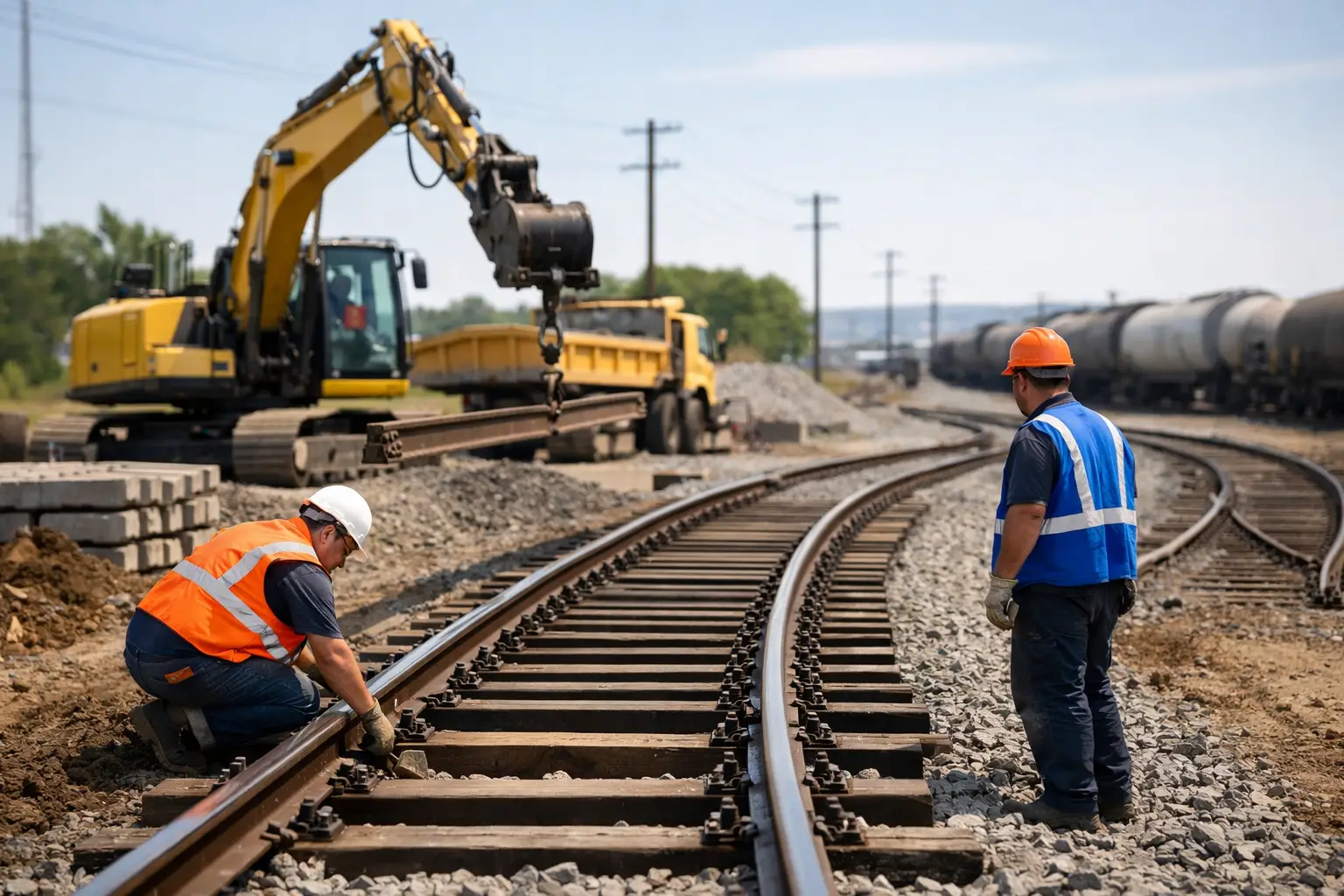
A well-executed rail spur doesn’t start with laying track. It starts when a plant, logistics center or terminal realizes its operation can no longer rely solely on trucks without paying a high price in time, switching, safety and capacity. At that point, rail spur construction stops being an isolated civil works project and becomes a strategic decision about access, operational continuity and competitiveness.
For an operations or expansion manager, the relevant question isn’t just how much it costs to build. The right question is whether the spur will be aligned with the expected volume, the type of freight, the switching scheme, the site’s constraints and the regulatory requirements for connecting to the main line. When those variables are resolved late, the project becomes more expensive. When they’re resolved from the design stage, the infrastructure starts working in the business’s favor.
What rail spur construction really involves
A rail spur is a connecting track that links an industrial or logistics facility to a main line or to existing rail infrastructure. Its function seems simple, but its performance depends on very precise decisions: geometry, load capacity, curve radii, drainage, earthworks, turnouts, signaling, access points, auxiliary yards and compatibility with the rolling stock that will operate on it.
In practice, building a rail spur isn’t limited to laying rail and ties. It includes conceptual and detailed engineering, site analysis, permitting, coordination with railroad concessionaires or infrastructure managers, civil works, track installation, integration with yards or terminals, testing and maintainability criteria. If even one of these layers fails, the spur may physically exist and still operate poorly.
That’s one of the most frequent mistakes in industrial projects: thinking of the spur as an access point, when in reality it’s part of the entire logistics system. If the unloading point is poorly oriented, if the usable length is insufficient or if switching requires unproductive moves, the problem doesn’t appear on opening day. It appears every day during operation.
Design defines future profitability
The engineering phase is where the most value is gained and the most risk is eliminated. A spur can be technically well built and still be inefficient if it doesn’t match the real traffic pattern. Designing for occasional receipt of railcars is not the same as designing for continuous supply of raw materials, shipment of finished goods or intermodal integration.
Geometry, capacity and operation
Track geometry determines almost everything. A curve radius that’s too tight can limit equipment, increase wear or complicate switching. A poorly designed grade affects operational safety and may require additional control measures. Usable length, for its part, must be defined according to train makeup, the number of railcars to be spotted and the loading or unloading sequence.
The type of freight must also be considered. Sectors such as automotive, steel, bulk, food or hydrocarbons don’t have the same requirements. Yard requirements, structural strength, cycle times, safety measures and the relationship between fixed infrastructure and switching equipment all change.
Integration with the terminal or plant
An isolated spur rarely solves a logistics problem on its own. It must be integrated with internal roads, loading areas, scales, warehouses, docks, safety systems and switching routes. In many projects, the critical point isn’t the external rail connection, but how the train enters, is positioned, is serviced and leaves without interfering with the rest of the operation.
That’s why it’s worth analyzing from the outset whether the project requires only a simple connection or a terminal expansion with crossovers, sidings, switches, bumping posts, signage, crossings and holding areas. The real scope doesn’t always match the client’s first idea, and adjusting it in time avoids having to redo construction later.
Permits, compliance and institutional coordination
In Spain and in any market with regulated rail operations, the regulatory side can define the entire project schedule. Connection to the existing network, occupation of rights-of-way, construction authorizations, specific studies and technical validation of certain elements are not secondary formalities. They are entry conditions.
It’s worth being very direct here: good engineering without solid regulatory management doesn’t make it to operation. And regulatory management without technical understanding usually leads to delays, scope changes or insufficient documentation. The value lies in coordinating both dimensions at the same time.
Every project has its particularities. Developing a spur in an established industrial setting is not the same as doing so on a site under expansion. Nor is connecting to infrastructure already prepared for private switching the same as doing so in an area with capacity limitations, interference or additional safety requirements. The schedule, therefore, depends less on a generic commercial promise and more on the project’s technical maturity from the start.
Construction: where details cost money or save it
Building a rail spur requires construction discipline. Embankment, subgrade, sub-ballast, ballast, ties, fastenings, rail, welds, joints, switches, drainage and crossings must meet the specification and the actual field conditions. If the track bed isn’t stable, the track will suffer. If drainage is underestimated, settlement and loss of geometry will appear. If materials don’t match the intended use, maintenance costs skyrocket.
In this type of infrastructure, the lowest initial cost isn’t always the best decision. In some cases a lean solution makes sense, especially in low-volume or intermittent-use operations. But in terminals with recurring traffic, heavy loads or demanding operating windows, cutting costs on critical elements usually ends up being expensive: more corrections, more downtime and greater risk of unavailability.
Track materials and specification
Material selection must match the expected service, not a standard recipe. Rail section, tie type, fastening system, hardware, turnouts and safety elements must be specified with life-cycle logic. A spur designed to grow should also plan how to expand without undoing key decisions made in the initial phase.
This approach is especially valuable for companies that start with moderate demand but anticipate higher frequency, new customers or freight diversification. Designing for scalability doesn’t mean oversizing everything. It means having the right decisions in place to grow without operational friction.
Maintenance and switching: the project doesn’t end when the first railcar arrives
A profitable rail spur is one that can be operated and maintained predictably. That involves periodic inspection, geometry upkeep, vegetation control, hardware checks, drainage care, scheduled component replacement and switching discipline. When these factors are ignored, the infrastructure deteriorates, speeds drop and incidents increase.
This is where another decisive variable comes in: switching equipment. Not every facility requires the same solution for moving railcars within the site. In some cases, outside service arrangements will suffice; in others, the operation requires autonomy with specialized equipment that reduces times and improves safety. The spur and the switching must be planned together, because correct infrastructure with inefficient switching still creates bottlenecks.
For many industrial companies, working with a partner that integrates design, construction, supply, maintenance and technical support reduces a friction that usually goes unnoticed until there’s already a problem. That integration makes it possible to make consistent decisions from engineering through operation. In that model, companies like Track Speq bring a clear advantage: unifying technical and commercial criteria throughout the entire project cycle.
When it makes sense to invest in a rail spur
Not every facility needs its own spur, and it’s worth saying so clearly. If volume is low, frequency is marginal or the logistics network doesn’t justify the investment, there may be more suitable alternatives. But when there’s a recurring flow of freight, cost pressure, a need for more capacity, a requirement for stable service or critical dependence on supply, the spur stops being an optional improvement.
It makes particular sense in operations where rail reduces exposure to road transport, improves planning of inbound and outbound flows, allows freight consolidation and provides more competitive access to long-haul logistics corridors. It’s also strategic when the company seeks to attract customers or suppliers who value direct rail connectivity.
The key is to evaluate the project with a comprehensive logic: initial investment, development timeline, operating cost, maintainability, switching flexibility and growth capacity. A well-planned spur doesn’t just move railcars. It organizes the operation, expands logistics options and supports expansion decisions with a reliable physical foundation.
The best rail spur isn’t the most complex or the most expensive. It’s the one that fits the business’s operating reality precisely and keeps performing when volume grows, demands increase and the margin for improvisation disappears.
