
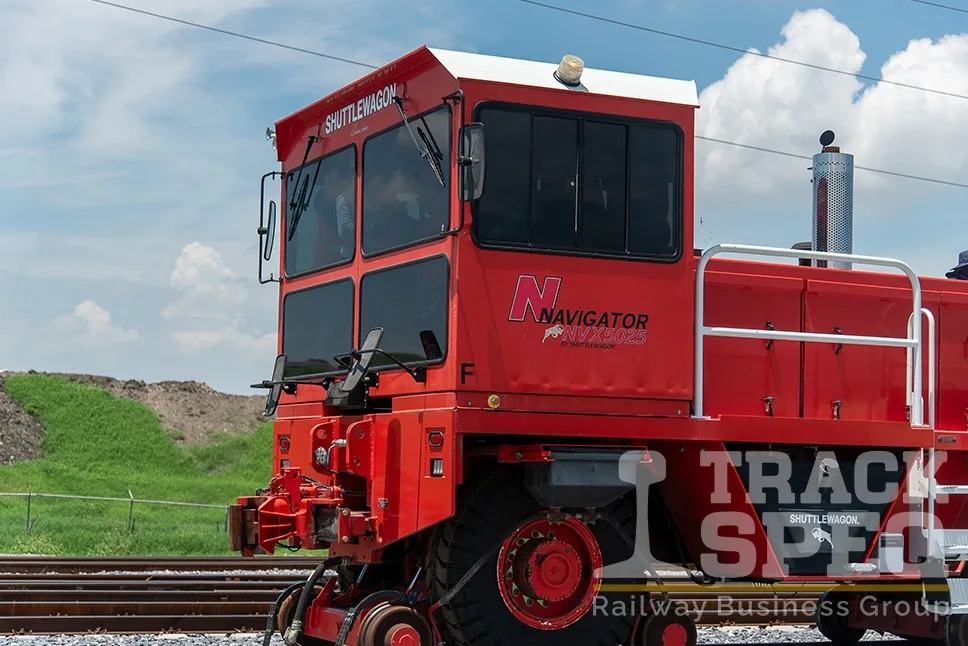
A terminal doesn’t lose productivity only when a track goes out of service. It also loses productivity when the switching equipment can’t keep up with the loading pace, when the yard becomes congested, or when a locomotive is overkill for a one-off operation. In that context, renting a Shuttlewagon in Mexico has become an increasingly sensible operational decision for plants, logistics centers and industrial terminals that need immediate capacity without tying up capital in a premature purchase.
The point isn’t just having a railcar mover. The point is having a switching solution aligned with the site’s real demands, with technical support, spare parts, operational backing and a clear path to continuity. For many operations managers, that is the difference between solving a bottleneck and pushing it to next month.
What Shuttlewagon rental in Mexico solves
A Shuttlewagon is designed to move railcars in yards, spurs and industrial environments where switching demands precision, frequency and control. Compared with other alternatives, its value shows when the operation needs independence from railroad service windows, more agility in short moves and better use of the space available at the terminal.
Shuttlewagon rental in Mexico usually responds to very specific scenarios. The first is the start-up of a new rail operation, when there isn’t yet enough history to determine whether demand will justify a purchase. The second is handling volume peaks, common in sectors such as automotive, steel, food or dry bulk. The third is temporarily replacing an owned unit that is out of service, or covering a transition while infrastructure is being expanded.
There is also a significant financial factor. Renting turns an operational need into a predictable cost, without tying up resources that may be more urgently needed for civil works, track, signaling, yards or capacity expansion. For an industrial company, that is no small matter. Often the return doesn’t depend on owning the asset, but on the asset being available when it’s needed.
When renting makes more sense than buying
The decision between renting and buying shouldn’t be based on a generic preference, but on the operation’s profile. If the number of railcars moved varies markedly by season, if the terminal is still adjusting its flows, or if the project depends on authorizations, new connections or construction phases, renting provides room to maneuver.
It is also a solid option when the customer wants to validate the equipment’s performance under real conditions before committing to a larger investment. In industrial environments, any estimate looks good on paper, but day-to-day switching reveals details that change the equation: curve radii, grades, cycle times, track quality, interaction with yard personnel and actual loading and unloading windows.
Buying may make more sense in mature operations with high and stable utilization, a long-term horizon and an internal structure prepared for maintenance, spare parts and asset management. But even in those cases, renting still has value as a strategic backup for contingencies or temporary expansions.
Technical factors to review before renting
A common mistake is to treat rental as if it were only about equipment availability. In reality, a sound decision requires reviewing the compatibility between the railcar mover and the infrastructure where it will operate.
Track condition is one of the first points. If there are worn sections, geometry deficiencies, turnouts that need rehabilitation or yards with irregular maintenance, the equipment’s expected performance may be affected. Efficient switching doesn’t depend solely on the Shuttlewagon, but on the entire rail environment that supports it.
Next comes the operating load. Knowing how many railcars will be moved per day isn’t enough. You need to understand the type of railcar, the length of the cuts, the coupling and uncoupling points, the grades, the frequency of moves and the time available per shift. That analysis determines the most suitable configuration and avoids oversizing or falling short.
The third point is the human side of the operation. Switching equipment performs when there is training, clear procedures and safety discipline. If personnel are not familiar with rail protocols, yard communication or basic pre-operation checks, operational risk increases. A well-structured rental usually comes with support, training and defined usage criteria.
What a serious Shuttlewagon rental arrangement in Mexico should include
Not all rental proposals have the same scope. For a technical buyer, the difference lies in what happens after the equipment is delivered.
A serious arrangement should cover real availability, response times, technical support, preventive maintenance, access to spare parts and contractual clarity on operational responsibilities. When these are not defined, any initial savings can turn into downtime, cost overruns or dependence on third parties with no ability to respond.
It’s also worth checking whether the supplier understands the full rail context. An industrial terminal doesn’t work in silos. Switching equipment coexists with track, construction work, crossings, signage, hardware, inspection, regulations and maintenance routines. When the supplier only rents out the asset but doesn’t understand the infrastructure or the logic of the yard, the solution is incomplete.
That’s why, for many companies, the value isn’t just in getting access to a Shuttlewagon, but in doing so alongside a specialist who can support the operation with technical judgment and a view toward continuity. In Mexico, that difference is especially important in projects where implementation speed and operational compliance leave no room for improvisation.
Risks of choosing on price rather than responsiveness
In industrial purchasing, the pressure to optimize costs is constant. However, in rail switching, price alone rarely reflects the true cost of the decision.
If a rented unit fails and support is slow, the impact isn’t limited to the repair. It translates into idle railcars, loading delays, missed commitments to end customers, demurrage and disruption in yard scheduling. In sectors with tight supply chains and strict logistics windows, a seemingly minor incident can escalate quickly.
Choosing a supplier with proven experience in infrastructure, operations and maintenance reduces that risk. Not because it eliminates every contingency, but because it improves the ability to anticipate and respond. That’s where a company with a comprehensive view of the rail environment delivers a tangible advantage over a merely transactional lease.
Questions to ask before signing a contract
Before moving forward with a rental, the operations or technical procurement manager should demand clear answers: what operating capacity is expected from the equipment in their yard, what field support is available, what maintenance is included, what response times apply, how spare parts are managed and what training personnel will receive.
It’s also worth asking about integration with the rest of the rail operation. If the track requires adjustments, if there are rehabilitation needs or if the yard needs improvements to make better use of the equipment, it’s best to know from the start. A well-implemented rental can even serve as the starting point for organizing a broader operation.
In that sense, companies like Track Speq bring a particularly valuable approach because they don’t separate the equipment from the ecosystem in which it operates. That perspective makes it possible to evaluate rail switching as part of a complete solution rather than an isolated need.
An operational decision, not just a commercial one
Shuttlewagon rental shouldn’t be seen as a low-commitment stopgap. Properly structured, it is a strategic tool to gain capacity, reduce operational friction and make decisions based on real performance data. For plants and terminals that need to move freight continuously, this approach is usually smarter than rushing into a purchase or relying on oversized solutions.
When the rail operation demands fast response, flexibility and technical backing, renting can be the most efficient way to sustain results without losing control. The key is choosing a supplier that understands switching doesn’t end when the equipment arrives at the yard, but when the operation runs safely, at pace and with room to grow.
